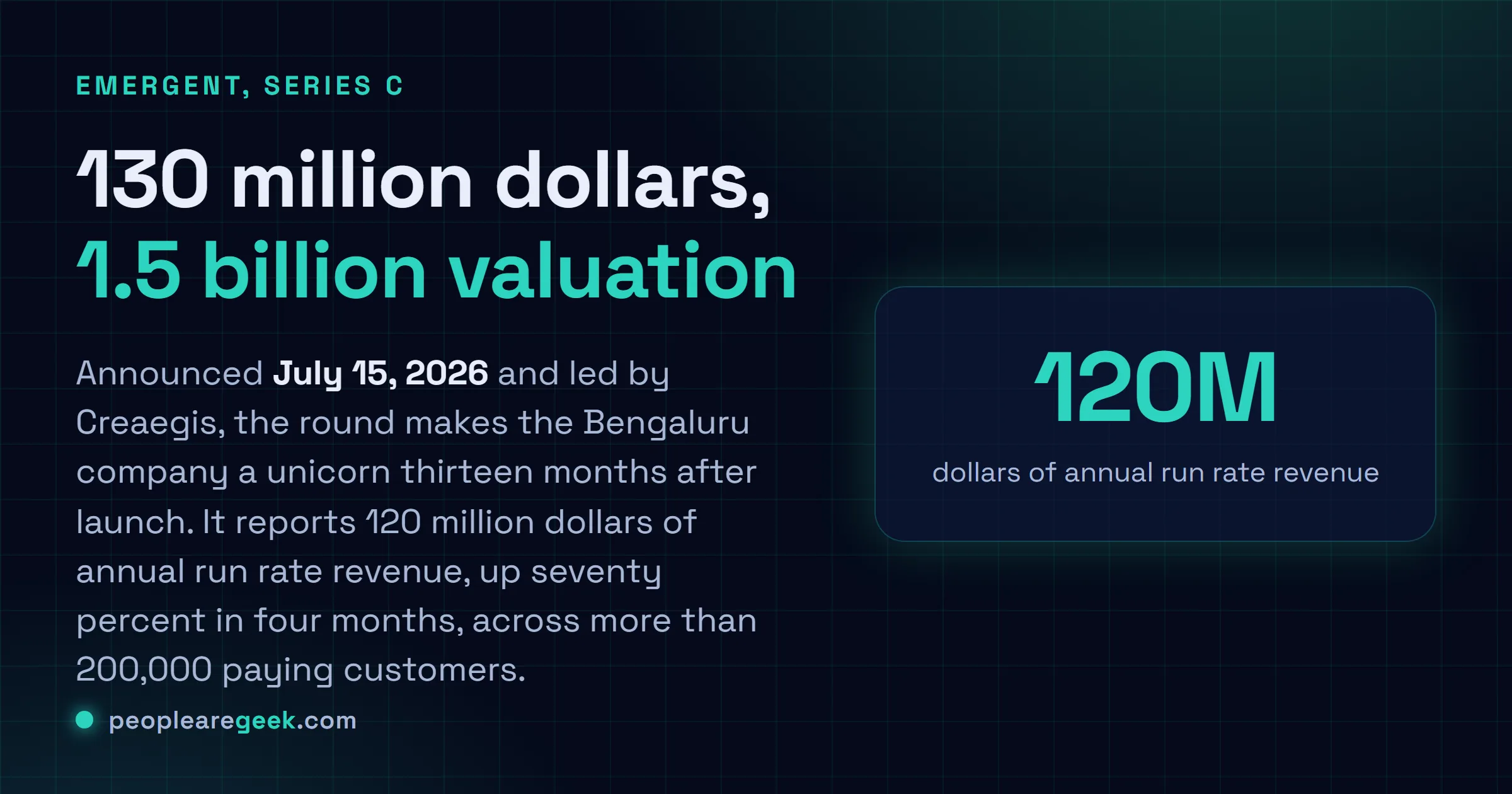
Emergent, an AI coding platform founded in Bengaluru, raised a one hundred and thirty million dollar Series C at a one point five billion dollar valuation, announced on July 15, 2026. The round was led by Creaegis and makes Emergent a unicorn just over a year after launch. The company reports one hundred and twenty million dollars in annual run rate revenue, up seventy percent in four months, across more than two hundred thousand paying customers. What makes it worth a look is not the valuation curve. It is what the product owns that developer tools deliberately do not, which turns out to be the whole argument.
The short answer
Emergent, an AI coding platform founded in Bengaluru, announced a one hundred and thirty million dollar Series C at a one point five billion dollar valuation on July 15, 2026, led by the private equity firm Creaegis. The company launched in June 2025 and was valued at three hundred million dollars as recently as January. It reports one hundred and twenty million dollars in annual run rate revenue, up seventy percent in four months, and more than two hundred thousand paying customers, with roughly two hundred staff. Total funding now stands at two hundred and thirty million dollars. The platform handles deployment, hosting, testing and debugging alongside code generation.
Funding announcements in AI tooling have a sameness to them that makes it easy to skim past the one detail that explains the business. In this case the detail is not the valuation. It is a list of four unglamorous responsibilities the product took on, and why that list is the reason the revenue exists.
The round
Emergent announced a one hundred and thirty million dollar Series C on July 15, 2026, at a one point five billion dollar post money valuation. The round was led by the private equity firm Creaegis, with participation from MNI Ventures Claypond, Sentinel Global, Khosla Ventures, SoftBank Vision Fund 2, Lightspeed and Y Combinator. Total funding reaches two hundred and thirty million dollars.
The growth numbers are the part investors are paying for. The company launched in June 2025. It was valued at three hundred million dollars at its Series B in January 2026, so the valuation has gone up fivefold in six months. Annual run rate revenue is one hundred and twenty million dollars, up seventy percent in four months, across more than two hundred thousand paying customers. Headcount is around two hundred, mostly in Bengaluru with some staff in San Francisco. Founders Mukund Jha and Madhav Jha serve as chief executive and chief technology officer.
That revenue figure is worth pausing on. Plenty of companies reach this valuation on a promise. This one is charging two hundred thousand people already, which is a different kind of evidence.
What it actually sells
Jha's description is "an engineering team in a box", and the target customer is entrepreneurs and small to medium businesses who want a working business application without hiring engineers.
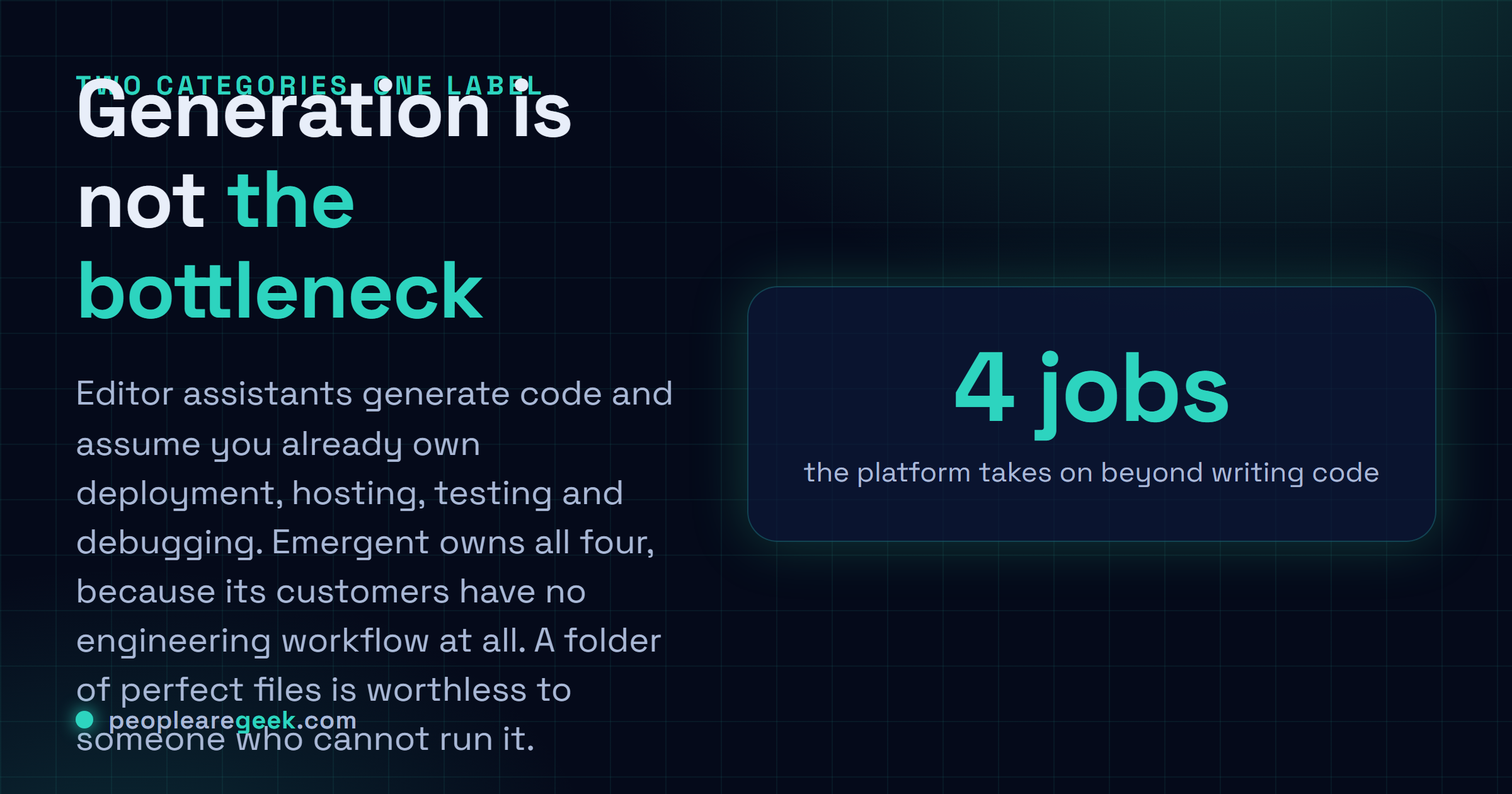
The important part is the scope. Emergent does not stop at generating code. It handles deployment, hosting, testing and debugging. The company names Replit as its closest competitor, and explicitly distinguishes itself from developer tools such as Claude Code and Cursor.
That distinction is the whole product strategy, and it is more interesting than a competitive slide.

Two categories wearing the same label
Everything in this space gets filed under AI coding, which hides a real split.
An assistant in your editor makes a large assumption: that you already have the rest of an engineering practice. Somewhere to run the code. A deployment path. A test suite, or at least the instinct to write one. Enough judgement to tell code that works from code that merely runs. Those tools are sharp precisely because they assume all of that and refuse to own it. A developer with a working setup does not want a platform taking over their deployment.
Emergent's customer has none of that, and the missing pieces are not a detail. They are the entire distance between generated code and a thing a business can use. A small business owner who receives a perfect application as a folder of files has received nothing, because the gap between that folder and a running service is exactly the part they could not do in the first place. Generation was never their bottleneck.
So the four responsibilities Emergent takes on, deployment, hosting, testing, debugging, are not features bolted onto a code generator. They are the product. The generation is the commodity part.
This is why we would resist reading the revenue as evidence about model quality. It is evidence that a large population wants software and cannot hire anyone to run it, and that they will pay for someone to own the operational half. That demand was there before any of this was possible.
What we would take from it
If you are a working developer, this is not a tool aimed at you, and the arrival of two hundred thousand customers on a platform like this does not say much about your editor.
What it does say is worth knowing anyway. The durable business in this category is forming around operational ownership rather than code generation, because generation is converging across every provider while running things reliably is not. Anyone can produce a plausible application. Keeping it up, patched, tested and debuggable is where the work and the money actually are, and it is the part that does not get cheaper as models improve.
There is a version of this that ends badly, and it is worth naming. Two hundred thousand businesses now depend on applications they did not write, cannot read, and could not debug if the platform vanished. That concentration risk is real, and it is the natural consequence of selling operational ownership as a service. It is also, at the moment, exactly what people are choosing to buy.
Sources and further reading
- TechCrunch: Indian AI coding startup Emergent becomes a unicorn just over a year after launch
- AlleyWatch: The AlleyWatch startup daily funding report, July 15, 2026
- Crunchbase News: The week's biggest funding rounds
Frequently asked questions
What did Emergent raise and from whom?
Emergent raised one hundred and thirty million dollars in a Series C at a one point five billion dollar post money valuation, announced July 15, 2026. The round was led by the private equity firm Creaegis, with participation from MNI Ventures Claypond, Sentinel Global, Khosla Ventures, SoftBank Vision Fund 2, Lightspeed and Y Combinator. Total funding to date is two hundred and thirty million dollars.
How fast has the company grown?
Emergent launched in June 2025 and reached unicorn status just over a year later. Its valuation went from three hundred million dollars at a Series B in January 2026 to one point five billion in July, a fivefold increase in six months. Annual run rate revenue stands at one hundred and twenty million dollars, up seventy percent in four months, with more than two hundred thousand paying customers and roughly two hundred employees, mostly in Bengaluru.
What does Emergent actually do?
It is a platform for building business applications without traditional coding expertise, aimed at entrepreneurs and small to medium businesses. Chief executive Mukund Jha describes it as an engineering team in a box. Beyond generating code, the platform handles deployment, hosting, testing and debugging, which is the part that distinguishes it from tools that stop at writing code.
How is this different from an AI coding assistant?
Assistants that live in your editor assume you already have somewhere to run the code, a way to deploy it, and the judgement to tell working code from code that merely compiles. Emergent targets people who have none of those things, so it owns the surrounding infrastructure too. That is a different product for a different buyer, even though both categories are described as AI coding.
Who are its competitors?
Emergent positions Replit as its closest competitor, since both combine generation with hosting and deployment for non specialist builders. The company draws a distinction with developer focused tools such as Claude Code and Cursor, which are built for people who already have an engineering workflow and do not want a platform to own their deployment.