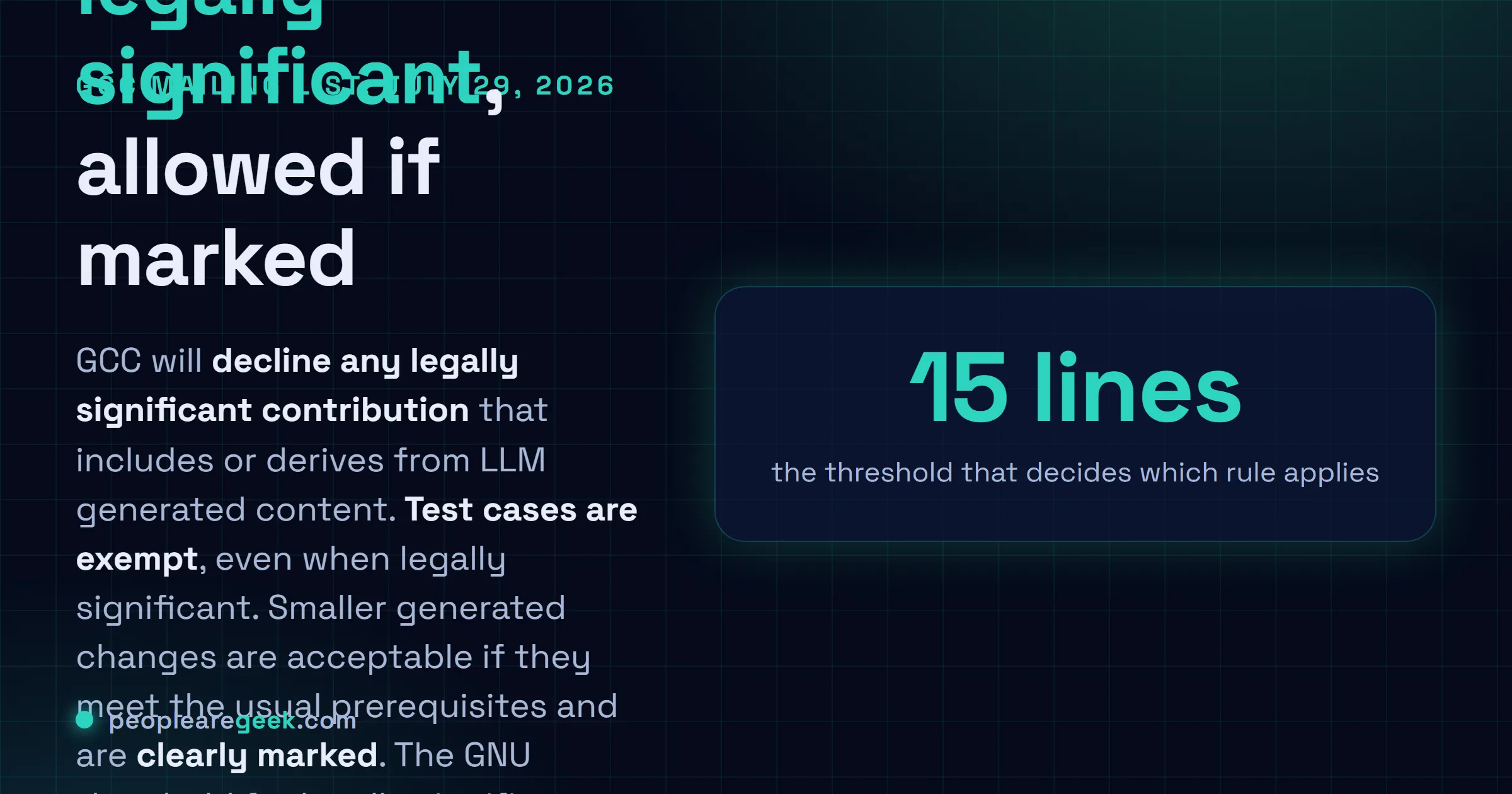
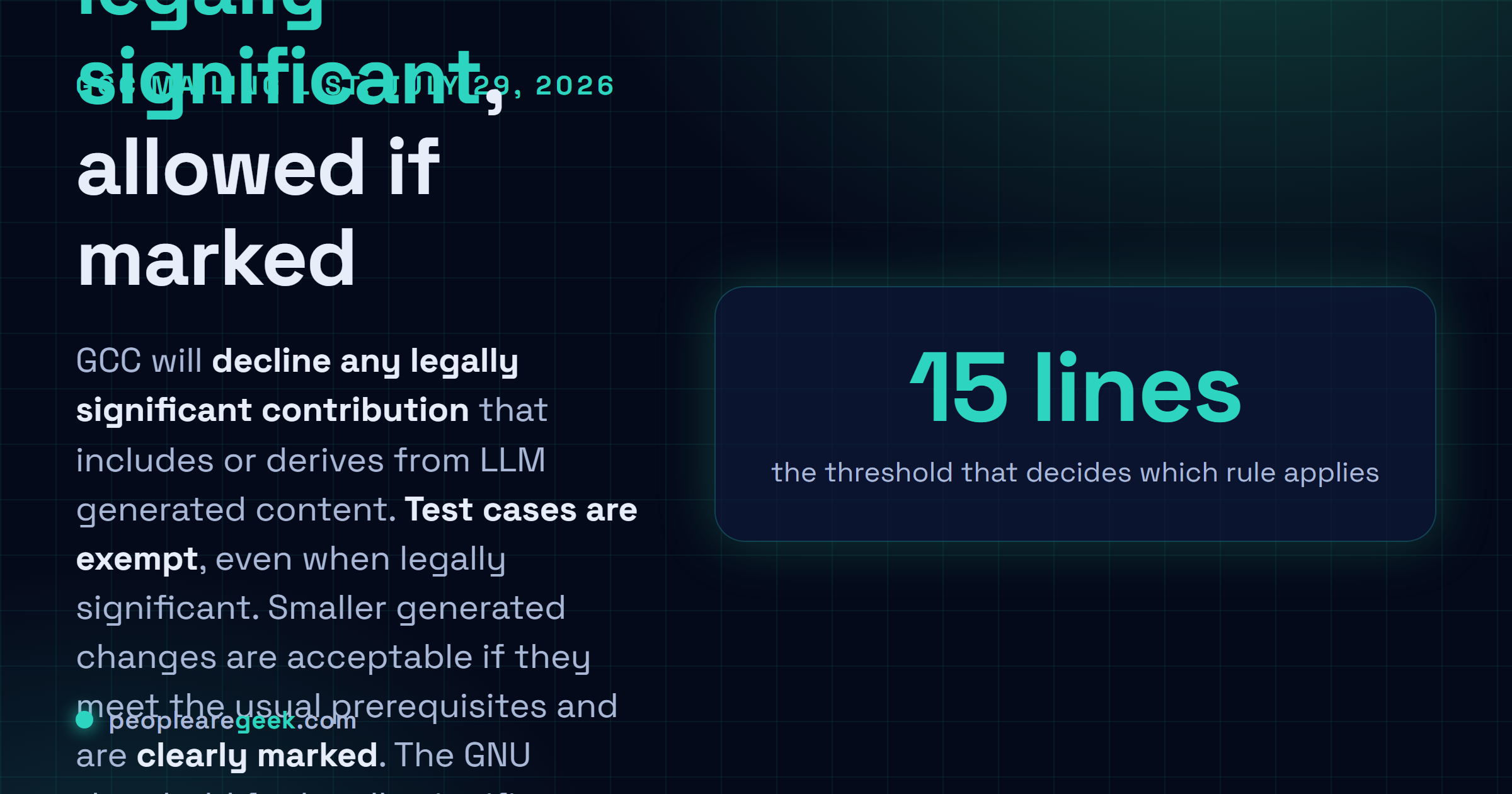
The GCC Steering Committee has adopted the recommendation of its AI Policy Working Group, and the result is short: for now, GCC declines any legally significant contribution that includes or derives from LLM generated content. Test cases are the exception, and small changes below the copyright threshold can still be accepted if they are clearly marked as machine generated. The wording matters more than the headline, because legally significant is not a vague judgement call in GNU projects. It is an existing threshold with an existing rule of thumb, and it is what turns this policy from a statement of taste into something a maintainer can apply to a patch.
The short answer
On July 29, 2026, David Edelsohn announced on the GCC mailing list that the Steering Committee accepted the recommendation of the GCC AI Policy Working Group, chaired by Jonathan Wakely. GCC will decline any legally significant contribution that includes or derives from LLM generated content. Legally significant test cases generated in whole or in part by an LLM are allowed, and legally insignificant generated contributions may be accepted if clearly marked. The policy document is staged as a pull request in Sourceware Forge for the GCC website.
Most project policies on generated code end up saying either nothing enforceable or everything at once. This one is unusual because it borrows a line that already existed, and in doing so it gives maintainers something they can actually apply during review.
The sentence that matters
The policy text is brief. For the time being, GCC declines any legally significant contribution which includes LLM generated content or is derived from LLM generated content.
Then two exceptions. Legally significant contributions to test cases, generated in whole or in part by an LLM, are permitted. And legally insignificant contributions generated by an LLM may be accepted, so long as they meet the usual prerequisites for any contribution and are clearly marked.
David Edelsohn posted the announcement to the gcc list in the early hours of July 29, on behalf of the Steering Committee, which had accepted the recommendation of a working group chaired by Jonathan Wakely and including Carlos O'Donell, Sudakshina Das, Jason Merrill, Joel Sherrill, Sam James, Robin Dapp and Arthur Cohen. The policy document itself is staged as a pull request in Sourceware Forge and had not yet appeared on the GCC website when we checked.
Legally significant is not a mood

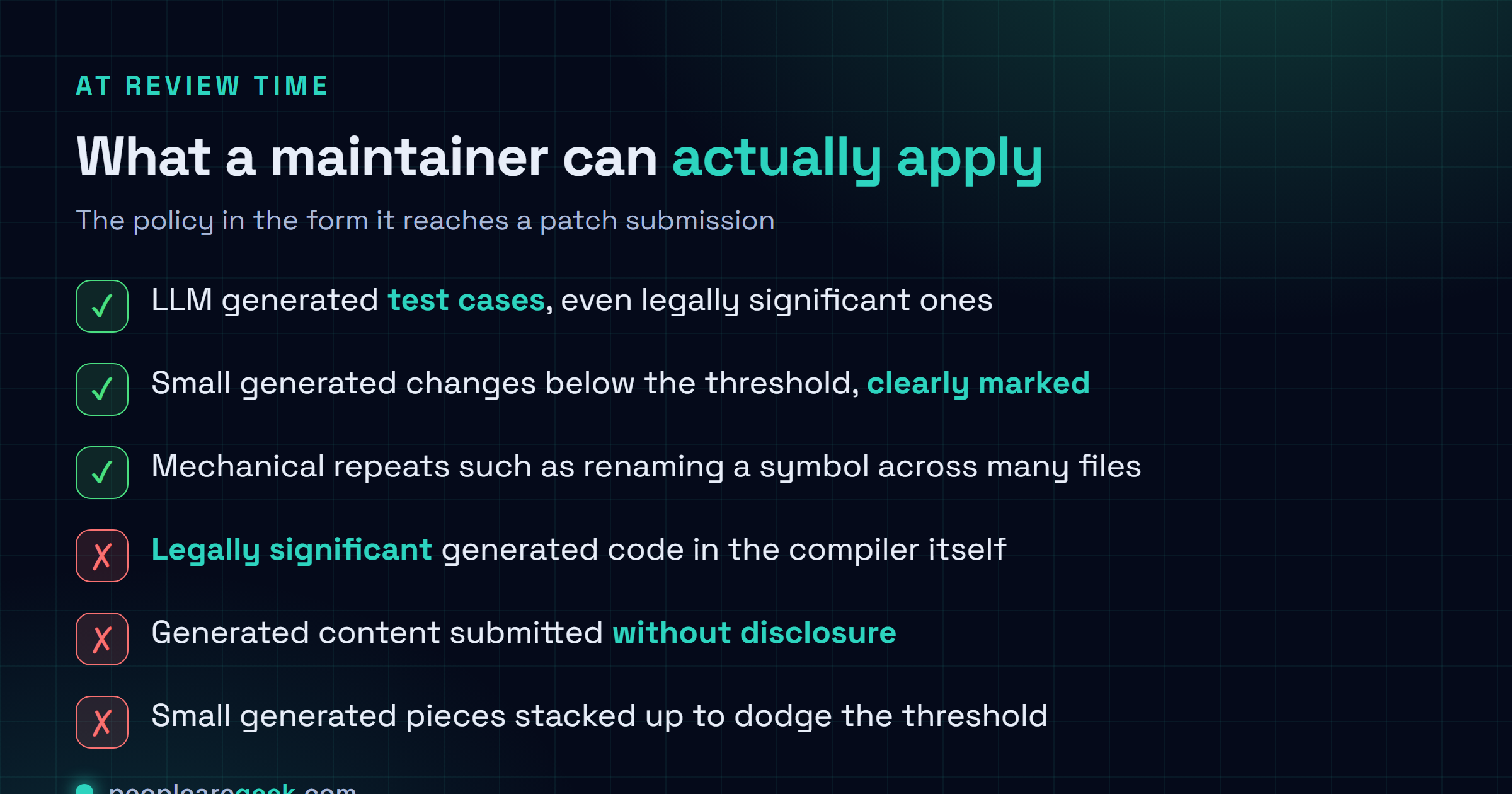
The phrase is the load bearing part. In GNU projects it has a specific history tied to copyright paperwork rather than to opinion. The maintainers document sets the boundary at roughly fifteen lines: a contribution of more than around fifteen lines of code or text is legally significant and requires copyright papers, while a change of fewer than fifteen or so lines is not legally significant for copyright.
Two footnotes to that come straight from the same document and both apply here. A regular series of repeated changes, such as renaming a symbol in many places, is not legally significant even when it touches a lot of files. And small contributions from the same person accumulate, so what counts is the total over time rather than each submission in isolation. That second point closes the obvious loophole before anyone tries it.
The practical effect is a rule a maintainer can hold in their head. A short generated fix, disclosed, is acceptable. A generated optimisation pass is not.
Why test cases got the exception
The carve out looks arbitrary until you consider what a compiler test case is. It is usually a small program written to provoke one behaviour, its expressive content is thin, and its value lies in covering a case nobody thought of rather than in how it is phrased. That combination puts it at the low end of copyright exposure and the high end of generation usefulness, since enumerating awkward inputs is one of the things models genuinely do well.
Taking the productivity where the legal risk is smallest, and refusing it where the risk is largest, is a more considered position than either a blanket ban or a shrug.
It says for the time being, and means it
The committee wrote that it expects the policy to evolve and will revisit it periodically, with a review reported for early 2027. That is not hedging for its own sake.
The open question is not whether a model can write a correct patch. It plainly can. It is whether a contribution derived from a model trained on a corpus of other people's code can carry a clean provenance claim under a project's copyright arrangements. GCC dropped mandatory FSF copyright assignment in 2021 in favour of accepting the Developer Certificate of Origin, and the DCO asks a contributor to certify where their work came from. Nobody has a settled answer to what that certification means when part of the work came out of a model, so the project has taken the reversible position and set a date to look again.
Different projects, different answers
Anyone contributing across several codebases should read this as one data point rather than a trend to generalise. Debian has been working through the same question by general resolution, which we covered in Debian votes again on LLM written contributions, and the EFF published its own policy for its open source projects in February. Those three landed in different places on disclosure, scope and enforcement.
The through line is not a shared conclusion. It is that provenance is becoming a thing you are expected to state rather than a thing nobody asks about, and the projects that were already strict about copyright paperwork are the ones formalising it first.
Sources and further reading
- GCC AI Policy Announcement, David Edelsohn, gcc mailing list, July 29 2026
- Phoronix: GCC to decline any significant contributions made via AI or LLMs, except for test cases
- GNU maintainers document, section on legally significant changes
- GCC contribution guidelines
- EFF's policy on LLM assisted contributions to its open source projects
Frequently asked questions
What does the GCC policy actually say?
The operative sentence is that for the time being, the GNU Compiler Collection policy is to decline any legally significant contributions which include LLM generated content or are derived from LLM generated content. Two carve outs sit alongside it. Legally significant contributions to test cases generated in whole or in part by an LLM are permitted, and legally insignificant contributions generated by an LLM may be accepted provided they meet the usual prerequisites for any contribution and are clearly marked as such. The announcement was posted to the GCC mailing list by David Edelsohn on July 29, 2026, on behalf of the Steering Committee.
What counts as legally significant?
It is not a new term invented for this policy, which is the reason the policy is usable at all. The GNU maintainers document has long drawn the line at copyright: a contribution of more than around fifteen lines of code or text is treated as legally significant and needs copyright paperwork, while a change of fewer than roughly fifteen lines is not legally significant for copyright purposes. It also notes that a repeated mechanical change, such as renaming a symbol across many files, is not legally significant even when it touches a lot of places, and that small contributions from one person accumulate over time. So the practical reading is that a one line fix suggested by a model is fine if you say so, and a new optimisation pass is not.
Why are test cases treated differently?
Test cases are the part of a compiler tree where the copyright exposure is lowest and the utility of generation is highest. A test case is usually a small program written to trigger one behaviour, its expressive content is thin, and its value comes from covering a case nobody thought of rather than from how it is written. Models happen to be good at enumerating awkward inputs. Carving them out lets the project take the productivity where the legal risk is smallest, without opening the door to generated code in the compiler proper. It is the same instinct behind marking small generated changes rather than banning them: the goal is provenance you can audit, not abstinence.
Is this permanent?
No, and the announcement is explicit about it. The wording opens with for the time being, and the committee stated that it expects the policy to evolve and will revisit it periodically, with reporting pointing to a review in early 2027. That framing is doing real work. The unresolved question is not whether models write useful patches, it is whether a contribution derived from a model trained on other code can carry a clean provenance claim under the project's copyright arrangements. Nobody has a settled answer, so GCC has chosen the reversible position while the legal picture develops.
How do I stay compliant if I use an assistant?
Three habits cover most cases. First, know which side of the fifteen line threshold your change sits on, and be honest about it, because the accumulation rule means repeatedly submitting small generated pieces is not a loophole. Second, mark generated content explicitly when you submit a legally insignificant change that came from a model, since the policy makes marking a condition of acceptance rather than a courtesy. Third, treat test cases as the safe place to lean on generation, and write the compiler side yourself. If you contribute to other projects too, check each one separately: Debian, the EFF and GCC have all landed in different places, and none of them can be assumed from the others.