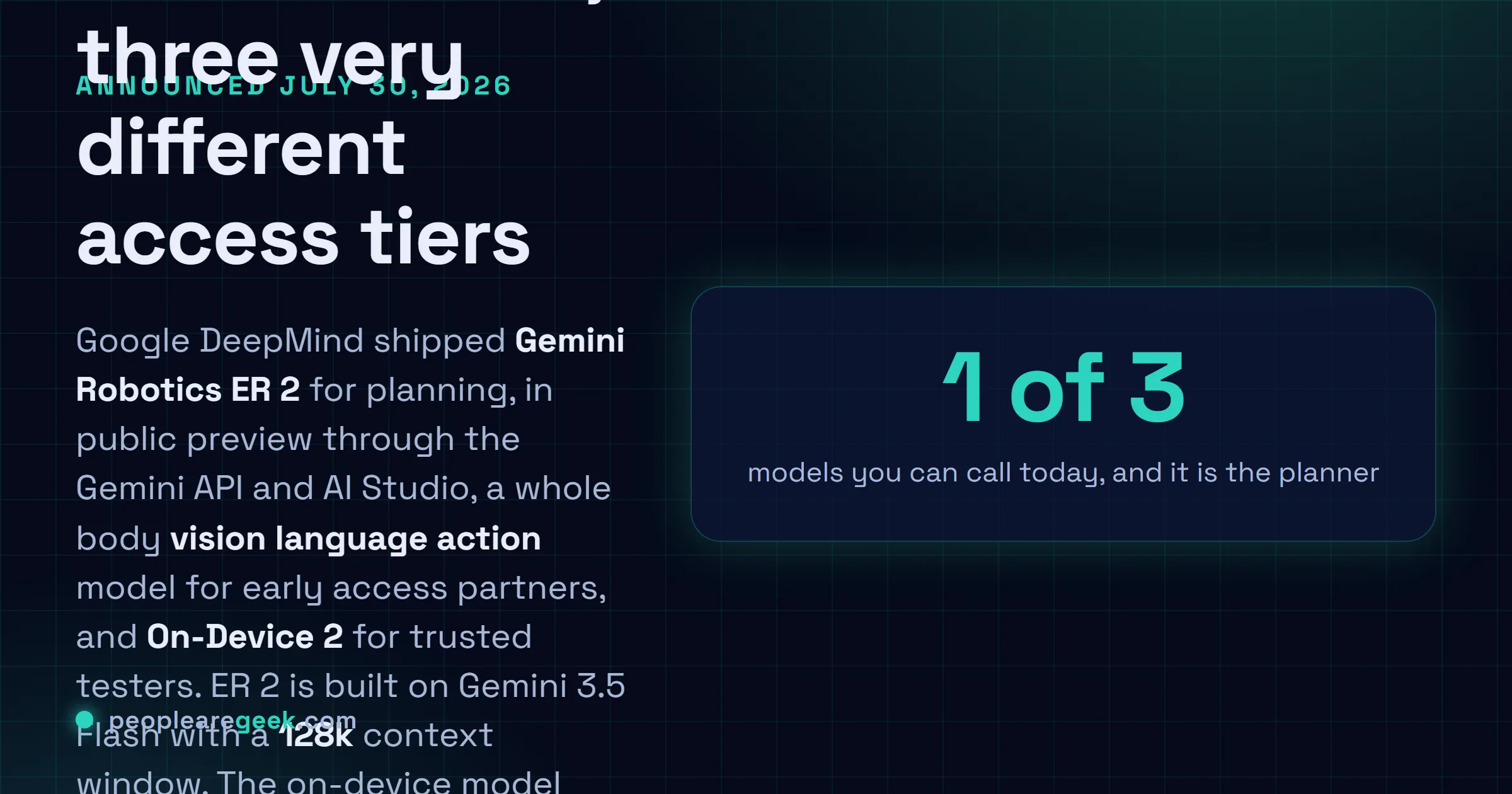
Google DeepMind released Gemini Robotics 2 on July 30, 2026, and the part worth your attention is not the humanoid demo reel. It ships as three separate models with three separate access tiers. Gemini Robotics ER 2 is the planning and reasoning layer, built on Gemini 3.5 Flash with a 128k context window, and it is the only one you can call today through the Gemini API and AI Studio. The vision language action model that actually drives the joints is restricted to early access partners. Gemini Robotics On-Device 2 runs on the robot's own computer and adapts to a new two arm platform with fewer than 200 examples.
The short answer
Google DeepMind announced Gemini Robotics 2 on July 30, 2026. The release is three models, not one. Gemini Robotics ER 2 handles high level reasoning and planning, is built on Gemini 3.5 Flash, takes interleaved text, image, video and audio up to 128k tokens, and is in public preview through the Gemini API and AI Studio. Gemini Robotics 2 itself is the vision language action model that drives whole body control on humanoids and bi-arm robots, available to early access partners. Gemini Robotics On-Device 2 runs on the robot's onboard computer and adapts to a new two arm platform in a few hours with fewer than 200 examples.
Robotics announcements come with video, and video is a bad way to judge a model. What we can judge is the published success table and the access tiers, and on both counts this release says something more specific than the demo reel does.
What actually shipped
Three models, released together, doing three different jobs.
Gemini Robotics ER 2 is the embodied reasoning model. You describe a task in natural language, and it plans, in Google's framing, hundreds of steps across several minutes. It can call external tools, distribute work between multiple robots, and watch camera feeds to decide whether the plan is on track. It is built on Gemini 3.5 Flash, takes interleaved text, image, video and audio with a 128k context window, and emits up to 64K tokens.
Gemini Robotics 2 is the vision language action model. It takes what the cameras see plus the instruction and produces motor commands, and the change from the previous generation is that it now drives the whole body rather than mostly the upper half. Google specifically calls out managing the centre of gravity so a humanoid can crouch or bend without falling, and support for multi finger hands with 22 degrees of freedom as well as simple parallel grippers.
Gemini Robotics On-Device 2 is a smaller VLA built on Gemini Robotics 1.5 and Gemma, designed to run on the robot's own computer with no network dependency.
Read the whole table, not the headline
The number that travelled was 92%, the success rate for unscrewing a light bulb on an Apptronik Apollo 2 with SharpaWave hands. It is a genuinely hard task, requiring the robot to hold position while applying rotational force. It is also the best row in its table by a wide margin.

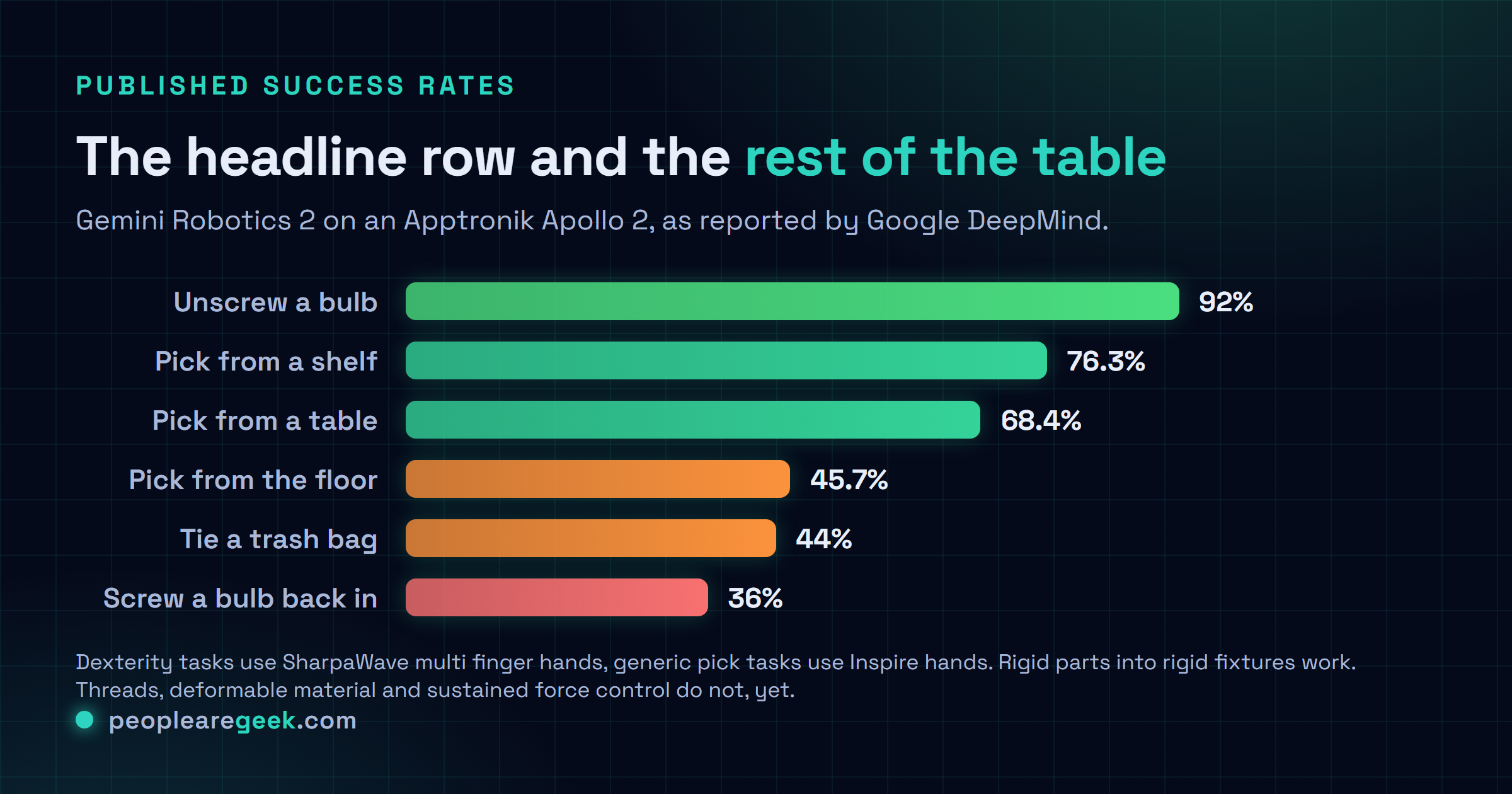
Screwing the bulb back in scores 36%. Tying a trash bag, 44%. A ziplock, 40%. A dustpan, 32%. On the generic manipulation side with Inspire hands, picking from a shelf reaches 76.3%, from a table 68.4%, and from the floor 45.7%, which is the whole body control claim being tested and coming out mid pack. The Franka Duo gripper results are stronger, with 89.6% on precise insertion and 78.9% on tool kitting, though a two arm fixed base robot with a gripper is a much easier control problem than a walking humanoid with fingers.
The pattern is consistent and it is the useful takeaway. Rigid parts into rigid fixtures work. Threads, deformable materials and anything requiring sustained force control while maintaining balance do not, yet. A pick rate under one in two from the floor is not a system you schedule work around.
What a developer can touch this week
Only ER 2, and only as a planner.
That is a real constraint and it changes what these models are for right now. ER 2 in the Gemini API is a reasoning component: it accepts a scene and a goal, produces a structured plan with spatial references, and judges progress from video. It does not actuate anything. Whatever executes the plan is your problem, whether that is a classical motion planner, a vendor SDK, or a robot you do not have.
That makes ER 2 closer in shape to the agent tooling in the rest of the Gemini model line than to a robotics stack. If you are prototyping, the honest framing is that you are building a planner today and reserving a slot for a controller you cannot yet obtain.
The on-device result is the one to file away
Buried under the humanoid footage is the number that matters most operationally. Gemini Robotics On-Device 2 adapts to an entirely new bi-arm robot in a few hours, typically with fewer than 200 demonstrations. Google reports SO101 going from 6.7% to 53.3% and Dexmate from 24.4% to 75.6% after that adaptation.
Cross embodiment transfer has been the expensive part of deploying learned policies. Every new robot body historically meant a new data collection campaign. Two hundred examples is a different order of cost, and it is the difference between a research demo and something a systems integrator can quote for.
Running locally also removes the network from a control loop, which anyone who has debugged a real time system will recognise as the correct default rather than an optimisation. The trade is that the on-device model is built on smaller foundations, so you buy determinism with capability. Investment in the physical layer is not slowing down either, as the funding going into general purpose robotics shows.
Safety got a benchmark, which is progress of a sort
Google introduced ASIMOV-Agentic alongside the models, measuring whether an embodied reasoning agent refuses unsafe tool calls, predicts whether a task is feasible at all, asks a human for help proactively, and stops when a person comes close. Google calls ER 2 its safest robotics model to date on safety constraint following and human proximity.
A benchmark is not a certification and a vendor evaluating its own model is not an audit. It is still better than the previous state of affairs, which was no shared measure at all. Treat the numbers as a floor for comparison between releases rather than as a clearance to operate near people.
What to take from it
Nothing here puts a working humanoid in a warehouse this year. What changed is the shape of the offering: the reasoning layer is now a normal API you can call, the control layer is gated, and the on-device layer has a credible answer to the cross embodiment problem that has kept learned robot policies stuck in labs.
If you build software rather than robots, the practical read is that ER 2 is an agent model with spatial grounding and video progress tracking, and those two capabilities have uses well outside robotics. If you build robots, the number to watch in the next release is not 92% on a bulb. It is whether picking off the floor climbs out of the forties.
Sources and further reading
- Google DeepMind: Gemini Robotics 2 brings whole body intelligence to robots
- Gemini Robotics 2 model page on Google DeepMind
- SiliconANGLE: Google DeepMind debuts Gemini Robotics 2 model series for humanoid robots
- MarkTechPost: three physical AI models for whole body control, dexterity and multi robot collaboration
- Engadget: Google's new Gemini Robotics 2 platform allows for intelligent whole body control
Frequently asked questions
Which of the three models can I actually use today?
Only one of them without an application. Gemini Robotics ER 2, the embodied reasoning model, is in public preview through the Gemini API and Google AI Studio, with a private preview on the Gemini Enterprise Agent Platform. The vision language action model, the one that converts a plan into joint commands, is limited to early access partners who sign up through a form. Gemini Robotics On-Device 2 goes to trusted testers only. So if you want to experiment this week, you are experimenting with the planner, not with the controller. That distinction matters, because ER 2 does not move anything on its own: it emits plans, points, and progress judgements that some other layer has to execute.
What is ER 2 built on, and what are its input and output limits?
Google describes Gemini Robotics ER 2 as built on Gemini 3.5 Flash. It accepts interleaved text, image, video and audio with a context window of up to 128k tokens, and it outputs up to 64K tokens. The video part is the operationally interesting one. ER 2 watches a continuous camera feed to track whether a task is progressing, which is what lets it notice a failure and retry rather than running blindly to the end of a plan. Google reports 57.4% accuracy on progress classification and 91.3% accuracy on moment finding with a mean absolute distance of 0.96 seconds, which is roughly the ability to say when in a video something happened.
The 92% light bulb number is impressive. Is it representative?
No, and the published table is honest about that. On an Apptronik Apollo 2 fitted with SharpaWave multi finger hands, unscrewing a bulb succeeds 92% of the time and screwing one back in succeeds 36% of the time. Same hardware, same model, inverted task, and the success rate drops by more than half. Tying a trash bag lands at 44%, a ziplock at 40%, a dustpan at 32%. The generic manipulation numbers with Inspire hands sit in between: 76.3% from a shelf, 68.4% from a table, 45.7% from the floor. Read the whole table, not the headline row. Insertion of a rigid part into a fixture is close to reliable, and anything involving compliant material or a screw thread is not.
What does "fewer than 200 examples" mean for adapting the on-device model?
It means the demonstration budget for teaching Gemini Robotics On-Device 2 a new two arm robot body is small enough to collect in an afternoon. Google reports going from 6.7% to 53.3% success on the SO101 platform and from 24.4% to 75.6% on Dexmate, in a few hours of adaptation each, typically with fewer than 200 examples. The important word is embodiment, not task: this is about porting the model to a robot with different arms and different kinematics, not about teaching it a new skill from scratch. For anyone maintaining a fleet of mixed hardware, that is the number that changes the maintenance calculus, more than any success rate.
Why does running on the robot instead of in the cloud matter here?
Latency and failure mode. A vision language action model in a control loop has to close that loop faster than the robot can fall over, and a round trip to a datacenter adds tens of milliseconds of jitter that you do not control. Running locally also means the robot keeps working when the link drops, which for anything deployed in a warehouse or a field is not a nice to have. The trade is capability: the on-device model is built on Gemini Robotics 1.5 and Gemma rather than on the full frontier model, so you give up reasoning depth to get determinism. The three tier split in this release is essentially that trade made explicit.