GNOME 51 reached beta on August 2, and the headline change is that Wayland applications can finally ask for background blur. Mutter 51 beta implements ext-background-effect-v1, the protocol that lets a client request the compositor blur whatever sits behind its window, which is how a translucent terminal is supposed to work and has not been able to on Wayland until now. Alongside it, Mutter picks up the upstream xdg_session_management_v1 protocol in place of its own private interface, and a run of frame scheduling work from Michel Danzer. GNOME 51, codenamed A Coruna, is due on September 16.
The short answer
Mutter 51 beta and GNOME Shell 51 beta were released on the night of August 2. Mutter adds ext-background-effect-v1, so Wayland clients can ask the compositor to blur what is behind them, and switches from its private XX prefixed session interface to the upstream xdg_session_management_v1 protocol. Michel Danzer contributed frame scheduling improvements, and there are fixes for blurred rendering on monitors that are not pixel aligned, button scrolling for mice, and cursor hiding during input capture. GNOME Shell 51 adds initial reduced motion support, SVG cursors in KDE's format, keyboard navigation for screenshot selection, and web login in the greeter. GNOME 51 is due on September 16.
Translucent terminals are a small thing to want and a surprisingly awkward thing to deliver. They worked on X11 for twenty years because any client could read the pixels behind it, which is also the reason Wayland stopped allowing it. Mutter 51 beta, tagged on August 2, closes that gap the correct way round.
The blur, and why it took a protocol
Under X11, a translucent terminal blurred its own backdrop by reading what was underneath. That worked because X11 let any client read essentially anything on the screen. Wayland removed that ability on purpose, and the blurred terminal was collateral damage.
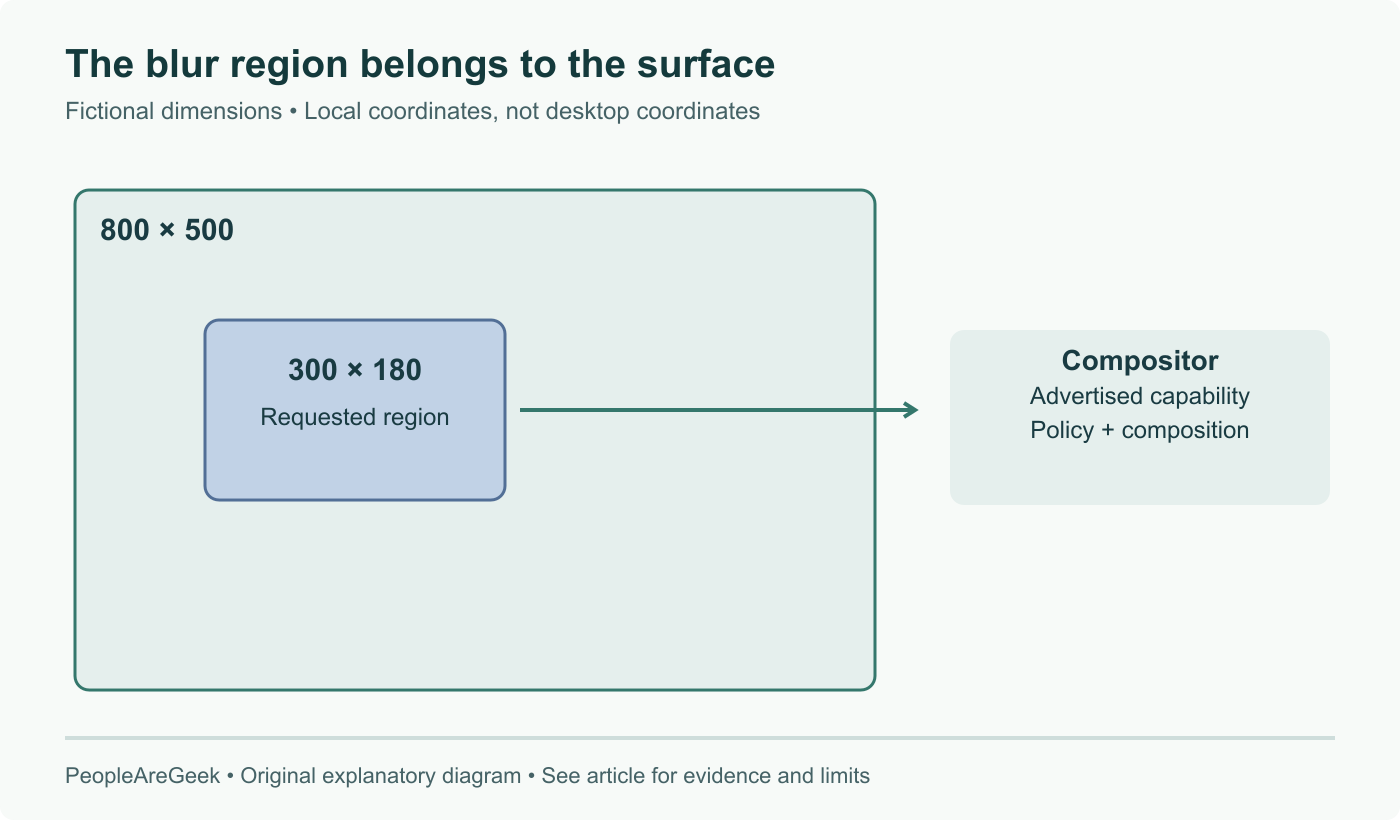
ext-background-effect-v1 puts the capability back without putting the ability to read your neighbours back with it. The client marks a region and asks for the effect. The compositor, which is the one component legitimately holding both layers, decides whether to honour the request and does the work. The application never sees the pixels it is blurring.
That is more plumbing than the old approach needed, and it is the right amount of plumbing. It also means the effect is now specified rather than negotiated per compositor, which is what makes it worth an application implementing: KWin has been working against the same specification, so a toolkit that adopts it gets both desktops.
The practical caveat is that the compositor half is the half that just landed. Applications still have to ask, and they will adopt it on their own schedules.
Session management stops being a private interface
The other structural change is quieter and probably matters more day to day. Mutter has been carrying an XX prefixed private interface for session management, the naming convention Wayland uses for a protocol that is still being designed. That protocol is now upstream in wayland-protocols as xdg_session_management_v1, and Mutter 51 switches to it.
Session management is what lets a compositor restore your windows to the places they were when you logged out. It has been a long standing gap between a Wayland session and the X11 session it replaced, and it needed to be standardised rather than implemented privately, because the value only exists if applications can rely on it across compositors.
Frame scheduling, and the rest
Michel Danzer landed a series of frame scheduling improvements in the compositor. Frame scheduling is the logic that decides when Mutter composites and hands a frame to the display, and getting it wrong shows up as latency, stutter and dropped frames rather than as a missing feature. There is no benchmark attached to the merge, so we will reserve judgement until GNOME 51 is out and people have measured it, but this is an area where the work tends to be felt before it is noticed.
The remainder of the Mutter changes read like a maintenance list, which is what a beta should look like. Blurred rendering on monitors that are not pixel aligned is fixed. Mice get button scrolling support. The cursor now hides while input capture is active. There is support for an external cursor implementation, and the disable while typing timeout setting is wired through.
GNOME Shell 51
The Shell side is smaller but not trivial.
Initial support for the reduced motion setting arrives, which is the accessibility preference that tells the desktop to cut back on animated transitions. GNOME's workspace and overview animations are among the more motion heavy in the Linux desktop, so this is a meaningful option for anyone who finds them uncomfortable.
Cursors move to SVG, in the same format KDE uses. That sounds like housekeeping and is closer to convergence: a cursor theme authored once now scales cleanly on both desktops instead of being shipped as bitmaps at a handful of sizes.
Screenshot area selection gains keyboard navigation, so choosing a region no longer requires a pointer. And the login greeter picks up web login support and a unified authentication mechanism, which is aimed squarely at managed environments where sign in goes through an identity provider rather than a local password file.
Where this sits
The beta arrived one day after the API and ABI freeze, the feature freeze and the user interface freeze. The feature set is now fixed, and the six weeks between here and the September 16 release of GNOME 51, codenamed A Coruna, are for bugs and translations.
If you want to try it, the routes are the usual ones: a distribution development branch, Fedora Rawhide, or the GNOME nightly runtime. We would keep it off a machine you depend on. A spare laptop or a virtual machine is enough to find out whether session restore behaves with your application set, which is the change most likely to surprise you either way.
Sources and further reading
- GNOME Mutter 51 beta released with Wayland background blur, Phoronix, August 3, 2026
- Mutter tags on GNOME GitLab, showing 51.beta on August 2, 2026
- Mutter merge request 5071, adding ext-background-effect-v1 blur support
- GNOME 51 A Coruna scheduled for September 16, 2026, 9to5Linux
Frequently asked questions
Why did background blur need a whole Wayland protocol?
Because on Wayland a client cannot see what is behind it. Under X11 an application could read the root window and the pixels underneath itself, which is how translucent terminals with blurred backdrops were built for two decades, and it is also exactly the kind of unrestricted reading that Wayland deliberately removed. That isolation is a security property rather than an oversight. The consequence is that the blur has to be done by the only component that can legitimately see both layers, which is the compositor. ext-background-effect-v1 is the request channel: the client marks a region of its surface and asks the compositor to blur what is composited behind it, and the compositor decides whether and how to honour that. It is more machinery than the X11 approach, and it is the reason the effect works without handing every application a window into its neighbours.
What is in Mutter 51 beta besides the blur?
Several things worth knowing about. Mutter now speaks xdg_session_management_v1, the upstream protocol, instead of the XX prefixed private interface it was carrying while the specification was still in flight, which is what lets applications have their windows restored to the right place across a session. Michel Danzer landed a run of frame scheduling improvements in the compositor, which is the kind of change whose effect shows up in latency and smoothness rather than in a feature list. There is a fix for blurred rendering on monitors that are not pixel aligned, button scrolling support for mice, cursor hiding while input capture is active, support for an external cursor implementation, and integration of the disable while typing timeout setting.
And GNOME Shell 51?
The Shell beta adds initial support for the reduced motion setting, which matters for anyone who finds the animation heavy workspace transitions uncomfortable or is sensitive to vestibular triggers. Cursors move to SVG, in the same format KDE uses, which is a quietly useful piece of cross desktop convergence because it means a cursor theme can be authored once and scale cleanly on both. Screenshot area selection gains proper keyboard navigation, so selecting a region no longer requires a pointer. The login greeter picks up support for web login and a unified authentication mechanism, aimed at environments where sign in goes through an identity provider rather than a local password.
When can I actually run this?
GNOME 51, codenamed A Coruna, is scheduled for September 16, 2026. The beta arrived the day after the API and ABI freeze, the feature freeze and the user interface freeze all took effect, which means the feature set is now fixed and the remaining six weeks are for bug fixing and translation. If you want it before September, it comes through the usual routes: Fedora Rawhide, the GNOME nightly Flatpak runtime, or your distribution's development branch. We would not put a beta compositor on a machine you need to work on, but a spare laptop or a virtual machine is a reasonable place to check whether the blur and the session restore behave with the applications you care about.
Will my terminal get blur automatically?
No. The compositor side is the half that was missing, but each application still has to request the effect through the protocol, and toolkits and terminals will adopt it on their own schedules. GTK applications will be first in practice, since the protocol work and the GNOME side move together, and other terminals will follow as the protocol becomes something more than one compositor supports. KDE's KWin has been working with the same specification, which is the point of standardising it in the first place: the effect stops being a per compositor extension that each application has to special case.