Google announced its largest AI leadership change on August 5, and the departure that matters most to people who build systems is Jeff Dean's. After twenty seven years he is leaving alongside Sanjay Ghemawat, Oriol Vinyals and Quoc Le to found Discovery Loop, a public benefit corporation whose stated goal is to automate machine learning research itself. Alphabet is investing in it and will supply the compute for the first year. In the same announcement Demis Hassabis stepped back from running DeepMind, and Koray Kavukcuoglu took over day to day leadership reporting to Sundar Pichai. Alphabet shares fell four to five percent. The vocabulary most of us use for distributed systems came from two of the people walking out.
The short answer
Google restructured its AI leadership on August 5. Jeff Dean is leaving after twenty seven years with Sanjay Ghemawat, Oriol Vinyals and Quoc Le to found Discovery Loop, a public benefit corporation aiming to automate machine learning research. Alphabet is an investor and the cloud partner. Demis Hassabis moved from DeepMind chief executive to chair of the unit and chief scientist of Alphabet. Koray Kavukcuoglu now runs Gemini, frontier research and the developer platforms, reporting to Sundar Pichai.
Most coverage of this led with Demis Hassabis, which is understandable and, for our readers, the wrong end of the story. The name to stop on is Jeff Dean, and the reason has almost nothing to do with AI.
The papers you have been building on
Jeff Dean and Sanjay Ghemawat have worked together for something close to twenty five years, and the list of things they produced in that time is the reason half the industry's infrastructure looks the way it does.
MapReduce gave everyone a mental model for batch computation over a cluster, and Hadoop existed because that paper existed. The Google File System paper became HDFS. Bigtable became HBase, and its data model is visible in Cassandra. LevelDB was forked into RocksDB, which now sits underneath a startling number of databases, message queues and blockchain nodes. Spanner made globally consistent transactions a thing engineers argued about rather than assumed impossible. TensorFlow, later, put automatic differentiation in front of an entire generation.
The pattern in all of that is consistent and it is worth naming: build it internally, then publish the design in enough detail that others can rebuild it. The industry got its distributed systems vocabulary because two engineers at one company kept writing it down.
That is the habit walking out the door, and whether it survives incorporation is the open question we care about most.
What Discovery Loop says it will do
The company is a public benefit corporation, co-founded by Dean, Ghemawat, Oriol Vinyals and Quoc Le. Vinyals was a Gemini co-lead with thirteen years at Google. Le co-founded Google Brain and has his name on the work that made neural architecture search and sequence to sequence modelling practical.
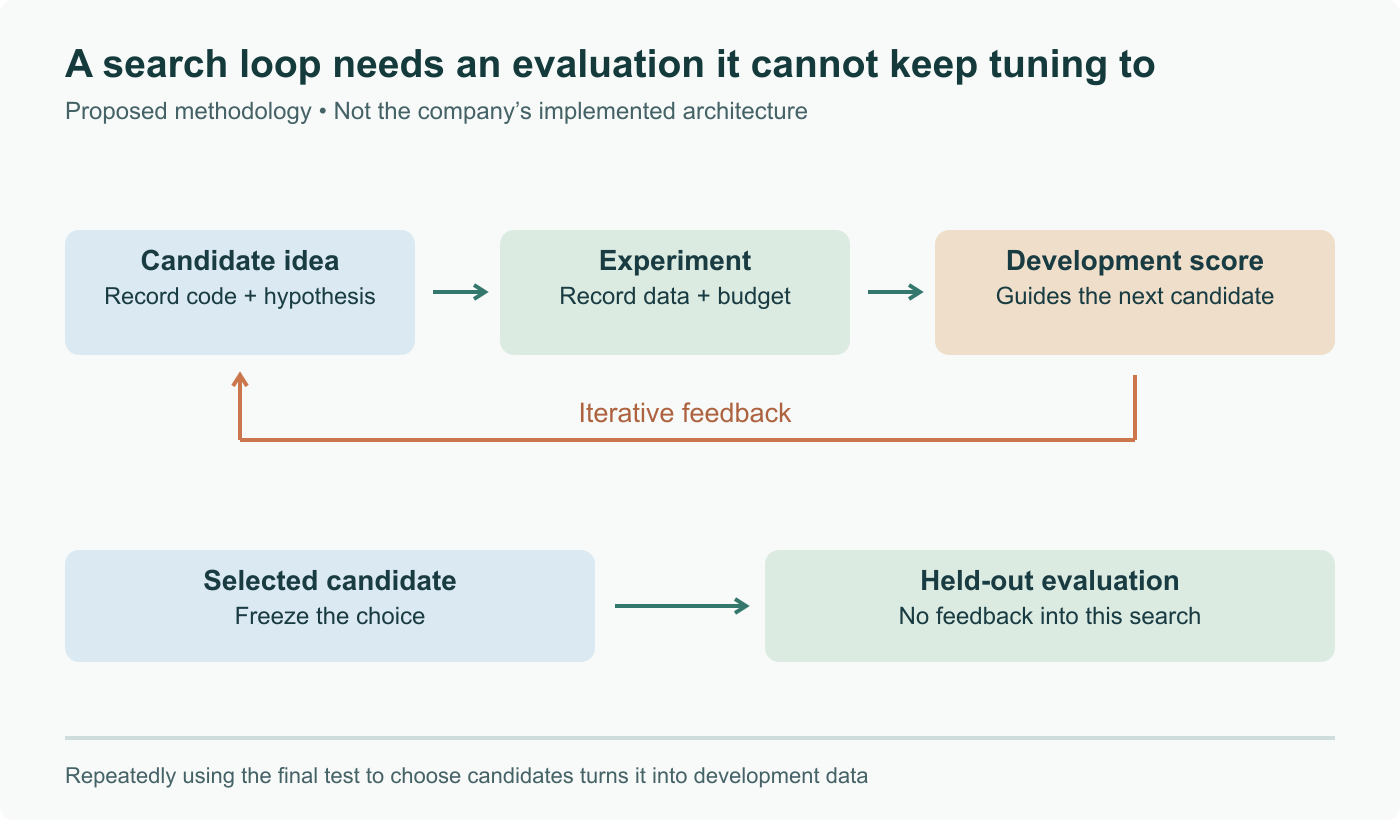
The first target is automating the machine learning research loop: design an experiment, run it, evaluate it, decide the next one, without a person in the middle, and then run thousands of those loops at once. After that the plan is to point the system at its own stack, which is where the name comes from. The longer list, as reported, runs through hardware design, drug discovery and clean energy, with the National Academy of Engineering Grand Challenges named as the eventual scope.
Funding comes from a seed round led by Radical Ventures and Khosla Ventures, with Lightspeed, Kleiner Perkins, Doerr Capital and Alphabet participating. Google is the cloud partner and covers compute for year one. Neither the raise nor the valuation has been made public.
The one thing worth being skeptical about
Automating research is a claim with a bad track record, and the founders are unusually clear eyed about why.
Vinyals has said publicly that generating genuinely novel research ideas is not something current models are strong at. That is the whole problem in one sentence. Running thousands of experiments in parallel is an engineering exercise, and this team is arguably the best in the world at engineering exercises of that shape. Deciding which thousand experiments are worth running is the part nobody has solved, and no amount of parallelism substitutes for it. A loop that iterates quickly on the wrong hypothesis space is an expensive way to stand still.
We would take the bet seriously anyway, because the specific failure mode of most research automation attempts has been infrastructure rather than ideas: the loop breaks, the cluster is underutilised, the evaluation harness is inconsistent, the results are not reproducible. Those are exactly the problems the two people who wrote MapReduce and GFS are best equipped to remove. Whether removing them is sufficient is the experiment.
What actually changed inside Google
Hassabis is now chair of Google DeepMind and chief scientist of Alphabet, still running Isomorphic Labs, focused on longer term strategy. Koray Kavukcuoglu, DeepMind's chief technology officer and Google's chief AI architect, moved up to senior vice president and now reports to Sundar Pichai directly. Gemini model development, frontier research, the Gemini app and the developer platforms all sit under him.
Some outlets have described that as him becoming chief executive of the unit. Google's own framing is senior vice president, and Pichai laid it out in a message to employees published on the company blog. Either way, the practical fact for anyone shipping against the Gemini API is that the models and the platform now answer to one person, which historically tends to make deprecation timelines and capability parity slightly less erratic.
Alphabet shares fell somewhere between four and five percent on the day, touching 362.31 dollars, depending on which report you read. That is a market reacting to headline risk rather than to any change in shipping capacity, and we would not read much into it.
What we would watch
Three things, none of them the stock price.
Whether Discovery Loop publishes. If the first substantial result arrives as a paper with enough detail to reproduce, the habit survived the incorporation and the rest of us benefit. If it arrives as a product announcement, it did not.
Whether Gemini's release cadence changes over the next two quarters. Four senior people leaving at once is a real loss of context, and context loss shows up as slipped dates before it shows up anywhere else.
Whether anyone else builds the same thing in the open. Automating an experiment loop is not a secret technique, and there is a version of this that is a well engineered open source harness rather than a company. If you run experiments at any scale, that is the version worth waiting for.
Sources and further reading
- The next chapter of our AI momentum, message from Sundar Pichai, Google blog
- Google chief scientist Jeff Dean leaving the company after 27 years, CNBC, August 5, 2026
- Google DeepMind shakeup: Gemini co-leads quit for a startup, The Next Web, August 5, 2026
- Google DeepMind loses both its CEO and chief scientist, The Decoder, August 5, 2026
- Google DeepMind CEO Demis Hassabis is stepping aside, Axios, August 5, 2026
- Demis Hassabis no longer DeepMind CEO, Jeff Dean departs, 9to5Google, August 5, 2026
Frequently asked questions
Why should an infrastructure engineer care about an AI leadership reshuffle?
Because of who is in it. Jeff Dean and Sanjay Ghemawat are the pair behind MapReduce, Bigtable, Spanner and LevelDB, and later TensorFlow. Almost every distributed data system built in the last twenty years either descends from one of those papers or was written in reaction to it. Hadoop exists because MapReduce was published. HBase and Cassandra exist because Bigtable was published. RocksDB is a fork of LevelDB. When you shard a table, run a batch job over a cluster or reason about a globally consistent timestamp, you are using vocabulary those two invented and then gave away in papers. Where they choose to spend the next decade is a reasonable leading indicator for what the next generation of systems papers will be about, and Discovery Loop says that subject is automating the research loop itself.
What is Discovery Loop actually trying to build?
The stated first target is automating large scale machine learning research: running the experiment design, execution and evaluation loop without a human in the middle, and running thousands of those loops in parallel. The team then intends to point the resulting system at its own stack, which is the recursive part that gives the company its name, before moving to broader problems. Public statements name hardware design, drug discovery and clean energy, and reporting points at the National Academy of Engineering Grand Challenges as the longer term target list. It is registered as a public benefit corporation rather than a standard C corp, which is a legal commitment to weigh a stated mission alongside shareholder return. Worth noting: Oriol Vinyals has been publicly candid that generating genuinely novel research ideas is not something current models are strong at, which is the exact gap the company is betting it can close.
Who is funding it, and why is Alphabet paying a competitor?
The seed round is led by Radical Ventures and Khosla Ventures, with Lightspeed, Kleiner Perkins, Doerr Capital and Alphabet itself participating. Google is also the cloud partner and is providing compute for the first year. The amount and the valuation have not been disclosed. Alphabet funding a company founded by four of its own departing researchers looks strange until you consider the alternative: those four raise from someone else, run on someone else's infrastructure, and Alphabet has neither equity nor visibility. This is a familiar structure in the current market, where the scarce asset is a small number of people who have shipped frontier systems, and the cost of keeping a relationship with them is much lower than the cost of losing it outright.
What changed at DeepMind itself?
Demis Hassabis stepped down as chief executive of Google DeepMind and became chair of the unit and chief scientist of Alphabet, continuing to lead Isomorphic Labs. Koray Kavukcuoglu, previously DeepMind's chief technology officer and Google's chief AI architect, took over day to day leadership as senior vice president reporting directly to Sundar Pichai. He now owns Gemini model development, frontier AI research, the Gemini application and the developer platforms. He is a thirteen year DeepMind veteran who started its deep learning team, so this is an internal promotion rather than an outside hire. Coverage has been inconsistent on whether his title is formally chief executive or senior vice president, and the official framing from Google is the latter. For anyone building on the Gemini API, the practical consequence is that model development and the developer platform now report to the same person.
Does this change anything about the models we build against today?
Not this quarter, and probably not this year. Gemini development continues under someone who was already the chief technology officer of the unit shipping it, and the API surface, pricing and deprecation policies are unaffected by a reporting line change. The honest read is that this matters on a two to three year horizon rather than a two to three month one. What we would watch instead is publication behaviour. Dean and Ghemawat's historical pattern was to build something internally and then publish the design in enough detail that the rest of the industry could rebuild it, which is how the open source data ecosystem got started. Whether Discovery Loop keeps that habit or treats its methods as the product is the question that decides how much of this ends up in tools you can actually use.