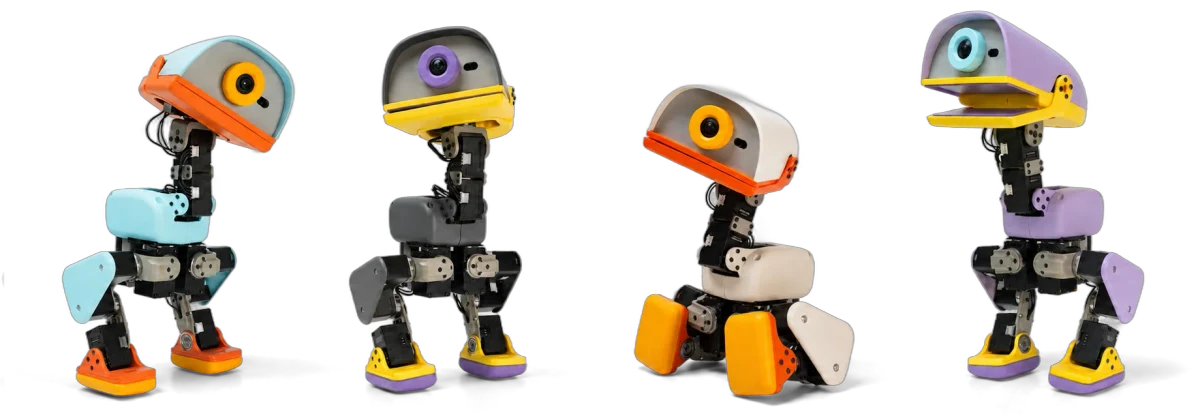
Hugging Face and its Pollen Robotics subsidiary opened pre-orders on Thursday August 27, 2026 for Microduck, a 25 centimetre bipedal robot at $399 that ships before Christmas. The hardware is modest and deliberately so: 15 motors, a camera, a small LiDAR, two inertial measurement units, a beak that grips, 32 GB of storage and 1 GB of RAM, with a control policy running at 50 Hz on board. What makes it interesting for developers is the other half. The SDK, the MuJoCo simulation and the full reinforcement learning training stack are published under Apache 2.0, so the robot arrives with seven trained behaviours and an open path to more.
The short answer
Pollen Robotics, the French company Hugging Face acquired in April 2025, unveiled Microduck on Thursday August 27, 2026 and opened pre-orders the same day, with shipping promised before Christmas. It is 25 centimetres tall, weighs under 800 grams and runs 15 motors, a camera, a small LiDAR and two IMUs, with a 50 Hz control policy running on board. Seven behaviours ship with it, including recovering from a fall and roller skating. The SDK, the MuJoCo simulation and the reinforcement learning training stack are Apache 2.0 on GitHub.
Most robotics announcements this year have been about humanoids that cost more than a car. This one is a duck that costs less than a phone, and it is the more interesting release of the two.
What you get for $399
Microduck stands 25 centimetres and weighs under 800 grams. Fifteen motors drive it. Sensing is a camera, a small LiDAR unit and two inertial measurement units, with a microphone and speaker on board. Storage is 32 GB against 1 GB of RAM, with Wi-Fi and Bluetooth for connectivity.
The specification that tells you what kind of device this is: the control policy runs at 50 Hz locally. Nothing round trips to a server to decide where a foot goes. That is the difference between a research platform and a toy with an app.
Seven trained behaviours are included, covering walking, sitting and standing, kicking, grabbing with the beak, roller skating and getting back up after a fall. The recovery behaviour is the one worth noticing. Falling over is what small bipeds do, and a robot that needs a human to set it upright again stops being useful within about ten minutes of unsupervised operation.
A game controller, a battery and a USB-C cable are in the box. Four colourways are offered: Cream, Graphite, Lavender and Sky.
The part that matters to developers
The hardware is unremarkable on purpose. The stack around it is the product.
Hugging Face publishes the SDK, the simulation environment built on the MuJoCo physics engine, and the full reinforcement learning training pipeline, all under Apache 2.0 in the pollen-robotics/microduck repository. That combination is the whole point: you train a policy in simulation on your own machine, and you deploy it to the physical robot, with no vendor gate and no cloud dependency in between.
Anyone who has tried to get into reinforcement learning on physical hardware knows the actual barrier is not the algorithms. It is that a platform capable of walking has historically cost several thousand euros, arrived with a proprietary SDK, and broke expensively the first time your policy did something stupid. A $399 machine with published training code and a dev pack that includes spare motors changes that arithmetic for a university lab, a hackerspace or one determined person at a kitchen table.
It also fits a pattern. The most useful open hardware is rarely the most capable hardware; it is the cheapest thing whose failure you can afford to learn from.
The design choices worth arguing about
Microduck does not speak. It communicates through non verbal sound, and each unit receives a permanent audio identity fixed at setup.
That is a real decision and a good one. Bolting a language model onto a small robot produces a chatbot that happens to have legs, and the interesting research question on a biped has nothing to do with language. Keeping the interaction non verbal ties the feedback loop to what the machine is physically doing, and removes any reason to stream audio anywhere.
The other choice worth naming is what is not open. The software stack is Apache 2.0; the hardware is a product you buy, not a design you fabricate. That is a reasonable trade at this price, and it is worth being precise about rather than calling the whole thing an open hardware project.
Where this sits
Pollen Robotics was a French startup building affordable open robotics platforms when Hugging Face acquired it in April 2025, and Microduck is the clearest expression yet of what that acquisition was for. The strategy is legible: put cheap, physically capable hardware in front of the same developer community that already uses the company's model hub, and let the training stack be the thing people build on.
It arrives at an odd moment for the parent company, which has spent the last fortnight in acquisition headlines of its own, from reports of a $12.9 billion Nvidia approach to the earlier disclosure that it was exploring a sale at $13 billion or more. Whatever comes of that, a $399 robot with an Apache 2.0 training stack is a more concrete contribution to physical AI than most of the funding rounds announced alongside it, including the general purpose humanoid work drawing hundreds of millions.
Pre-orders are open now. Units are promised before Christmas 2026, and the introductory price excludes tax and shipping.
Sources and further reading
- Microduck product page, Pollen Robotics
- Hugging Face is selling a cute $399 open source duck robot, TechCrunch, August 27, 2026
- Hugging Face and Pollen Robotics open pre-orders for the $399 Microduck, Engadget
- Hugging Face offers $399 robot duck, The Register, August 27, 2026
Frequently asked questions
What exactly is open source about Microduck, the hardware or the software?
The software stack, published under Apache 2.0. That covers the SDK, the simulation environment built on MuJoCo, and the reinforcement learning training pipeline used to produce the behaviours the robot ships with. In practical terms that means you can train a new policy in simulation on your own machine and deploy it to the robot, without a vendor SDK gate or a cloud service in the middle. The hardware itself is a product you buy at $399 rather than a set of files you fabricate, so treat this as an open software platform on closed hardware rather than an open hardware project.
What can it actually do out of the box?
Seven trained moves ship with it: walking, sitting and standing, kicking, grabbing objects with its beak, roller skating, and getting back up after a fall. That last one is less of a party trick than it sounds, because recovery from an arbitrary fallen posture is one of the harder things to learn on a small biped and one of the fastest ways to make a robot unusable if it is missing. A game controller, a battery and a USB-C cable are in the box, so it is usable on arrival without buying anything else.
What are the actual specifications?
It stands 25 centimetres tall and weighs under 800 grams, driven by 15 motors. Sensing is a camera, a small LiDAR unit and two inertial measurement units, with a microphone and speaker for audio. Onboard there is 32 GB of storage and 1 GB of RAM, with Wi-Fi and Bluetooth, and the control policy runs at 50 Hz locally rather than depending on a network round trip. That last number is the one to weigh if you plan to train your own policies, because it sets the budget your policy has to run inside.
Does it talk?
No, and that is a design choice rather than a limitation they ran out of time to fix. Microduck communicates through non verbal sound, and Hugging Face says each unit gets its own audio identity that is fixed permanently after setup. Avoiding speech sidesteps the whole assistant framing, keeps the interaction loop tied to what the robot is physically doing, and removes any need to pipe audio to a speech service. For a device aimed at reinforcement learning experiments rather than at being a household assistant, that is the coherent choice.
What do the accessory packs add and are they worth it?
There are three, all optional. The charger pack at $39 adds a dual charger and two spare batteries, which is the one to consider if you plan long training or demo sessions, since battery time is the binding constraint on any small biped. The accessory pack, also $39, adds a laser pointer, rollers, a ball and NFC tags. The dev pack at $119 is the substantial one, bundling spare motors, cables, batteries, a charger, NFC tags, tools and Hugging Face credit. Spare motors matter on a machine you intend to make fall over repeatedly.