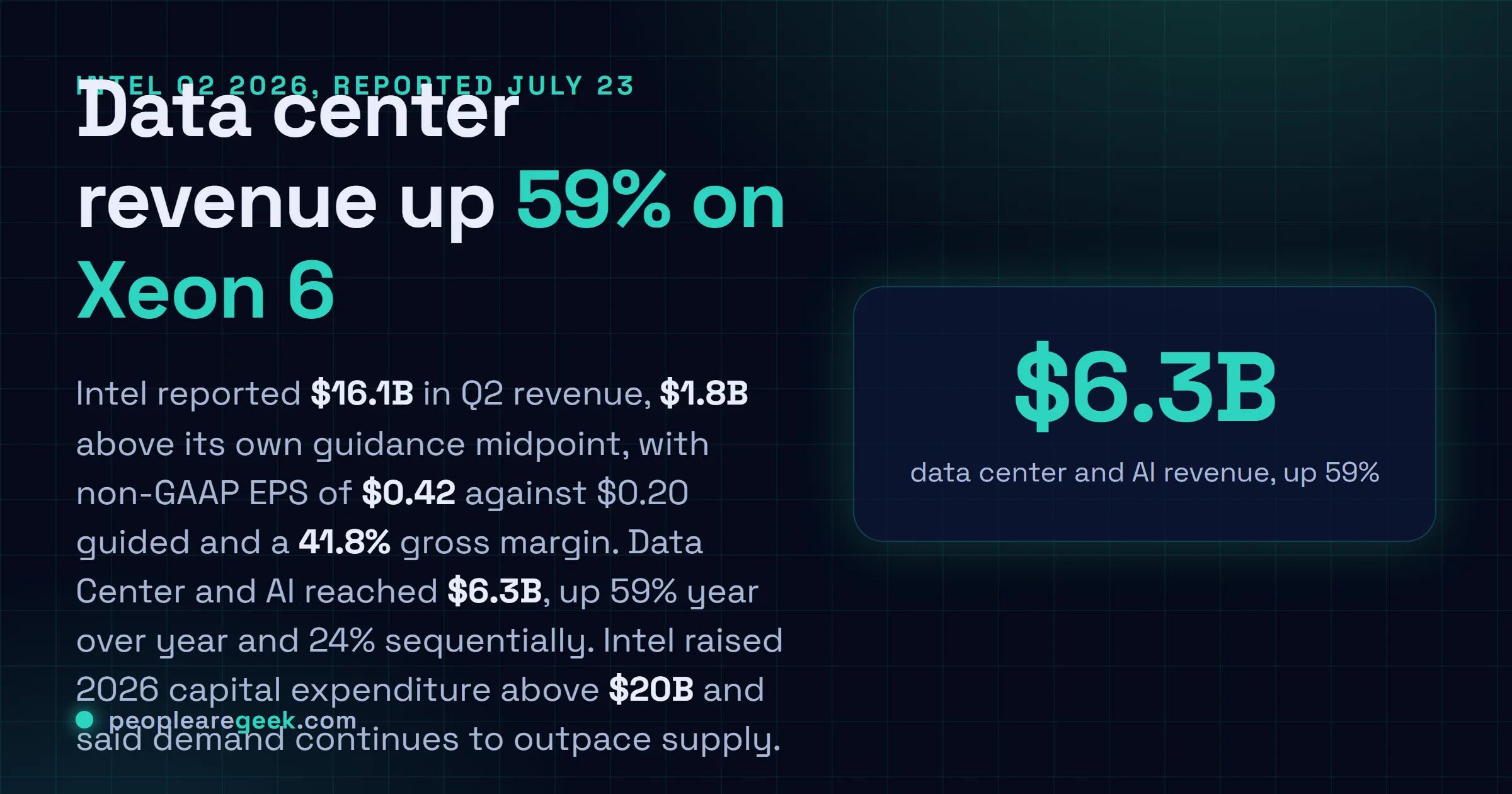
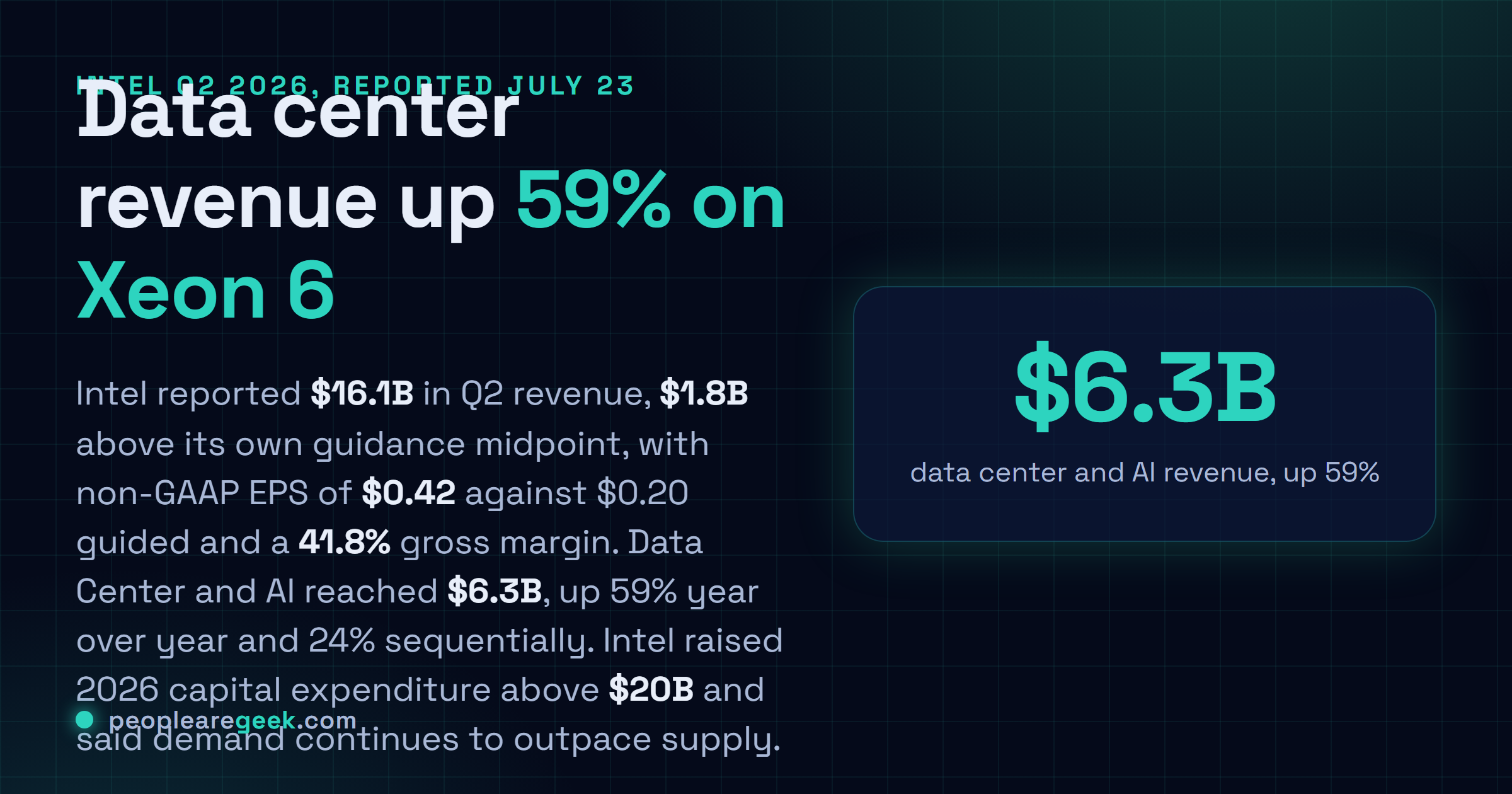
Intel reported Q2 2026 results on Thursday, July twenty third, and the number that matters for anyone who buys servers is $6.3 billion in data center and AI revenue, up 59% year over year and 24% on the previous quarter. Total revenue came in at $16.1 billion, $1.8 billion above the midpoint of Intel's own guidance, with non-GAAP earnings per share of $0.42 against $0.20 guided. Chief executive Lip-Bu Tan framed the quarter in one sentence that should shape your procurement calendar more than any benchmark: demand continues to outpace supply. If a server refresh is on your roadmap, the lead time is now the constraint.
The short answer
Intel reported Q2 2026 results on July twenty third. Total revenue was $16.1 billion, $1.8 billion above the midpoint of its own guidance, with non-GAAP earnings per share of $0.42 against $0.20 guided and a gross margin of 41.8%. The Data Center and AI segment grew 59% year over year to $6.3 billion on Xeon 6 demand. Intel raised 2026 capital expenditure guidance above $20 billion and said 2027 will be significantly higher. The operative line for buyers is that demand is outpacing supply, so lead times, not benchmarks, are the thing to plan around.
Quarterly earnings are usually somebody else's problem. This one is worth reading if you buy servers, because Intel spent the call describing a supply situation rather than a demand problem, and that distinction lands directly on your purchase orders.
What Intel reported
Total revenue for the second quarter of 2026 was $16.1 billion, which came in $1.8 billion above the midpoint of Intel's own guidance. Non-GAAP earnings per share were $0.42 against $0.20 guided, and non-GAAP gross margin reached 41.8%, roughly 280 basis points ahead of forecast. Operating cash flow was $7.0 billion, and Intel closed the quarter with about $30 billion in cash and short term investments.
The segment breakdown is where it gets specific. Data Center and AI brought in $6.3 billion, up 59% year over year and 24% on the previous quarter, with $2.5 billion of operating profit at a 40% margin. Client Computing and Physical AI contributed $8.9 billion, up 15% sequentially, with AI capable PCs now representing two thirds of client revenue. Intel Foundry reported $5.8 billion, of which $293 million came from external customers, and management said the 18A node exceeded internal targets by roughly 25%. Purpose built silicon, the custom ASIC business, nearly tripled year over year and is approaching a $2 billion run rate.
For the third quarter Intel guided to revenue between $15.8 billion and $16.8 billion, a 42% gross margin and non-GAAP earnings per share of $0.38.
The server CPU did not become a bystander
There is a comfortable assumption that an AI buildout is an accelerator story and general purpose CPUs are along for the ride. A 59% year over year jump in a server CPU business, driven by a product Intel calls one of its fastest ramping ever, argues otherwise.
The mechanics are not mysterious. Accelerator nodes need host processors to keep them fed, and the estate around them still has to run databases, hypervisors, storage services, control planes and the ordinary application tier. A large GPU deployment tends to drag general purpose sockets in behind it rather than displacing them. Add the custom silicon line approaching $2 billion, and you get two demand streams pulling on the same manufacturing capacity, which is the part that eventually reaches you.
Supply is the constraint, and that is the actionable part
Lip-Bu Tan's summary of the quarter was that strong demand for Intel's products continues to outpace its growing supply. Vendors do not volunteer that phrasing casually, and it is more useful to you than any benchmark in the release.
When demand outpaces supply, the symptoms are predictable and they are all scheduling problems rather than technical ones. Lead times stretch and become harder to forecast. A configuration quoted in week one can be unavailable by the time the purchase order clears internal approval in week six. Discounting gets thinner because the vendor has no shortage of buyers. Substitutions get proposed late, when you have the least room to evaluate them.

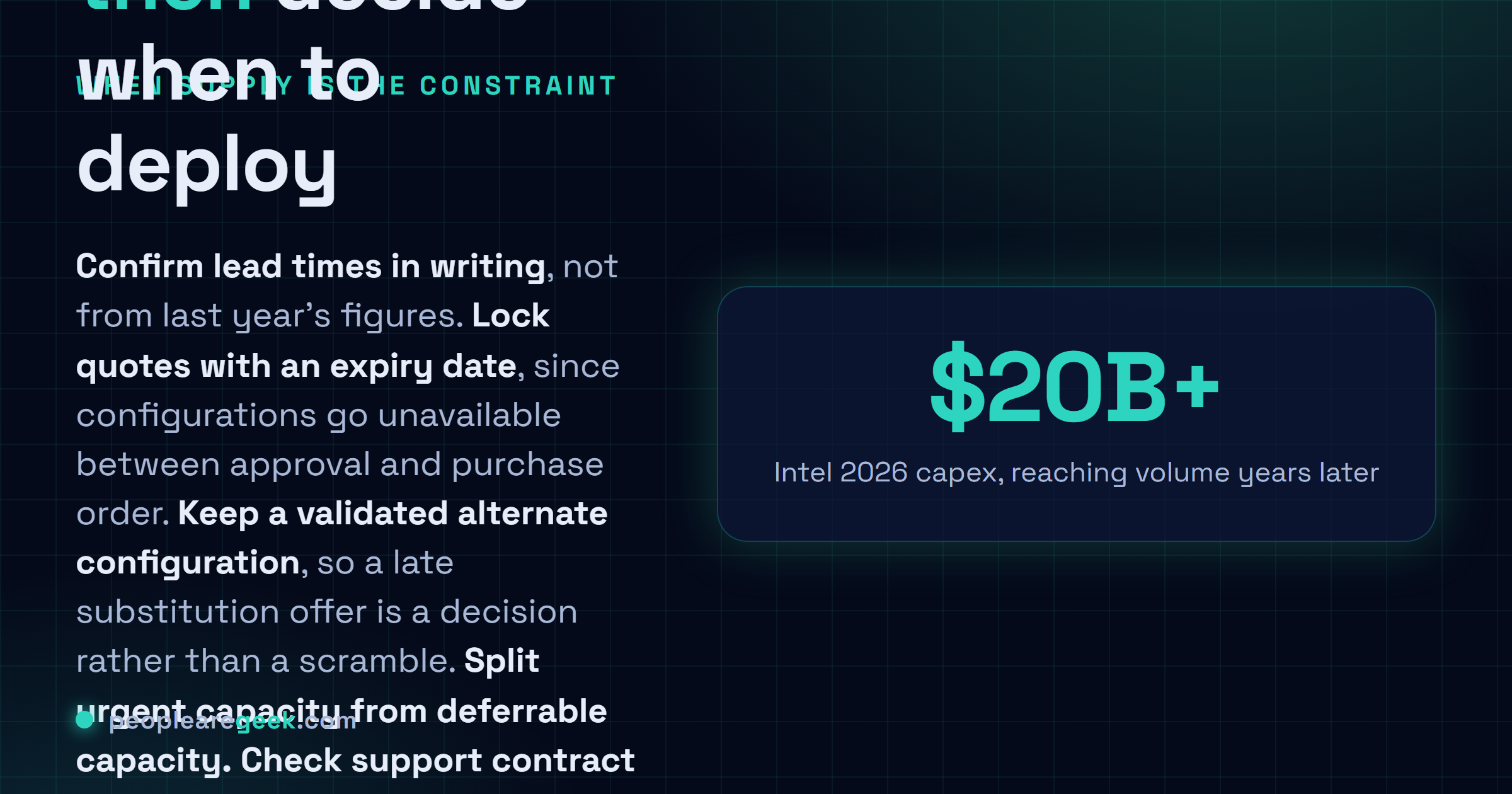
The response is not complicated, it just has to happen earlier than feels natural. Get quotes into the process before the budget conversation is fully settled, and ask for lead times in writing rather than assuming last year's figures still hold. Keep a second configuration you have actually validated, so a substitution offer is a decision rather than a scramble. Separate the capacity you genuinely need this quarter from the capacity that can slip, because those two lists deserve different levels of urgency and different amounts of your negotiating leverage. And check your existing support contract end dates before you order, not after, since an expiry that lands mid queue turns a scheduling annoyance into a real risk.
What the capital expenditure number does and does not tell you
Intel raised 2026 capital expenditure guidance above $20 billion, with tooling spend up around 40% on 2025, and said 2027 will be significantly above that, concentrated in United States facilities and supported by the CHIPS Act investment tax credit.
That is a genuine commitment, and it is also slow. Fab capacity announced now reaches volume production years later. It tells you something about the supply picture in 2028 and nothing at all about the machine you are trying to take delivery of this autumn. The same pattern is visible across the industry right now, from AMD's MI400 and EPYC Venice launch to the hyperscaler buildouts, where announced capacity and available capacity are separated by a multi year gap. Plan against what you can order, not against what has been announced.
Sources and further reading
- CNBC: Intel earnings report, Q2 2026
- BigGo Finance: Intel Q2 2026 earnings call, record server growth
- Yahoo Finance: Intel Corporation Q2 FY2026 earnings call transcript
- TradingKey: Intel Q2 2026, AI data center and foundry analysis
Frequently asked questions
What exactly did Intel report for the second quarter of 2026?
Intel reported total revenue of $16.1 billion for Q2 2026, which is $1.8 billion above the midpoint of its own guidance, with non-GAAP earnings per share of $0.42 against $0.20 guided and a non-GAAP gross margin of 41.8%, some 280 basis points above forecast. Operating cash flow was $7.0 billion and the company ended the quarter with roughly $30 billion in cash and short term investments. Chief executive Lip-Bu Tan described it as the seventh consecutive quarter of exceeding financial expectations. Results were announced on Thursday, July twenty third, 2026.
How much of that came from the data center business?
The Data Center and AI segment produced $6.3 billion, up 59% year over year and 24% sequentially, with operating profit of $2.5 billion at a 40% margin. Intel attributed the growth to Xeon 6, which management called one of the fastest ramping products in company history. For context, the Client Computing and Physical AI group contributed $8.9 billion, up 15% sequentially, with AI capable PCs now accounting for two thirds of client revenue. Intel Foundry contributed $5.8 billion, of which $293 million came from external customers.
Why does a general purpose Xeon sell well in an AI cycle?
Because accelerators do not run a data center on their own. Every GPU node needs host CPUs to feed it, and the surrounding estate still runs databases, virtualisation, storage services, control planes and the ordinary application tier that pays the bills. A large accelerator deployment therefore pulls general purpose server sockets along with it rather than replacing them. Intel also reported that its purpose built silicon business, meaning custom ASIC work, nearly tripled year over year and is approaching a $2 billion annual run rate, which is a second demand stream feeding off the same buildout.
What is Intel spending on capacity, and does that help me?
Intel raised its 2026 capital expenditure guidance to more than $20 billion, up from a baseline near $17 billion, with tooling spend up around 40% on 2025. It also signalled that 2027 capital expenditure will be significantly above 2026, concentrated in United States facilities and supported by the CHIPS Act investment tax credit. New fab capacity takes years to reach volume, so none of this relieves a shortage in the current quarter. Treat it as a signal about 2028 supply, not about the server you are trying to order this autumn.
What should I change in my hardware planning because of this?
Move your ordering decision earlier than your deployment decision. When a vendor says demand outpaces supply, the practical effect is longer and less predictable lead times, quoted configurations that become unavailable between approval and purchase order, and less room to negotiate. Get quotes early, confirm lead times in writing rather than assuming last year's figures, keep a validated second configuration you would accept, and separate the parts of your refresh that are genuinely urgent from the parts that can wait a quarter. That sequencing costs nothing and protects you if the queue lengthens.