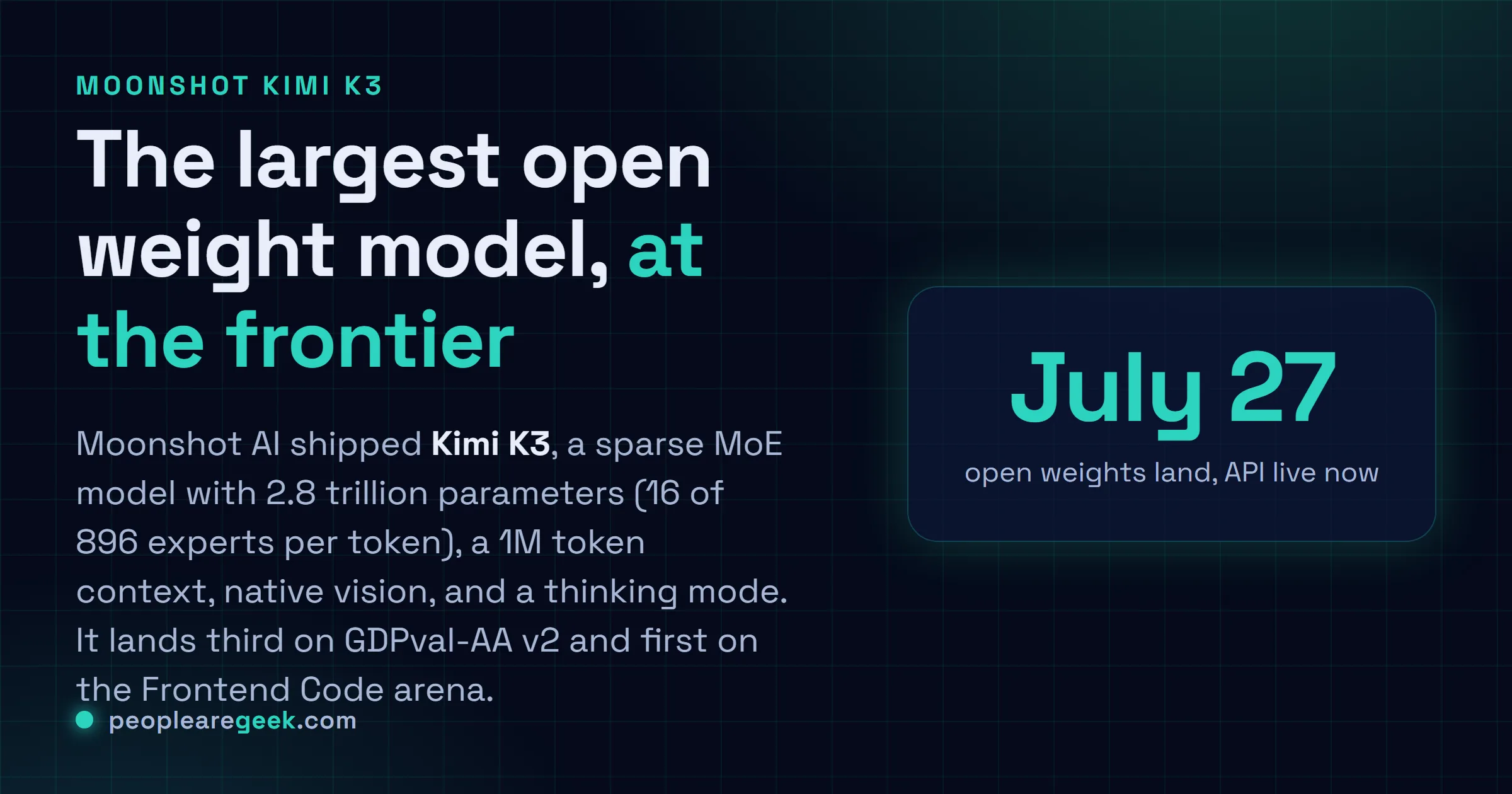
Moonshot AI has released Kimi K3, and the headline number is hard to ignore: 2.8 trillion parameters, which the company says makes it the largest open weight model anyone has shipped. It is a sparse mixture of experts model, so each token only wakes up a small slice of that total, and it comes with a one million token context window, native vision, and an always on reasoning mode Moonshot calls thinking mode. Announced on July 16, 2026, with full weights promised for July 27, K3 already lands near the top of a couple of respected benchmarks. For developers weighing whether to route work to a frontier API or eventually self host, this is the release worth reading closely.
The short answer
Moonshot AI released Kimi K3, a sparse mixture of experts model with 2.8 trillion total parameters that it calls the largest open weight model shipped so far. It runs a one million token context, native vision, and an always on thinking mode, and it lands third on GDPval-AA v2 while topping the Frontend Code arena. The API is live now at 15 dollars per million output tokens, and the full weights are promised for July 27, 2026.
Every few weeks a new model arrives claiming a crown, and most of the time the sensible move is to shrug and wait for the dust to settle. Kimi K3 is a little different, and not only because of the eye watering parameter count. An open weight model that trades blows with the closed frontier changes the arithmetic for anyone who has been quietly wondering whether they will always be renting their intelligence from someone else's API.
The number that matters, and the one that does not
Two point eight trillion parameters is the figure everyone will repeat, and it is genuinely large. But the honest way to read a mixture of experts model is to look at what actually runs. K3 routes each token through just 16 of its 896 routed experts, so the model behaves, for the cost of a single forward pass, far more like a mid sized model than its headline total suggests. That is the whole point of the sparse design: you get the knowledge capacity of a giant while paying compute closer to something you can actually serve.
Underneath sit two pieces of Moonshot's own engineering. Kimi Delta Attention is a hybrid linear attention mechanism that keeps the memory cost of a very long context in check. Attention Residuals is what the company describes as a drop in replacement for the usual residual connections, one that it says gives steadier gains as the model scales. You do not need to love the internals to care about the result, which is a one million token context window that stays affordable enough to use rather than just advertise.
Where it lands against the frontier
Benchmarks are noisy and easy to overfit, so read these as a signal rather than a scoreboard. On GDPval-AA v2, which scores real tasks across 44 occupations and 9 industries, K3 came in at 1,687. That put it third overall, behind Claude Fable 5 Max at 1,815 and GPT-5.6 Sol Max at 1,747.8, and comfortably ahead of Claude Opus 4.8 at 1,600. On the Frontend Code arena, where developers blind test the models on building interfaces, K3 finished first at 1,679, nudging past Fable 5.
The one line summary making the rounds is that K3 offers roughly Opus class quality at a fraction of the price. That is a marketing gloss, not a law of nature, and your own evals on your own workloads will tell you more than any leaderboard. Still, a top three frontier result from a model whose weights you can download in a week is the kind of thing that reshapes buy versus build conversations.

Self hosting is a server job, not a laptop one
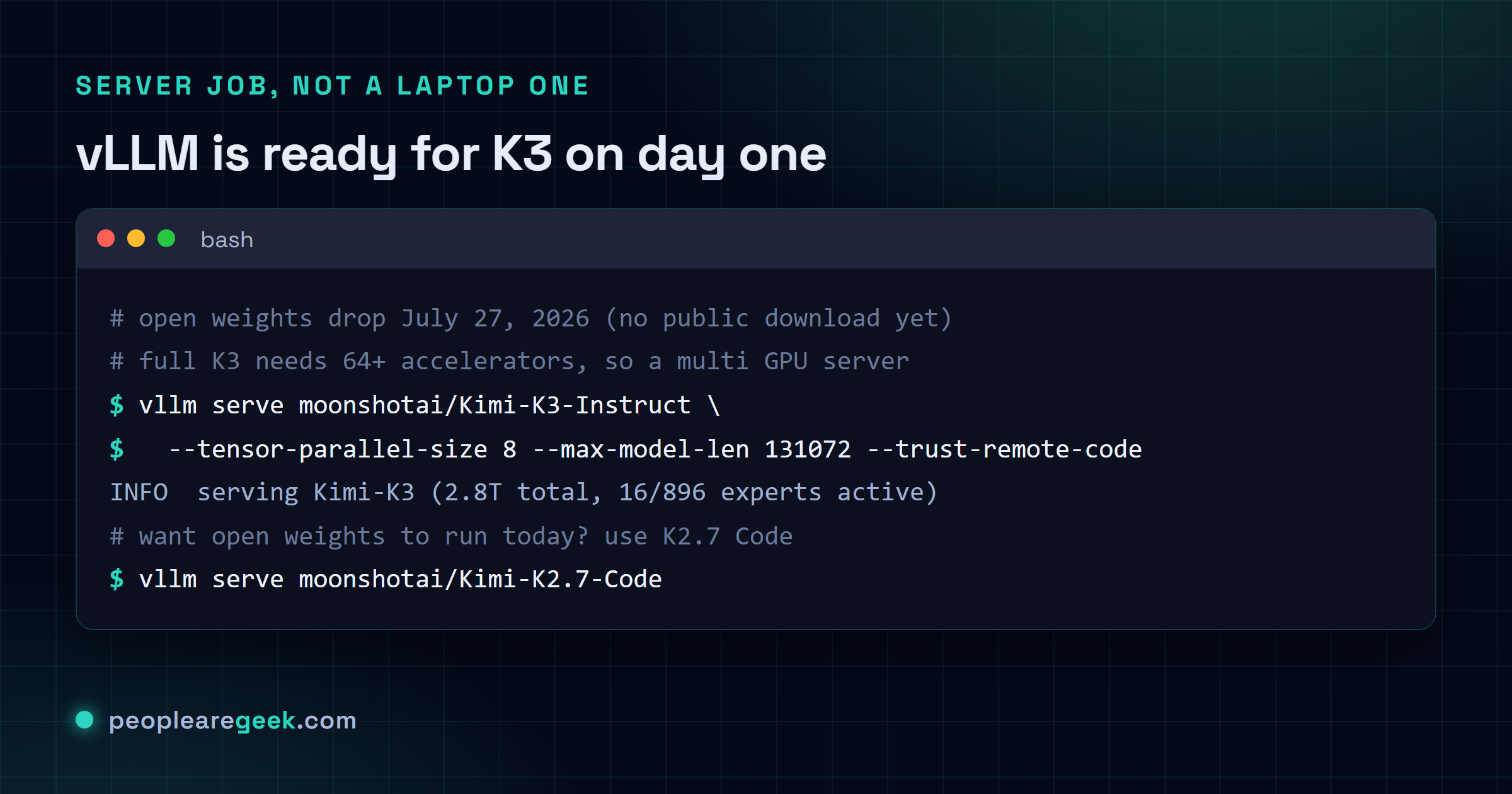
Here is the reality check that the parameter count implies. You are not running full K3 on a workstation. Moonshot recommends at least 64 accelerators to serve the model, and even an aggressively quantized build needs far more memory than any single card carries. For reference, the lab's earlier one trillion parameter K2.7 Code needs roughly 577 gigabytes of VRAM at four bit precision, and K3 is nearly three times larger. So plan for a multi GPU server, a rented cluster, or a quantized deployment on serious hardware.
The encouraging part is that Moonshot is doing the plumbing so the community does not have to reverse engineer it. The lab is contributing a vLLM prefill cache implementation for its Kimi Delta Attention, timed to release alongside the weights on July 27. That means a serving command as ordinary as the one below should work on day one, rather than months later once tooling catches up.
If you want open weights you can actually run today while you wait, Moonshot's own K2.7 Code remains the practical pick for local coding, and it slots into the same vLLM and SGLang workflows. Treat K3 as the frontier option you reach for through the API now and self host later, once you have the hardware and the weights are public.
What to do with this
For most teams the move this week is not to rip anything out. It is to run K3 through the API against your real prompts and see whether it holds up on the work you actually do, especially long context tasks and frontend code, which is where its published numbers are strongest. The cache hit pricing rewards agents that reuse a big shared system prompt, so if that describes your setup, the cost math may look better than the headline output price suggests.
The longer arc is the one worth watching. An open weight model landing in the top tier means the gap between what you can rent and what you can own keeps narrowing. That does not make the closed labs irrelevant, but it does give you leverage, a fallback, and a path to keeping sensitive workloads on hardware you control. On July 27, when the weights go public, that path gets a lot shorter.
Sources and further reading
- VentureBeat: China's Moonshot AI releases Kimi K3, the largest open source model ever
- MarkTechPost: Moonshot AI releases Kimi K3, a 2.8 trillion parameter open MoE model
- Tom's Hardware: Moonshot releases 2.8 trillion parameter Kimi K3
- Simon Willison: Kimi K3, and what we can still learn from the pelican benchmark
- Latent Space: Kimi K3 2.8T-A50B, the largest open model ever released
Frequently asked questions
What exactly is Kimi K3?
Kimi K3 is a large language model from the Chinese lab Moonshot AI, announced on July 16, 2026. It is a sparse mixture of experts model with 2.8 trillion total parameters, of which only 16 of 896 routed experts fire for any given token. It ships with a one million token context window, native visual understanding, and an always on reasoning mode the company calls thinking mode. Moonshot describes it as the largest open weight model released to date.
When do the open weights drop and where?
Moonshot announced K3 on July 16 and said the full model weights would be published on July 27, 2026. As of July 17 there is no public download yet, so if you plan to self host you can prepare your serving stack now and pull the weights once they land. The API is already live for anyone who wants to test the model before the weights ship.
How does K3 score on benchmarks?
On GDPval-AA v2, a benchmark that measures real work across 44 occupations and 9 industries, K3 scored 1,687, placing third overall behind Claude Fable 5 Max at 1,815 and GPT-5.6 Sol Max at 1,747.8, and ahead of Claude Opus 4.8 at 1,600. In blind developer testing on the Frontend Code arena, K3 ranked first at 1,679 points, edging out Fable 5. Benchmarks are a starting point, not a verdict, so treat these as one signal among several.
Can I run Kimi K3 on my own hardware?
Not on a desktop. At 2.8 trillion parameters, even a heavily quantized build needs far more memory than a single card. Moonshot recommends at least 64 accelerators for serving, so realistically you are looking at a multi GPU server or a rented cluster. The lab is contributing a vLLM prefill cache implementation for its Kimi Delta Attention so the model can be served the day the weights land.
What does the API cost?
Moonshot lists K3 API pricing at 0.30 dollars per million cache hit input tokens, 3 dollars per million on cache misses, and 15 dollars per million output tokens. The cache hit discount rewards workloads that reuse a large shared prompt, such as agents that carry the same long system context across many calls.