SysadminNews

Nvidia Guarantees $105B for OpenAI's Ohio AI Campus

On this page
  1. What was signed
  2. The guarantee is not a cheque
  3. Ten gigawatts in, eight gigawatts of compute out
  4. Nothing arrives before 2028
  5. The grid and the ratepayers
  6. Sources and further reading

Nvidia has confirmed the Ohio deal that leaked in July, and the shape of it is more interesting than the headline number. On August seventeenth, 2026, Nvidia said it will provide residual value guaranties capped at one hundred five billion dollars to secure land, power and shell capacity at SB Energy's PORTS-Pike Technology Campus in Pike County, Ohio, where OpenAI signs a twenty year lease. Nvidia is also putting one and a half billion dollars of equity into SB Energy. Ten gigawatts of new generation yields eight gigawatts of usable AI factory capacity, and the first eight hundred megawatts is targeted for 2028. That last sentence contains the two numbers worth keeping.

The short answer

Nvidia confirmed on August seventeenth, 2026 that it will guarantee up to one hundred five billion dollars of land, power and shell buildout at SB Energy's PORTS-Pike Technology Campus in Pike County, Ohio, and invest one and a half billion dollars in SB Energy itself. SB Energy builds, owns and operates. OpenAI leases for twenty years. The initial deployment covers four and a quarter IT-GW with an option on a further three and three quarter IT-GW. Ten gigawatts of new generation produces eight gigawatts of usable IT capacity, and nothing lands before 2028.

$105Bcap on Nvidia residual value guaranties
8 IT-GWAI factory capacity from 10 GW generated
2028first phase, reported at 800 MW
Answer card: on August 17, 2026 Nvidia confirmed residual value guaranties capped at 105 billion dollars for the PORTS-Pike Technology Campus in Pike County, Ohio, backing an initial 4.25 IT-GW with an option on a further 3.75 IT-GW, built and operated by SB Energy under a 20 year lease to OpenAI, with first capacity in 2028.
The confirmed structure, and the numbers that describe it. Source: Nvidia newsroom, August 17, 2026. PNG

Three weeks ago this was a leaked figure with no signature under it. Now it has a press release, a smaller number, and a set of technical details that are considerably more useful than the money.

What was signed

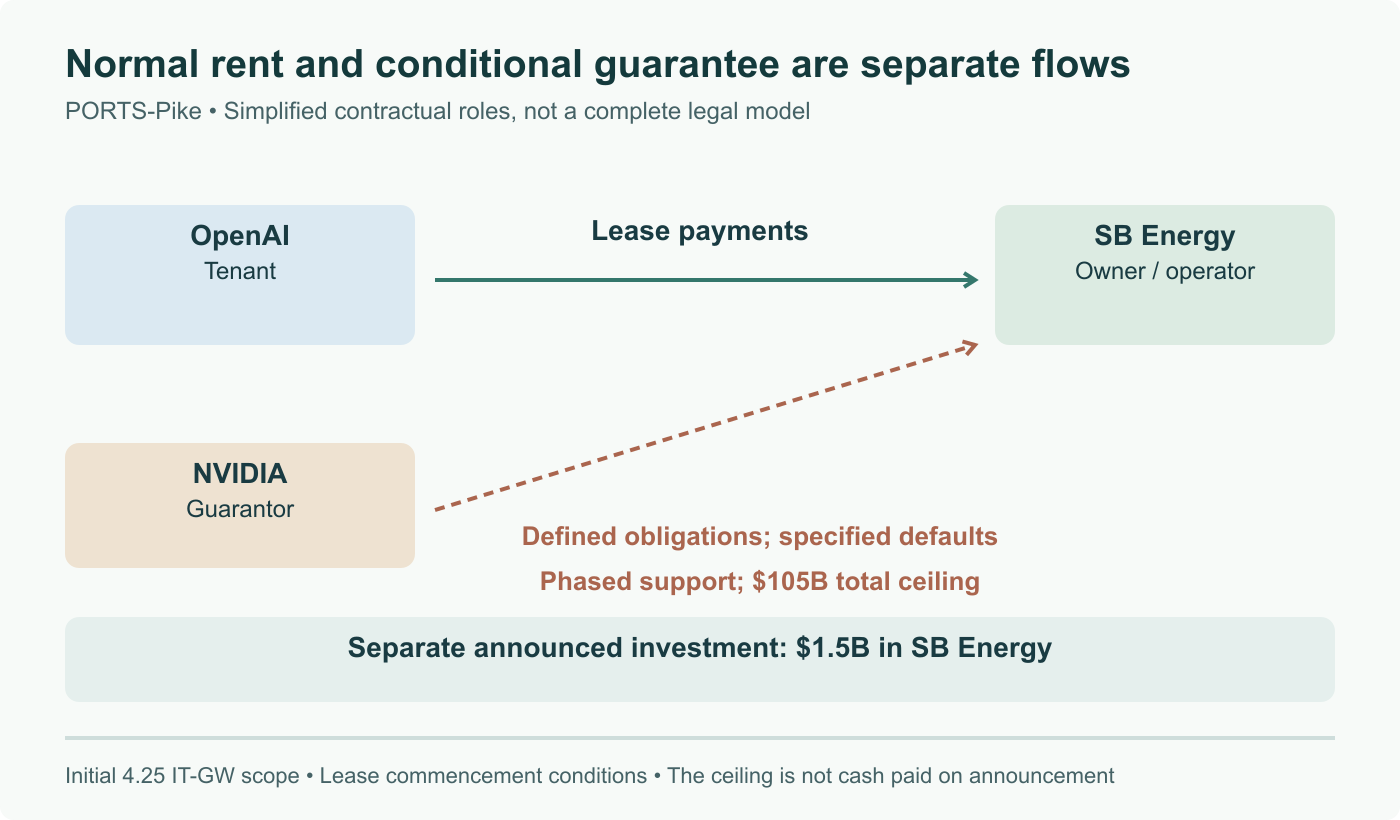
Nvidia published the arrangement in its own newsroom on Monday, August seventeenth, 2026. The company secures land, power and shell capacity at the PORTS-Pike Technology Campus in Pike County, Ohio, through a partnership with SB Energy, the SoftBank backed developer that will build, own and operate the site. OpenAI signs a twenty year lease and becomes the customer. The campus hosts Nvidia compute exclusively.

Two financial commitments sit underneath. Nvidia provides residual value guaranties capped at one hundred five billion dollars, and it invests one and a half billion dollars of equity into SB Energy, joining SoftBank Group and OpenAI on the cap table.

We covered the July reports of a two hundred fifty billion dollar backstop when they first surfaced. The confirmed number is roughly forty percent of that, and it covers a smaller first tranche, which is the ordinary distance between an opening conversation and a signed instrument.

The guarantee is not a cheque

This is the part that gets misread in every headline. A residual value guaranty is a statement about what an asset will be worth at a future date. It is the mechanism that lets a lender finance the land acquisition, the grid interconnect and the building shell at a rate that makes the project viable, because the lender's downside is capped by somebody with a strong balance sheet.

Nvidia has therefore not spent one hundred five billion dollars. It has accepted a contingent liability that only becomes real if the campus is worth considerably less than the model assumes. That is the same family of instrument as the compute collateralised financing programme announced earlier in August, and it points at the same underlying fact: the constraint on AI buildout stopped being demand a while ago, and became the cost of capital for physical infrastructure.

Ten gigawatts in, eight gigawatts of compute out

Here is the sentence in the announcement that repays attention. SB Energy and SoftBank commit to building at least ten gigawatts of new energy generation, which, the release says, results in eight IT-GW of AI factory capacity.

That ratio is the whole discipline of datacenter design expressed as a fraction. Everything between the meter and the accelerator takes a cut: power conversion, uninterruptible supply, switchgear losses, chillers, pumps, air handling, distribution. A ratio of ten to eight means roughly twenty percent overhead, which is a genuinely aggressive design point and only reachable with direct liquid cooling at density.

The practical lesson generalises well below this scale. When a vendor, a colocation provider or an internal capacity plan quotes you a gigawatt or a megawatt figure, the first question is always which side of the conversion it sits on. Generation capacity, facility capacity and IT capacity are three different numbers, and the difference between them is not a rounding error.

Comparison chart of the PORTS-Pike capacity numbers in gigawatts: 10 GW of new generation committed, 8 IT-GW of total planned AI factory capacity, 4.25 IT-GW in the initial guaranteed deployment, and 0.8 GW in the first phase targeted for 2028.
Four numbers, four different meanings. Only the smallest of them has a date attached. PNG

Nothing arrives before 2028

Capacity comes online in phases beginning in 2028, with the first phase reported at eight hundred megawatts. The guaranteed portion covers an initial four and a quarter IT-GW, with an option on the remaining three and three quarter IT-GW.

An option is not a commitment, and a 2028 date sits beyond most capacity plans anyone is writing today. If you are sizing GPU capacity for the next twenty four months, this announcement supplies exactly zero additional supply. What it does supply is a signal about what the people building at this scale believe: they are underwriting power and buildings four years out, at a ratio and a price that only makes sense if they expect the bottleneck in 2028 to still be electricity rather than silicon.

That belief matches what the operators keep saying out loud. Microsoft's own capacity commentary has made the same point for a year now.

The grid and the ratepayers

The site is the former Portsmouth uranium enrichment plant, which is a large brownfield with existing heavy transmission, and that is most of why it was chosen.

SB Energy and SoftBank commit at least four point two billion dollars to new regional grid infrastructure through a partnership with AEP Ohio, described in the announcement as designed to protect ratepayers. That phrase is doing real work. Large loads joining a regional grid typically socialise their transmission upgrade costs across every other customer on the system, and that mechanism has become the main driver of local opposition to datacenter projects across the United States. Whether the structure here actually holds is a question for the Ohio regulators, not for a press release, but the fact that it is addressed in paragraph one tells you how sharp the politics has become.

There is also a community benefits fund: forty million dollars originally from SB Energy, with OpenAI adding an incremental forty million.

Sources and further reading

Frequently asked questions

What did Nvidia actually announce, and how is it different from the July reports?

In late July the Wall Street Journal reported talks around a two hundred fifty billion dollar backstop, later reported as being scaled back. On August seventeenth, 2026 Nvidia published a confirmed arrangement in its own newsroom. The company will provide residual value guaranties capped at one hundred five billion dollars, invest one and a half billion dollars in SB Energy, and take the PORTS-Pike Technology Campus in Pike County, Ohio as an exclusive host for Nvidia compute. SB Energy builds, owns and operates the facility under a twenty year lease to OpenAI. So the correct reading is that a reported negotiation became a signed structure at roughly forty percent of the number first floated.

What is a residual value guaranty, and why does it matter here?

It is a promise about what an asset will be worth later, not a promise to pay for it now. Lenders financing the land, the power connection and the building shell need confidence that the collateral holds value across the debt term. Nvidia stepping in as the party backing that residual value is what makes the debt financeable at reasonable rates. Practically it means Nvidia has not written a hundred billion dollar cheque, it has accepted a contingent liability that only bites if the campus is worth much less than modelled. That is a very different balance sheet event from a purchase, and it is the same instrument pattern we saw in the compute collateral financing announced earlier in August.

Why does 10 GW of generation only produce 8 GW of AI factory capacity?

Because generation capacity and IT capacity are not the same unit, and the gap is everything that sits between the meter and the accelerator. Power conversion losses, uninterruptible supply, cooling plant, pumps, air handling and distribution all consume part of the incoming power before a single GPU draws current. SB Energy and SoftBank commit to at least ten gigawatts of new generation, which the announcement says results in eight IT-GW of AI factory capacity. That is a ratio of about one and a quarter to one, which is an aggressive design target and only achievable with modern liquid cooling. If you size a room by generation capacity rather than IT capacity, you will be wrong by roughly twenty percent.

When does any of this affect capacity that a team can actually rent?

Not this year and not next. Capacity comes online in phases beginning in 2028, with the first phase reported at eight hundred megawatts. The initial deployment is designed for four and a quarter IT-GW, with an option on the remaining three and three quarter IT-GW for eight IT-GW in total. Options are not commitments. For anyone planning GPU capacity in the next twenty four months, the useful conclusion is that this announcement changes nothing about supply you can buy today, and it tells you the industry expects the constraint to still be power in 2028.

What is the local and grid side of the deal?

SB Energy and SoftBank commit at least four point two billion dollars to new regional grid infrastructure through a partnership with AEP Ohio, structured, in the announcement's words, to protect ratepayers. That clause exists because large loads connecting to a regional grid usually shift transmission costs onto everyone else on the system, and that has become the main source of local opposition to datacenter projects. There is also a community benefits fund, originally forty million dollars from SB Energy, with OpenAI adding a further forty million. The site itself is the former Portsmouth uranium enrichment plant, which is why it already has heavy transmission and a large brownfield footprint.