The story of the last three years has been that AI training happens on rented racks of accelerators. This is a report about the exception. The Information's Aaron Tilley reported at the end of August 2026 that OpenAI has quietly bought tens of thousands of Mac minis and Mac Studios over the past several months, entirely separate from the cloud GPU clusters it leases for frontier model training. The workload is not pretraining. It is reinforcement learning on agents that operate computers, and once you know that, the choice of hardware stops looking strange and starts looking obvious.
The short answer
The Information reports that OpenAI has quietly purchased tens of thousands of Mac minis and Mac Studios over recent months, separate from the cloud GPU clusters it leases for large scale model training. The workload is reinforcement learning on computer use agents: models that navigate software interfaces, draft documents and carry out multi step tasks, which needs many independent desktop environments rather than one very large accelerator. Apple's unified memory architecture, where CPU, GPU and neural engine share one pool, suits that loop and undercuts enterprise GPU servers on cost per environment. Anthropic rents Mac mini capacity through AWS for the same kind of work. The buying is blamed for stretched delivery times and for Apple refreshing the Mac mini and Mac Studio on August 25, 2026, ahead of schedule.
We spent most of August writing about gigawatts. Compute leases, data centre sites, multi year accelerator commitments measured in billions. So a report that one of the largest buyers in that market has also been quietly filling rooms with small aluminium desktops is worth stopping on, because it points at a category of AI work that the gigawatt story completely misses.
The workload decides the hardware
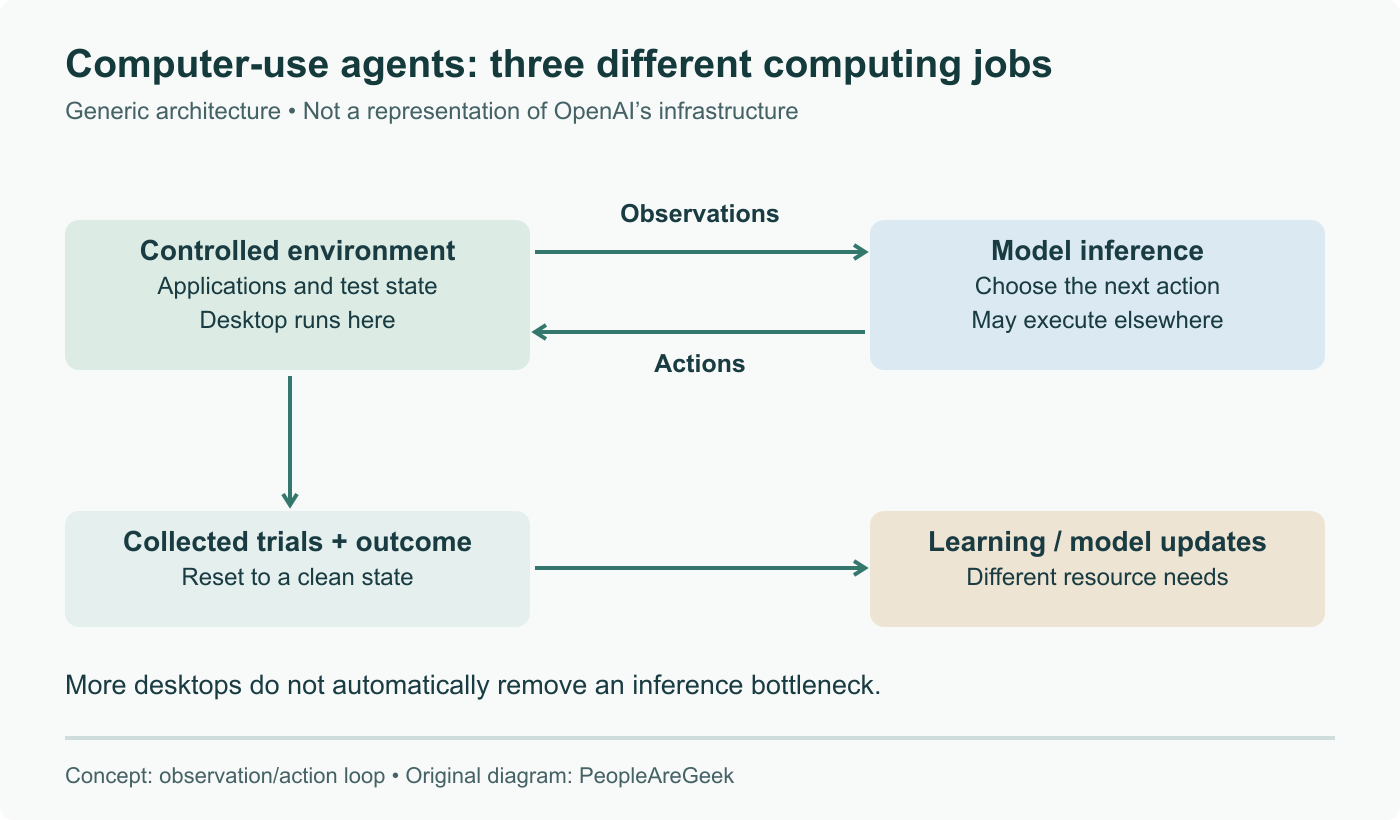
Training a model to operate a computer is not the same problem as training a model to predict text. You need environments. Thousands of them, running at once, each one a real desktop with real applications, where the agent takes an action, something happens, and the outcome gets scored. Then you do it again several million times.
That is a fundamentally different hardware request. Pretraining wants the largest possible pool of interconnected accelerators sharing one enormous job. Reinforcement learning on computer use wants the opposite: a very large number of small, independent, fully self contained computers, each cheap enough that you can have a lot of them and complete enough that software behaves normally inside them.
A Mac mini is close to a perfect unit for that. It is a whole computer, it draws very little power, it stacks densely, and it runs the operating system that a large share of the software an agent might be asked to drive was written for. Carving equivalent isolated environments out of enterprise GPU servers costs considerably more per environment and buys capabilities the workload does not need.
Why Apple silicon specifically
The unified memory architecture is the technical reason usually given, and it is a real one. On Apple silicon the CPU, GPU and neural engine draw from a single shared memory pool instead of shuttling tensors across a bus into dedicated video memory. An agent loop alternates constantly between running ordinary software and running the model that decides the next action. Removing a copy from the middle of that alternation matters more here than it does in a training run that stays inside the accelerator for hours.
The second reason is capacity per box. A high memory desktop can hold a model that would otherwise demand a discrete accelerator, which is the same property that made the M5 Ultra with 512GB of unified memory notable when Apple announced it. The report describes NVIDIA as now viewing Apple as its principal competitor in local AI processing, which is a striking sentence given how the two companies are usually positioned against each other, and it follows directly from cost per environment rather than from raw throughput.
Anthropic rents the same substrate
The detail that makes the report more than an Apple story is that Anthropic reportedly reaches the same conclusion and buys it differently, renting Mac mini capacity through Amazon Web Services rather than owning a fleet.
That is the more conservative position and probably the right one for most organisations. A bought fleet has a useful life tied to how long a generation of Apple silicon stays relevant to the workload, and agent training is moving quickly enough that a two year old assumption about environment count could be badly wrong. Renting trades a worse unit price for the option to stop. When two labs with similar problems and very different appetites for capital both land on desktop Macs as the substrate, the substrate is the signal, not the purchasing model.
The shortage, and what Apple did about it
The buying is reported as a contributing cause of shortages, with delivery times on customised high memory configurations stretching into weeks or months, and as pressure that pushed Apple into refreshing both machines ahead of its usual schedule. Apple updated the lines on August 25, 2026, putting M6 and M5 Pro into the Mac mini and M5 Max and M5 Ultra into the Mac Studio.
That sits on top of a memory squeeze that has been running all year and that had already reached the MacBook Air by early August, as DRAM capacity shifted toward high bandwidth memory for accelerators. Mac revenue grew roughly 29 percent year over year in Apple's most recent quarter, to a little over 10 billion dollars, which is not the growth rate of a mature desktop line serving its usual buyers. The same crunch is visible elsewhere: NVIDIA's newly launched RTX Spark parts are reported to have sold through to distributors before reaching shelves, with ASUS and MSI clearing their first batches immediately.
The part worth taking away
If you build anything that drives a real interface, the useful lesson is that your evaluation and training bottleneck is probably environment count, not floating point throughput, and those two constraints have very different price curves. It is worth measuring how many concurrent environments your work actually needs before assuming the answer is rented accelerator hours. Two of the best funded labs in the industry ran that calculation and both ended up buying desktop computers.
Sources and further reading
- OpenAI reportedly buys tens of thousands of Mac minis for AI training, Cryptobriefing, August 31, 2026
- OpenAI Hoarding Tens Of Thousands Of Apple Mac mini And Mac Studio Devices, Wccftech, August 31, 2026
- OpenAI buys thousands of Macs to train AI agents, NewsBytes, August 2026
- Apple Updates Mini and Studio, AI Computers, OpenAI Jalapeno, Stratechery, August 2026
Frequently asked questions
Why would anyone train on Mac minis instead of GPUs?
Because this workload is not a big matrix multiplication. Training an agent to operate a computer means running an enormous number of real desktop environments in parallel, taking actions inside them, and scoring what happened. Each environment needs its own machine state, its own applications and its own screen. What you want is many independent, cheap, self contained computers, not one very large accelerator. A rack of Mac minis is close to the ideal shape for that, and it is far cheaper per environment than carving the same thing out of enterprise GPU servers.
What does unified memory have to do with it?
On Apple silicon the CPU, GPU and neural engine draw from one shared memory pool rather than copying tensors across a bus into dedicated video memory. For a workload that constantly moves between running ordinary software and running a model that decides what to click next, that removes a copy from the middle of the loop. It also means a single desktop machine can hold a model that would otherwise need a discrete accelerator, which is the same property that made [the M5 Ultra with 512GB of unified memory](/articles/apple-m5-ultra-512gb-unified-memory/) interesting to people running models locally.
Is Anthropic doing the same thing?
A version of it. According to the report, Anthropic rents Mac mini capacity through Amazon Web Services for its own reinforcement learning work rather than buying and racking machines itself. Same substrate, different balance sheet. Renting avoids owning a fleet whose useful life is tied to how long a given generation of Apple silicon stays relevant, and it is the more sensible choice unless your utilisation is high and predictable.
Did this cause the Mac shortages?
It is reported as a contributing cause. Delivery times on customised high memory configurations stretched to weeks or months, and the buying is described as having pushed Apple to refresh both product lines earlier than expected. Apple updated the Mac mini and Mac Studio on August 25, 2026, adding M6 and M5 Pro options to the mini and M5 Max and M5 Ultra to the Studio. That sits on top of the wider memory crunch that had already reached [the MacBook Air](/articles/macbook-air-memory-shortage-dram-crunch/) earlier in the year.
What does this mean for a smaller team?
Mostly that the cost curve for agent evaluation is better than it looks. If you are building anything that drives a real user interface, you need many parallel environments far more than you need one large accelerator, and desktop class machines are a legitimate answer rather than a compromise. Start by measuring how many concurrent environments your evaluation actually needs, then price that against both rented GPU hours and a small number of high memory desktops. The answer surprises people.