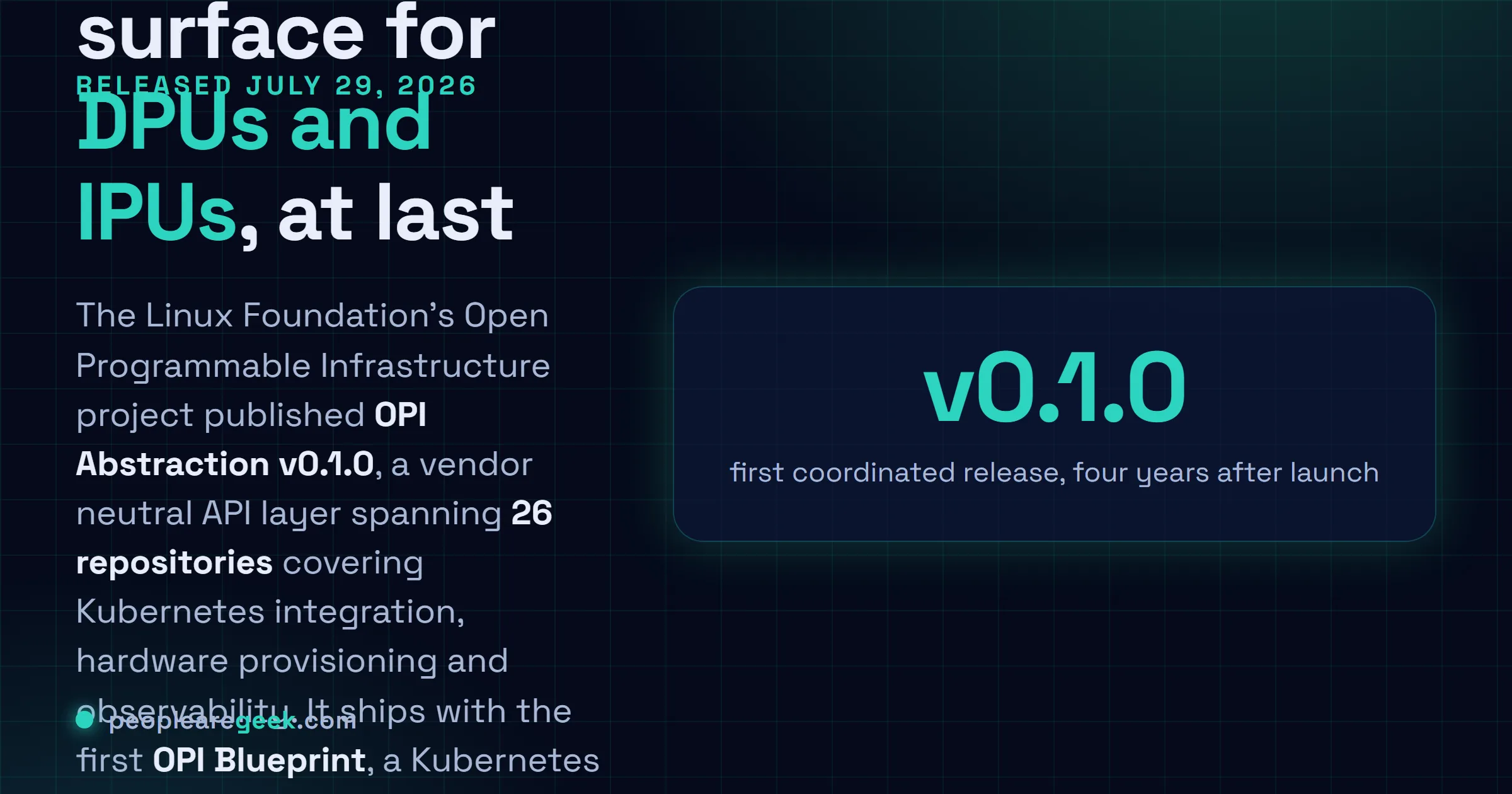
The Linux Foundation's Open Programmable Infrastructure project published OPI Abstraction v0.1.0 on July 29, 2026, its first coordinated release after four years of work. It is a vendor neutral API layer spanning 26 repositories that covers Kubernetes integration, hardware provisioning and observability for data processing units and infrastructure processing units. It also introduces OPI Blueprints, reference deployment patterns, starting with a Kubernetes Network Function Offload Blueprint built with F5 NGINX, Intel and Red Hat. If you have looked at a SmartNIC and stopped at the proprietary SDK, this is the release aimed squarely at that problem.
The short answer
The Open Programmable Infrastructure project, hosted by the Linux Foundation, published OPI Abstraction v0.1.0 on July 29, 2026. It is a vendor neutral, hardware agnostic API layer spanning 26 repositories that covers APIs, bridges, tooling, Kubernetes integration, hardware provisioning and observability for DPUs and IPUs. The release also introduces OPI Blueprints, starting with a Kubernetes Network Function Offload Blueprint developed with F5 NGINX, Intel and Red Hat, using Red Hat OpenShift for orchestration and F5 NGINX as the application delivery controller. A companion white paper on scaling DPU and IPU ecosystems was published on July 20, 2026.
There is a category of hardware that most infrastructure teams have bought, racked, and then quietly used as an ordinary network card. Programmable network cards have been technically impressive and operationally awkward for years, and the reason has never really been the silicon.
The problem this is aimed at
A DPU or IPU is a network card with its own CPU cores, its own memory and its own operating system. It runs infrastructure work that would otherwise consume host cycles: virtual switching, overlay encapsulation, storage protocol termination, traffic policy enforcement. On a host packed with expensive accelerators, every core you hand back to the workload is a core you did not buy twice.
The obstacle has always been the software. Each vendor exposes those capabilities through its own SDK, its own toolchain, its own provisioning model, its own telemetry. Writing an orchestration layer against two vendors means writing it twice, and writing it against a third means a third time. Multiply that by a hardware refresh cycle and the rational decision for most teams has been to not build on it at all.
That is the fragmentation the Linux Foundation says this release targets: proprietary SDKs, toolchains, APIs and operational models, each a separate wall.
What v0.1.0 contains

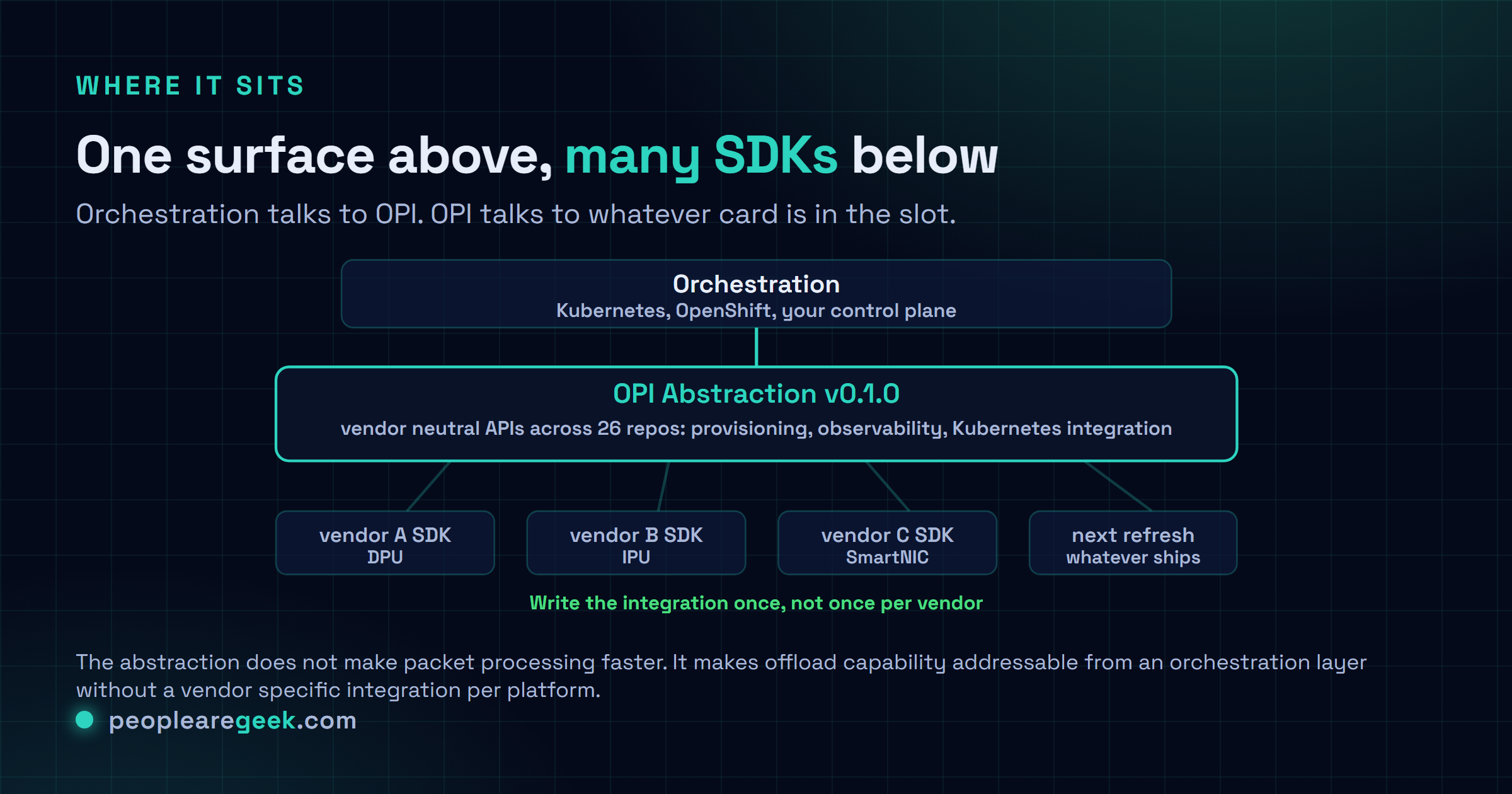
The release is a vendor neutral, hardware agnostic API layer distributed across 26 repositories. Those repositories cover the API definitions themselves, bridges to existing interfaces, tooling, Kubernetes integrations, hardware provisioning and observability.
Provisioning and observability are worth calling out specifically, because they are the parts people underestimate. Getting a DPU to accelerate a packet path is the demo. Getting a fleet of them imaged, configured, monitored and consistently upgraded across a hardware refresh is the actual job, and it is where vendor divergence hurts most.
The second piece is OPI Blueprints, which are not more API surface but reference deployment patterns. The first is the Kubernetes Network Function Offload Blueprint, developed with F5 NGINX, Intel and Red Hat, using Red Hat OpenShift for orchestration and F5 NGINX as the application delivery controller. Keysight Technologies is also named among contributors.
A blueprint beats documentation for a specific reason: it is opinionated and tested end to end. It names components, versions and wiring, so a first deployment is a reproduction rather than an integration project. Joel Moses, CTO for systems and platforms at F5, described reusable and extendable patterns as the groundwork enterprises build resilient architectures on, which is marketing language wrapped around a real point.
There is also a white paper, published July 20, 2026, titled Accelerating the AI Era: The Critical Role of Open Programmable Infrastructure in Scaling DPU and IPU Ecosystems.
Read the version number carefully
This is v0.1.0, and treating it as anything else would be a mistake.
A first coordinated release means the API shapes are agreed and published, not frozen. Breaking changes should be expected. What it genuinely establishes is a shared vocabulary and one working reference deployment, which is what a fragmented ecosystem needs before anything can stabilise.
The sensible posture for most teams is a lab evaluation against hardware already in the building, not a migration plan. Take a DPU you own, run the blueprint, and find out how much of your vendor's capability actually surfaces through the neutral API. That answer, per vendor, is the thing worth knowing, and it is not in any press release.
Note the timeline too. OPI was announced in 2022, which makes this first coordinated release roughly four years of work. Standards bodies move at this pace, and there is no version of this that arrives faster. Arpit Joshipura of the Linux Foundation attributes the urgency to AI driving a fundamental shift in how organisations think about the infrastructure layer, and Simon Horman of Red Hat, who chairs the technical steering committee, frames infrastructure layer standardisation as essential for cloud native environments.
Why AI clusters change the calculus
DPUs have been a nice to have in general purpose fleets. In AI infrastructure they are closer to necessary, for two reasons.
The first is host CPU contention. When a node carries several accelerators worth more than the rest of the server combined, spending host cores on packet processing is a direct tax on the expensive part. Offloading is not an optimisation, it is capacity recovery.
The second is east west traffic. Training and inference fabrics move enormous volumes of traffic between nodes, and the network functions handling that traffic sit directly in the path of job completion time. This is the same pressure driving interconnect bandwidth and optics moving inside the package: the network stopped being a service around the compute and became part of the compute.
An abstraction layer does not make any of that faster. What it does is make the capability addressable from an orchestration layer without a vendor specific integration per platform, which is the difference between hardware you can plan around and hardware you can only demo.
What to do about it
If you run Kubernetes on nodes with programmable NICs, the blueprint is the concrete artefact worth an afternoon. Reproduce it, measure it, and see what it does to host CPU utilisation on a node under real load.
If you are specifying hardware for a build landing in 2027, add a question to the vendor list: what is your OPI coverage, which repositories do you implement, and what is your commitment as the API stabilises. The answers will vary widely right now, and the variance itself is informative.
If you evaluated DPUs a couple of years ago and shelved them because the software was not there, this is a reasonable prompt to look again. Not because the problem is solved, but because for the first time there is a common surface to evaluate against, and the Kubernetes ecosystem it plugs into has matured considerably in the meantime.
Sources and further reading
- Linux Foundation press release: OPI announces first coordinated release, Abstraction
- Open Programmable Infrastructure project site
- Phoronix: OPI Abstraction v0.1 published with aiming to standardize DPU/IPU ecosystems
- PR Newswire release for OPI Abstraction
- Linux Foundation: the original OPI project announcement
Frequently asked questions
What is a DPU or IPU, and why does it need a standard?
A data processing unit or infrastructure processing unit is a programmable network card with its own CPU cores, memory and operating system, sitting between the host and the network. It runs the work that used to consume host cycles: virtual switching, encapsulation, storage protocol termination, traffic policy. The reason it needs a standard is that every vendor exposes those capabilities through its own SDK, its own toolchain, its own provisioning model and its own telemetry format. Writing an orchestration layer that works across two vendors currently means writing it twice, which is precisely why a great deal of purchased DPU capability sits unused in racks today.
What is actually in OPI Abstraction v0.1.0?
A vendor neutral, hardware agnostic API layer distributed across 26 repositories. Those repositories cover the APIs themselves plus bridges to existing interfaces, tooling, Kubernetes integrations, hardware provisioning and observability. The release also introduces the concept of OPI Blueprints, which are reference deployment patterns rather than more API surface. The first of them is the Kubernetes Network Function Offload Blueprint. Alongside the code, OPI published a white paper on July 20, 2026 titled Accelerating the AI Era: The Critical Role of Open Programmable Infrastructure in Scaling DPU and IPU Ecosystems.
What does the Kubernetes Network Function Offload Blueprint do?
It is a production grade deployment pattern showing how to move a network function off host CPUs and onto a DPU inside a Kubernetes environment. It was developed jointly by F5 NGINX, Intel and Red Hat, using Red Hat OpenShift for orchestration and F5 NGINX as the application delivery controller, with Keysight also contributing to the project. The value of a blueprint over documentation is that it is opinionated and tested end to end: it names the components, the versions and the wiring, so the first deployment is a reproduction rather than an integration project. Joel Moses, CTO for systems and platforms at F5, framed reusable and extendable patterns as the groundwork enterprises build resilient architectures on.
Does a v0.1.0 mean it is ready for production?
No, and the version number is the honest signal here. A 0.1.0 is a first coordinated release, which in practice means the API shapes are now agreed and published rather than frozen. Expect breaking changes. What v0.1.0 genuinely establishes is a common vocabulary and a working reference deployment, which is what a fragmented ecosystem needs before anything can stabilise. The right posture for most teams is a lab evaluation against hardware you already own, not a migration plan. The blueprint is the part with immediate practical value, because it works today regardless of how the APIs evolve.
Who is behind OPI and how long has it existed?
OPI is hosted by the Linux Foundation and was announced in 2022 to drive open standards for programmable infrastructure, which makes this first coordinated release roughly four years in the making. Contributors named around this release include F5 NGINX, Intel, Red Hat and Keysight Technologies. Arpit Joshipura, general manager and senior vice president for networking, edge and IoT at the Linux Foundation, described AI as driving a fundamental shift in how organisations think about the infrastructure layer. Simon Horman of Red Hat, who chairs the technical steering committee, framed standardisation at the infrastructure layer as essential for the future of cloud native environments.