SysadminNews

Podman 6.1 Adds Volume Rename and Fixes a Quadlet Race

On this page
  1. The new commands
  2. The Quadlet fix is the real reason to upgrade
  3. Networking, rootless, and the source IP
  4. Should you upgrade
  5. Sources and further reading

Podman 6.1 was released on August 13, 2026, and it is the tidy up release that Podman 6.0 needed. The headline additions are small and welcome: podman volume rename, podman machine restart, an --ignore flag on network rm, and retry options on manifest push. The item worth upgrading for is buried in the Quadlet section, where a race condition that could corrupt generated systemd units has been fixed. If you moved container units into Quadlet during the 6.0 cycle, that is the change that matters, and the new ImageVolume key gives you explicit control over volumes an image declares on its own.

The short answer

Podman 6.1 arrived on August 13, 2026 with podman volume rename, podman machine restart, an --ignore flag on podman network rm, and --retry with --retry-delay on manifest push. Quadlet gains an ImageVolume= key for .container units and loses a race condition that could corrupt generated systemd units. Rootless port forwarding through Pesto now handles IPv6 with the source IP preserved, and podman generate kube converts healthchecks into livenessProbe definitions.

6.1released on August 13, 2026
4new commands and flags across volume, machine, network
1race condition fixed in Quadlet unit generation
Answer card describing the Podman 6.1 release of August 13, 2026, adding podman volume rename, podman machine restart, a network rm --ignore flag, manifest push retry options, a Quadlet ImageVolume key and a fix for a race condition that could corrupt generated systemd units.
The release in one card. Source: the Podman 6.1 release notes, August 13, 2026. PNG

Point releases are where a project admits which parts of the last big release were uncomfortable to live with. Podman 6.1 is unusually honest about it.

The new commands

Four additions, all of them the kind of thing you notice by their absence rather than their presence.

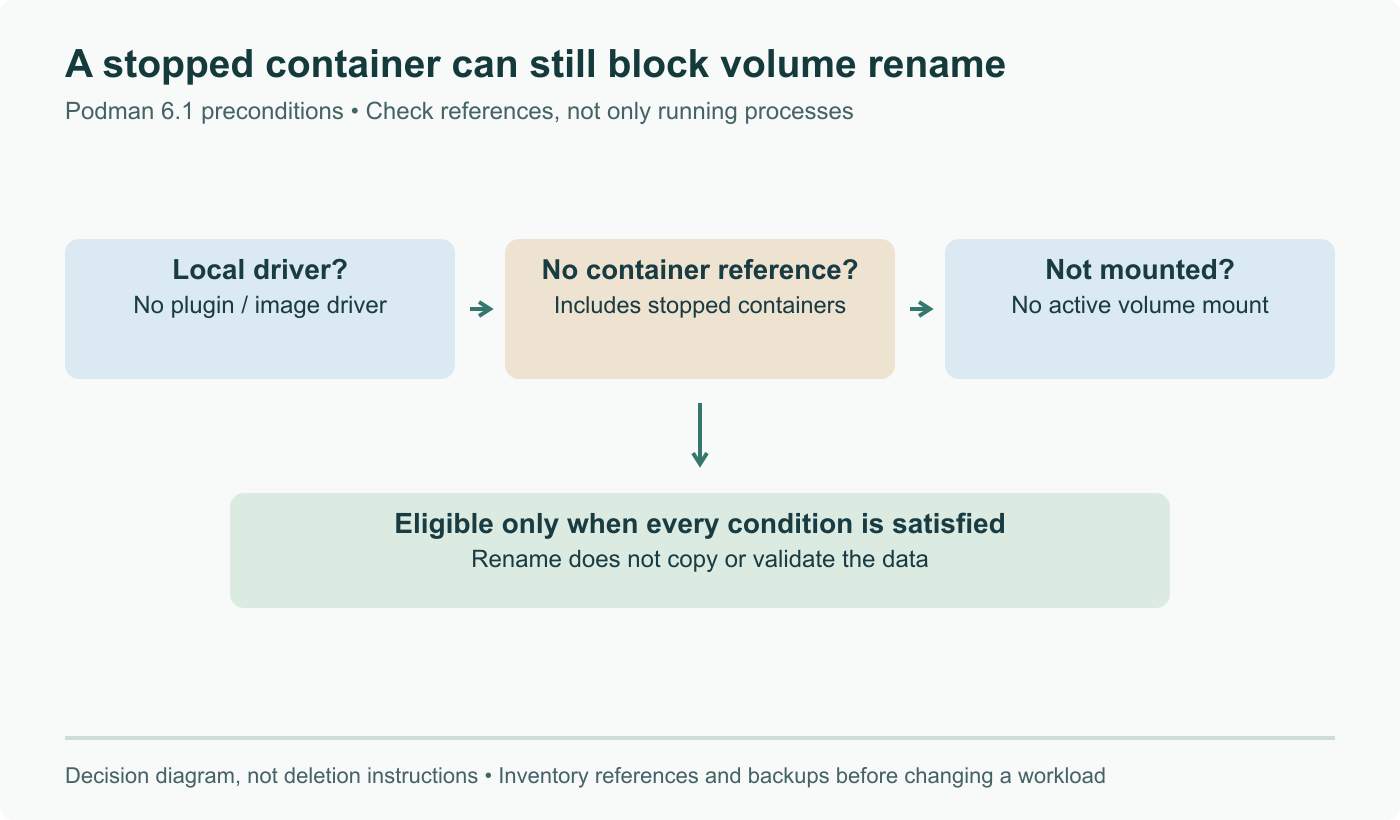
podman volume rename renames an existing volume in place, without the create, copy, delete dance that the task used to require. There are two conditions attached. A volume currently in use by a container cannot be renamed, and neither can a volume created through a volume driver. Both restrictions make sense once you remember that a volume name is a live reference held in container configuration, or in an external driver's own store, rather than a cosmetic label. Refusing is better than leaving a mount pointing at nothing.

podman machine restart restarts a managed virtual machine in one step. podman network rm --ignore suppresses the error when the target network is already gone, which is exactly what teardown scripts and idempotent automation need. And podman manifest push gains --retry and --retry-delay, moving a common registry failure from your shell loop into the tool.

Terminal figure showing the new Podman 6.1 commands: podman volume rename, podman machine restart, podman network rm with the ignore flag and podman manifest push with retry and retry delay options.
The new surface area, as shipped in 6.1. PNG

The Quadlet fix is the real reason to upgrade

Quadlet turns declarative unit files into generated systemd units, and in 6.1 a race condition in that generation, one that could corrupt the units it produced, has been fixed.

Corrupted generated units are a nasty class of failure because the corruption and the symptom are separated in time. Generation happens when you write or reload; the consequence appears at boot, or after the next daemon reload, when a service that should have come up simply did not. Anything that makes that gap smaller is worth taking, and the same release also fixes template unit handling and installation behaviour, and routes Quadlet errors to standard error rather than only into the kernel buffer. That last one sounds trivial and is not: an error you can see in the place you are already looking gets fixed on the same day it happens.

The new ImageVolume= key in .container units is the functional addition here. Images can declare their own volumes, and until now the handling of those declarations was implicit, which is a poor property for a file whose entire purpose is to make container configuration explicit and reviewable. Now the behaviour is stated in the unit.

Networking, rootless, and the source IP

Pesto rootless port forwarding now supports IPv6 with the original source IP preserved.

That second half is the important half. A forwarder that rewrites the source address turns every remote client into localhost by the time your application sees it, which quietly breaks access logs, per client rate limiting and any allow list that works on addresses. Teams usually discover this after shipping, when the logs are useless and nobody can explain why. Preserving the source keeps rootless deployments honest, and rootless is the default posture for most people running Podman on a shared host.

On Windows, a new force_port_listen option in containers.conf addresses port forwarding under WSL. And podman info now reports free host memory alongside its existing fields, which is the sort of thing that stops a monitoring script from having to shell out somewhere else. For teams tracking the wider systemd direction, this release sits alongside changes like Fedora CoreOS enabling systemd-oomd and zRAM swap by default: the container layer and the init layer keep converging.

Should you upgrade

If you are on 6.0, yes, and without much ceremony. This is a point release of fixes and additive changes, with the Quadlet corruption fix carrying most of the value.

If you are still on the 5.x series, the calculus is different, and the thing to read is not these release notes. Podman 6.0 was the release that broke things, removing a large amount of legacy networking, so treat 6.1 as the version you land on rather than the version you are upgrading to, and plan the jump against the 6.0 notes. In both cases the pre flight check is the same: confirm your Quadlet units regenerate cleanly, confirm healthchecks still fire as expected, and if you export to Kubernetes, take advantage of podman generate kube now emitting livenessProbe definitions from those healthchecks instead of dropping them on the way out.

Sources and further reading

Frequently asked questions

What is actually new in Podman 6.1?

A short list of ergonomic additions, released on August 13, 2026. The podman volume rename command renames an existing volume without recreating it. The podman machine restart command restarts a managed virtual machine without a separate stop and start. The podman network rm command gains an --ignore flag that suppresses the error when the network does not exist. The podman manifest push command gains --retry and --retry-delay for automatic retries on failed pushes. On the Quadlet side, .container units support a new ImageVolume= key that controls how volumes declared by the image itself are handled.

Which change justifies upgrading?

The Quadlet race condition fix. Quadlet generates systemd unit files from your .container and related definitions, and a race in that generation could corrupt the units it produced. Corrupted units are a bad failure mode because the damage appears at generation time and is discovered later, typically at boot or after a daemon reload, when the service that should have started did not. Alongside it, template unit handling and installation behaviour were fixed, and Quadlet now reports errors to standard error rather than only into the kernel buffer, which makes failures visible where you are already looking.

Why does volume rename come with conditions?

Because a volume name is a live reference, not just a label. Podman 6.1 refuses to rename a volume that is currently in use by a container, since containers hold the name in their configuration and renaming underneath them would leave a dangling reference. Volumes created through a volume driver also cannot be renamed, because the authoritative name lives in the external driver rather than in Podman's own store. Both restrictions are the safe choice: the command declines instead of leaving you with a mount that resolves to nothing.

What changed in networking?

Pesto rootless port forwarding now supports IPv6 while preserving the original source IP, which matters for any rootless service that logs, filters or rate limits by client address, since a forwarder that rewrites the source turns every client into localhost in your logs. A new force_port_listen option in containers.conf addresses port forwarding on Windows under WSL. The podman network rm --ignore flag is small but useful in teardown scripts, where removing a network that a previous run already removed should not fail the script.

Is this a safe upgrade from Podman 6.0?

For 6.0 users it is a point release with fixes rather than breakage, and the changes above are additive. The upgrade to plan carefully is the one from the 5.x series, because the breaking changes arrived in 6.0, which removed a large amount of legacy networking. If you are still on 5.x, read the 6.0 notes first and treat 6.1 as the version you land on rather than the version you are upgrading to. Either way, check your Quadlet units regenerate cleanly and that healthchecks still behave before rolling it across a fleet.

Anything useful for Kubernetes workflows?

Yes, podman generate kube now translates container healthchecks into Kubernetes livenessProbe definitions. That closes a gap that used to require hand editing: previously the health configuration lived in your container definition and silently disappeared when you exported the manifest, so the workload you tested locally and the one you applied to the cluster differed in exactly the place that determines whether a broken pod gets restarted. Also small but practical, podman info now reports free host memory alongside its existing metrics.