DevNews

Qwen3.8-27B Ships Open Weights Under Apache 2.0

On this page
  1. What shipped
  2. The numbers, and where they come from
  3. Getting it running
  4. What we would do this week
  5. Sources and further reading

Alibaba published Qwen3.8-27B on August 14, 2026, and the weights are on Hugging Face and ModelScope under Apache 2.0. This is the small companion promised when Qwen3.8-Max launched on August 3, and it is a dense model rather than a mixture of experts, which makes it the one you can actually host yourself. It handles text, images and video natively, carries 262,144 tokens of context out of the box and stretches to a million with YaRN. Alibaba reports it beating its own Qwen3.7-Plus on coding and office work. For anyone running models on their own hardware, this is the week's release that matters.

The short answer

Alibaba released Qwen3.8-27B on August 14, 2026 on Hugging Face and ModelScope under Apache 2.0, alongside open weights for the 2.4 trillion parameter Qwen3.8-2.4T-A95B. The 27B is a dense, natively multimodal model handling text, images and video, with 262,144 tokens of native context. Alibaba reports it ahead of its own larger Qwen3.7-Plus on coding and office benchmarks, and ahead of Meta's Muse Glimmer-30B on Terminal Bench 2.1 at 73.0 against 51.7. Official recipes exist for SGLang, vLLM and TokenSpeed, plus an FP8 checkpoint.

27Bdense parameters, all active on every token
262,144tokens of native context, 1M with YaRN
Apache 2.0no user thresholds, no field of use clauses
Answer card describing the Qwen3.8-27B release of August 14, 2026, a 27 billion parameter dense multimodal model published under Apache 2.0 with 262,144 tokens of native context, extensible to one million with YaRN.
The release in one card. Sources: the Qwen team's announcement of August 14, 2026 and the Hugging Face model card. PNG

Twelve days ago Alibaba shipped a 2.4 trillion parameter flagship and promised a small companion would follow. The companion is here, and for most of us it is the more interesting half of the pair.

What shipped

On August 14, 2026, the Qwen team published Qwen3.8-27B on Hugging Face and ModelScope under the Apache 2.0 licence, together with the open weights for Qwen3.8-2.4T-A95B, the Max tier mixture of experts we covered when it launched on August 3.

The 27B is a dense causal language model with a vision encoder built in, so text, images and video go through the same checkpoint. The model card lists 64 layers and a hidden dimension of 5,120, with blocks alternating Gated DeltaNet and Gated Attention, trained using multi-token prediction. Native context is 262,144 tokens, and RoPE scaling with YaRN takes it to roughly one million.

The Qwen team's own announcement, August 14, 2026.

Dense is the word doing the work. A mixture of experts with 2.4 trillion total parameters is a fascinating object and a hosting problem. A 27B dense model is a thing you put on a machine you already own.

The numbers, and where they come from

Every figure below is Alibaba's own evaluation, reported by others and not independently re-run. Read them as a claim, not a measurement.

Against Meta's Muse Glimmer-30B, the model Alibaba clearly picked as its size class rival, the reported gap is widest on agentic terminal work: Terminal Bench 2.1 at 73.0 against 51.7. GPQA Diamond comes in at 89.2 against 83.5 and IFBench at 79.5 against 77.0.

Comparison chart of Alibaba reported benchmark scores for Qwen3.8-27B against Meta Muse Glimmer-30B: Terminal Bench 2.1 at 73.0 versus 51.7, GPQA Diamond at 89.2 versus 83.5, and IFBench at 79.5 versus 77.0.
Alibaba's reported scores for Qwen3.8-27B against Muse Glimmer-30B. Vendor published figures, not independent testing. PNG

The comparison Alibaba seems proudest of is internal. Against Qwen3.7-Plus, a larger model from its own previous generation, the 27B reports SWE-bench Pro at 61.7 against 57.6 and QwenSWEBench at 79.0 against 59.2. Agents' Last Exam at pass@1 moves from 13.2 to 20.4. A smaller model beating the previous larger one is the pattern that has defined this year, and it is the reason a 27B release is worth reading at all.

Getting it running

Official deployment recipes ship for SGLang, vLLM and TokenSpeed, which covers most serving setups people actually run. Alibaba also publishes Qwen3.8-27B-FP8, a quantised checkpoint that halves the memory of the bf16 weights without a separate conversion step on your side.

Below that, the community moved fast: hundreds of quantised conversions are already on Hugging Face for llama.cpp, LM Studio, Jan and Ollama. Alibaba does not publish a VRAM requirements table, so anyone quoting you a precise figure is estimating. The useful approach is the empirical one: pick the largest quantisation your card holds, run your own evaluation set, and drop a level only if it fits and holds up.

One control worth knowing about before you wire it into anything: the model exposes a reasoning_effort parameter, so thinking depth is adjustable per request rather than fixed at deployment. If you have ever paid for a long chain of thought on a request that needed a one line answer, that dial is the feature to instrument first.

What we would do this week

Download it and re-run your own evaluation set, because the licence makes that cheap and the published numbers make it necessary. If you already serve a 30B class model, this is a straight A against B on your own traffic with no procurement conversation attached.

If you are running a text model next to a separate document or vision pipeline, test whether one endpoint replaces two. That consolidation is worth more operationally than a couple of benchmark points.

And check the context economics before enabling the million token mode. Native 262,144 is generous, YaRN extension is a quality tradeoff rather than a free upgrade, and most workloads that reach for a million tokens want retrieval instead.

Sources and further reading

Frequently asked questions

What exactly is Qwen3.8-27B?

It is a 27 billion parameter dense causal language model with a built in vision encoder, published by Alibaba's Qwen team on August 14, 2026 under the Apache 2.0 licence. Dense matters here: unlike the 2.4 trillion parameter Qwen3.8-2.4T-A95B released alongside it, every parameter is active on every token, so the memory footprint is predictable and a single machine can hold it. The model card describes 64 layers with a hidden dimension of 5,120, built from blocks that alternate Gated DeltaNet and Gated Attention, and trained with multi-token prediction. Native context is 262,144 tokens, extensible to roughly one million with RoPE scaling methods such as YaRN.

What does Apache 2.0 change compared with other open weight licences?

Apache 2.0 is a permissive licence with an explicit patent grant and no field of use restrictions, no user count thresholds and no acceptable use annex bolted on. You can run it commercially, fine tune it, redistribute the derivative and ship it inside a product without asking anyone. Several widely used open weight releases carry custom licences that look permissive until you reach the clause about monthly active users or the clause reserving certain deployments. This one does not have those clauses, which is the difference between a model your legal team approves in an afternoon and one that sits in review for a month.

What hardware do we need to run it?

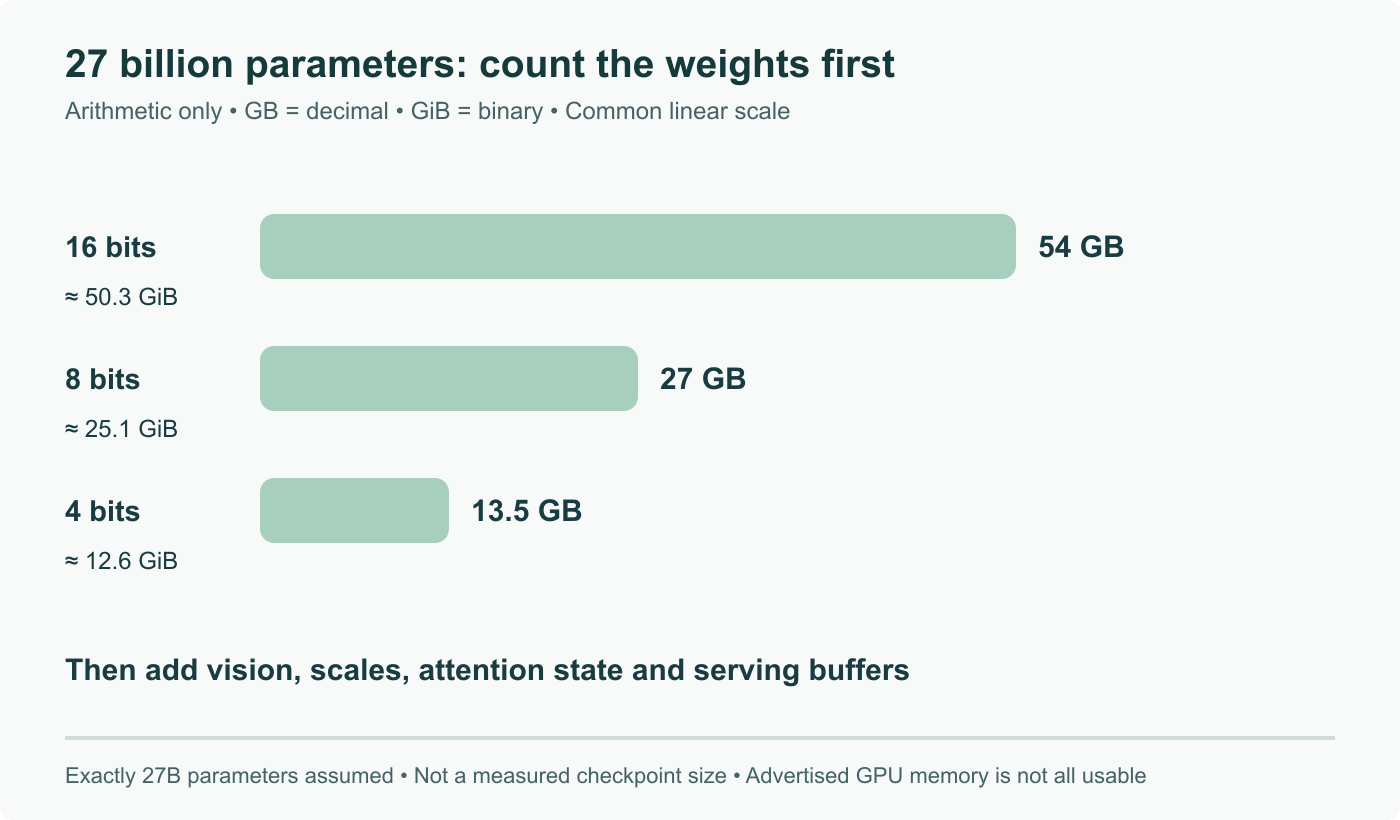
Alibaba does not publish a VRAM table, so treat any single number as an estimate rather than a specification. What the ecosystem does tell you is the shape of the options. Official deployment recipes exist for SGLang, vLLM and TokenSpeed, an FP8 checkpoint is published as Qwen3.8-27B-FP8, and the community has already produced hundreds of quantised conversions that load in llama.cpp, LM Studio, Jan and Ollama. A 27B dense model in FP8 is in the range a single high memory accelerator handles, and heavier quantisation brings it down to enthusiast hardware at some quality cost. The honest advice is to test your own quantisation on your own prompts before committing.

Are the benchmark numbers independent?

No, and that matters. Every figure in this article comes from Alibaba's own published evaluations, reported by third party outlets but not re-run by them. Alibaba reports Terminal Bench 2.1 at 73.0 against 51.7 for Meta's Muse Glimmer-30B, GPQA Diamond at 89.2 against 83.5, and IFBench at 79.5 against 77.0. Against its own larger Qwen3.7-Plus it reports SWE-bench Pro at 61.7 against 57.6 and QwenSWEBench at 79.0 against 59.2. Self reported numbers are directionally useful and routinely optimistic. The saving grace with an Apache 2.0 release is that you can download it and check, which is exactly what we would do before believing any of it.

Does the vision encoder cost anything if we only use text?

It costs memory, because the encoder ships inside the same checkpoint and is loaded with it, and it costs nothing in throughput on text only requests since the vision path is simply not exercised. The practical consideration is different: a natively multimodal model means one deployment instead of two. Teams currently running a text model next to a separate document or screenshot pipeline can collapse that into a single endpoint that reads diagrams, scanned documents and video frames. Whether the quality on your specific document type is good enough is an empirical question, but the architecture removes the excuse for running two stacks.