SysadminNews

ReactOS 0.4.16 Ships a Graphical Installer and Server Core

On this page
  1. The installer is the release
  2. What changed underneath
  3. The Wine jump is the compatibility story
  4. Where it sits
  5. Sources and further reading

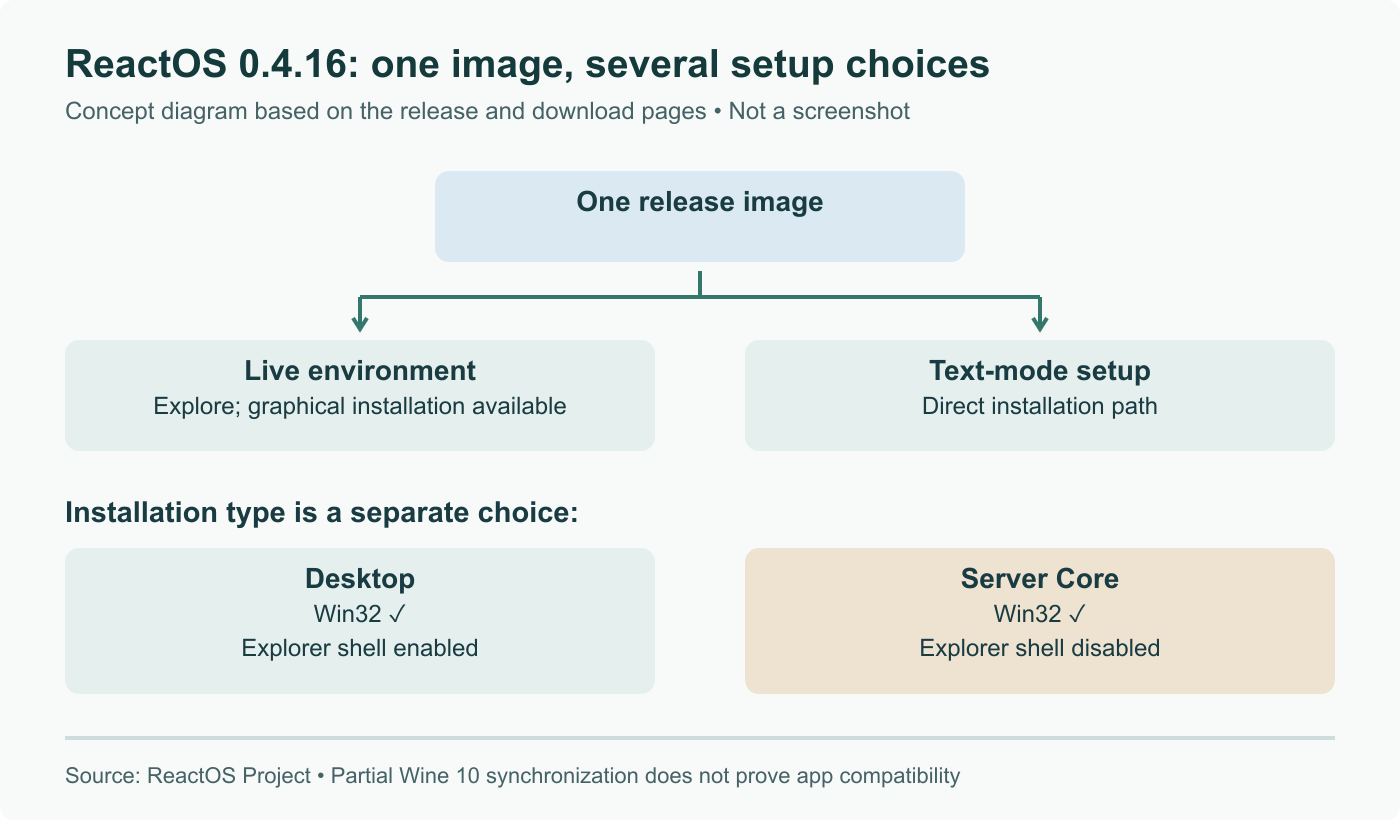
ReactOS 0.4.16 was released on Saturday August 29, 2026, roughly eighteen months after 0.4.15, and it closes 381 tracked issues across 2,808 commits. Two changes stand out for anyone who actually installs the thing. There is now a graphical installer, carried on a single image that boots as both a live environment and an installer, so you can try ReactOS and then commit to it without swapping discs. And there is a Server Core install type that disables the graphical shell while keeping the full Win32 subsystem underneath. Underneath those, the storage stack got a new ATA driver, the audio bus driver was replaced, and the Wine fork jumped from the 2.x era to Wine 10.0.

The short answer

ReactOS 0.4.16 landed on Saturday August 29, 2026, about eighteen months after the previous release. The headline items are a graphical installer riding on a combined live and boot image, and a Server Core install type that drops the Explorer shell while keeping the full Win32 subsystem. Below that, a new ATA driver replaces UniATA and unlocks Hyper-V Generation 1, the HD audio bus driver was replaced with sklhdaudbus, and the Wine fork jumped to Wine 10.0 with WineVDM restoring 16-bit application support. It remains alpha software.

2,808commits since 0.4.15, closing 381 tracked issues
Wine 10.0the fork rebased, up from the 2.x and 3.x era
2009the year the oldest issue fixed in this release was filed
Answer card summarising the ReactOS 0.4.16 release: a graphical installer on a combined live and boot image, a Server Core install type, a new ATA driver replacing UniATA, and the Wine fork rebased onto Wine 10.0, with 2,808 commits closing 381 issues.
ReactOS 0.4.16, the release in one card. PNG

Eighteen months between releases is a long time for a project that lives on the enthusiasm of volunteers. The list of what arrived makes the wait legible: one of the fixed issues was filed on February 3, 2009.

The installer is the release

ReactOS has always had a text mode installer inherited from the Windows setup it reimplements, and it has always been the first thing a curious person met and the first thing that made them close the virtual machine. Hermès Bélusca-Maïto replaced it with a graphical installer, and put it on a combined boot CD and live CD.

That second half is the part worth dwelling on. Until now, evaluating ReactOS meant choosing between a live image to look around in and a boot image to install from. One image that does both means the flow is: boot, poke at it, decide, install, without going back to the download page. Every mainstream distribution settled on that pattern long ago, and the reason is not aesthetics. It removes the moment where a curious person gives up.

Carl Bialorucki's Server Core install type is the complementary move at the other end. It turns off the graphical Explorer shell but keeps the full Win32 subsystem loaded, the same shape Windows Server 2008 Core took. For a virtual machine you want small, or a target for a service that never needed a desktop, that is a real option rather than a marketing bullet.

What changed underneath

The driver work is where the eighteen months went.

Storage got the largest single change: Dmitry Borisov's new ATA driver replaces the legacy UniATA stack. Boot times improve, and more usefully, Hyper-V Generation 1 virtual machines now work, which makes ReactOS practical to test on a Windows host without fighting the emulated controller. Doug Lyons restored FAT chkdsk functionality and Mark Jansen added disk cleanup utilities.

Graphics saw a fix that reads like a good bug hunt. Justin Miller traced severe Nvidia GPU slowdowns to the number of system page table entries the memory manager allocated, and raised it. AMD problems were handled through rewrites of ExtEscape. Infrastructure for multi-monitor support landed too, though the feature itself is not finished.

Audio was rebuilt rather than patched. Oleg Dubinskiy threw out the incomplete HD audio bus driver in favour of sklhdaudbus, added Kernel Mode Driver Framework support, and fixed the volume and balance controls in Sound Properties and the Audio Volume Mixer. Networking picked up a DC21X4 adapter driver, which is what gets you connectivity under Virtual PC 2007 and Hyper-V, plus asynchronous connection support.

Checklist card listing the ReactOS 0.4.16 changes: a graphical installer on a combined boot and live image, a Server Core install type keeping the full Win32 subsystem, a new ATA driver replacing UniATA with Hyper-V Generation 1 support, sklhdaudbus replacing the HD audio bus driver with KMDF support, Nvidia slowdowns fixed by raising system page table entries, a DC21X4 network adapter driver, and the Wine fork rebased from the 2.x era onto Wine 10.0 with WineVDM.
The 0.4.16 change list, condensed. PNG

The Wine jump is the compatibility story

ReactOS carries a fork of Wine for the parts of the Win32 surface the two projects share, and that fork had been sitting on Wine 2.x and 3.x code for years. In 0.4.16 it moves to Wine 10.0.

Skipping seven major versions in one release is not a routine dependency bump. It pulls in years of application compatibility work at once, and it is the reason to retest anything you previously found broken. WineVDM is included as well, which restores 16-bit application support, and that is precisely the audience ReactOS keeps: people with an old application and no supported operating system left to run it on.

Where it sits

ReactOS remains alpha software and nothing in this release changes that. What changed is the friction. The last time the project made news here it was for merging job objects support after a pull request sat open for years, which is the kind of progress that only means something to people already following along. A graphical installer, a single try-then-install image, a Server Core mode and a modern Wine base are different: they are the changes that make it worth an evening from someone who has never run it.

Images are available from the project download page. If you tried ReactOS years ago and put it down, this is the release that justifies picking it back up in a virtual machine.

Sources and further reading

Frequently asked questions

Is ReactOS 0.4.16 usable as a daily driver yet?

No, and the project has never claimed otherwise. ReactOS remains alpha software, and the version number is a fair signal of that. What 0.4.16 changes is the experience of evaluating it. A graphical installer on a combined live and boot image means you can boot the media, look around, and install from the same session, which is the workflow every Linux distribution normalised twenty years ago. Treat this as a release that makes testing pleasant rather than one that makes production viable. Run it in a virtual machine, on hardware you do not depend on, or against legacy applications you are trying to keep alive.

What does the Server Core install type actually do?

It disables the graphical Explorer shell while still loading the full Win32 subsystem, which mirrors what Windows Server 2008 Core did. That distinction matters: this is not a stripped kernel or a reduced API surface, it is the same system without the desktop shell running on top. In practice you get a smaller running footprint and a machine you drive by command line or remotely, which suits a virtual machine you want to keep lean, or a test target for services that never needed a desktop in the first place. The work was contributed by Carl Bialorucki.

Why does the new ATA driver matter?

Dmitry Borisov's new ATA driver replaces the legacy UniATA stack, and it does two useful things. Boot times improve, which anyone testing repeatedly in a virtual machine will notice immediately. More importantly it enables compatibility with Hyper-V Generation 1 virtual machines, so ReactOS becomes practical to run on a Windows host without hunting for the right emulated controller. Storage work in an operating system reimplementation is rarely glamorous, but a disk stack that does not boot is a hard stop, and this is the kind of change that moves a project from demo to testable.

How far has the Wine fork moved?

A long way. ReactOS carries a fork of Wine for the parts of the Win32 surface it shares, and that fork had been sitting on Wine 2.x and 3.x code. In 0.4.16 it is rebased onto Wine 10.0, which pulls in years of application compatibility work in one jump. WineVDM is also included, restoring support for 16-bit applications. If you keep ReactOS around because of a specific old application, this is the release worth retesting against, since the compatibility surface changed more here than in any single previous update.

What changed for graphics and audio?

Justin Miller tracked down severe Nvidia GPU slowdowns to the number of system page table entries in the memory manager and raised it, which removes a long standing performance cliff. AMD driver problems were addressed through rewrites of ExtEscape. On audio, Oleg Dubinskiy replaced the incomplete HD audio bus driver with sklhdaudbus, added Kernel Mode Driver Framework support, and fixed volume and balance controls in both Sound Properties and the Audio Volume Mixer. Groundwork for multi-monitor support also landed, though the user facing feature is not finished.