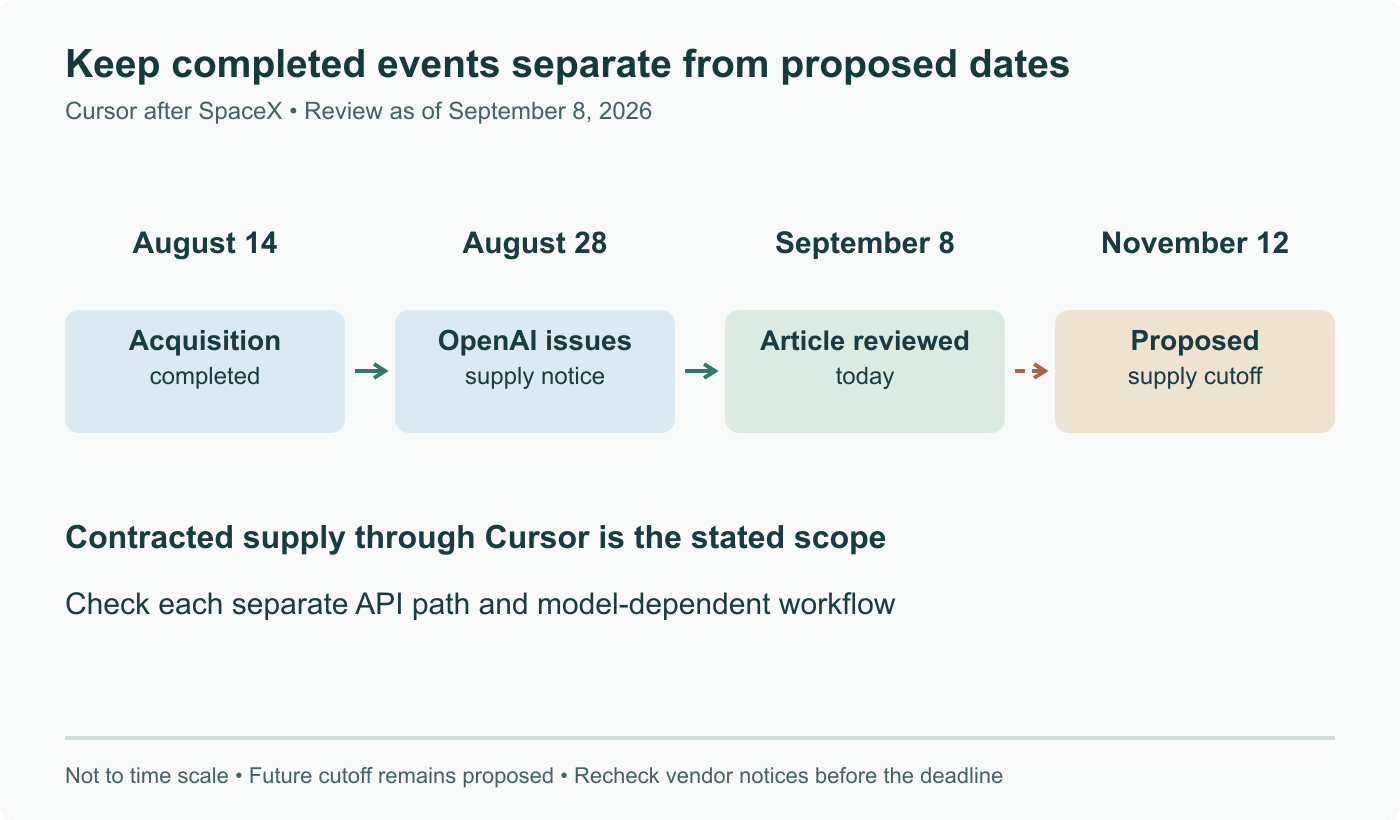
SpaceX completed the Cursor acquisition on August 14. Since then, a concrete model-supply announcement has changed what teams need to track; the article now includes that development.
The closing is confirmed
The SpaceX 8-K says the merger became effective on August 14, with Anysphere surviving as a wholly owned subsidiary. It reports an implied $60 billion equity value and conversion of outstanding common and preferred stock into 389,289,254 SpaceX Class A shares. Vested and unvested employee awards are described separately, so that share figure is not the entire award accounting.
Cursor's announcement confirms completion and presents access to SpaceX compute as a way to improve models and their economics. That explains the company's rationale. It does not establish how much a specific customer will save or when a particular workflow will improve.
A later notice changes the model-access question
On August 28, OpenAI announced its intention to wind down contracted model supply to Cursor, proposing November 12 as the shutoff date. It cited concerns about contract compliance following the acquisition. That is OpenAI's stated position, not an independent resolution of the dispute.
This dated notice is more actionable than the older article's forecast that third-party models would remain while first-party defaults took over. The proposed cutoff is not proof that access has already ended, nor that every independently contracted API path is covered. See our model-access analysis for the scope and preparation steps.
Map the work, not just the editor subscription
An application can depend on an editor, a selected model and external tools at the same time. Changing one layer can leave the others intact, or break a workflow that appears unrelated in the subscription menu.
Build a small inventory around jobs your team actually performs: refactoring, reviewing, generating tests and running background tasks. For each, record where rules live, which model is invoked, what credentials are required and what evidence counts as success. Repository files and editor-only settings should be identified separately; neither should be assumed portable without checking the destination tool.
For example, moving a prompt file is not enough if its task relies on an editor-specific tool, an account permission or an unavailable model. A disposable checkout lets you test the whole path without changing production repositories.
Ownership tells you who controls the business. Filings establish transaction facts. Product notices and a reproducible workflow test establish the consequences for your team. Keep those forms of evidence separate, and recheck the vendors' notices before acting on a proposed future deadline.
Verify August 14 legal close and consideration in 8-K, replace speculative branding/default forecasts with August 28 OpenAI supply notice and practical dependency mapping.