Wispr closed a two hundred eighty million dollar Series B on August seventeenth, 2026, at a two billion dollar valuation, led by Menlo Ventures, and shipped a new in house speech recognition model called Canto on the same day. The company says Canto cuts word error rates in noisy conditions from over thirty percent down to somewhere between five and ten percent, and reduces the edits you make afterwards by thirty to thirty five percent in everyday use. The metric it optimises for is the interesting part: not word error rate, but the share of transcriptions that need no correction at all.
The short answer
Wispr raised two hundred eighty million dollars at a two billion dollar valuation, led by Menlo Ventures, bringing total funding to three hundred sixty one million. On the same day it shipped Canto, an in house speech recognition model. The company says Canto cuts the share of misrecognised words in noisy conditions from over thirty percent to between five and ten, reduces post dictation edits by thirty to thirty five percent, and handles code switching within a sentence. The metric Wispr says it optimises for is zero edit rate: the share of dictations that need no correction on the first pass.
Most funding announcements tell you nothing you can use. This one came with a model, a number, and an argument about how to measure speech recognition that is worth stealing regardless of what you dictate into.
The round, briefly
Wispr announced a two hundred eighty million dollar Series B on Monday, August seventeenth, 2026, at a two billion dollar valuation. Menlo Ventures led. Existing backers Notable Capital, NEA, Neo Ventures, 8VC and MVP Ventures returned, joined by Acrew, Activate, Forerunner, Goodwater, Peak XV, Together Fund and PLUS Capital, along with a long list of athletes and public figures. Total capital raised now stands at three hundred sixty one million dollars, and the previous round closed less than ten months earlier, in November 2025.
The usage numbers are the part worth writing down. The company says about sixty billion words have been written through Flow, its dictation product, with users across more than ten thousand enterprises and nearly every company in the Fortune 500. Flow runs on Apple platforms, Windows and Android.
Canto, and the case for a different accuracy metric
The model shipped the same day, and its framing is more interesting than its headline numbers.
Wispr's claim for Canto is that in noisy conditions it takes the share of misrecognised words from more than thirty percent down to somewhere between five and ten percent, and that across everyday use it cuts the number of edits you make afterwards by thirty to thirty five percent. It also handles code switching, where a speaker moves between languages inside one sentence, and supports multilingual vocabularies and personal dictionaries. Worth noting for honesty: users had been reporting dictation quality problems in the weeks before launch, so Canto is partly a repair.
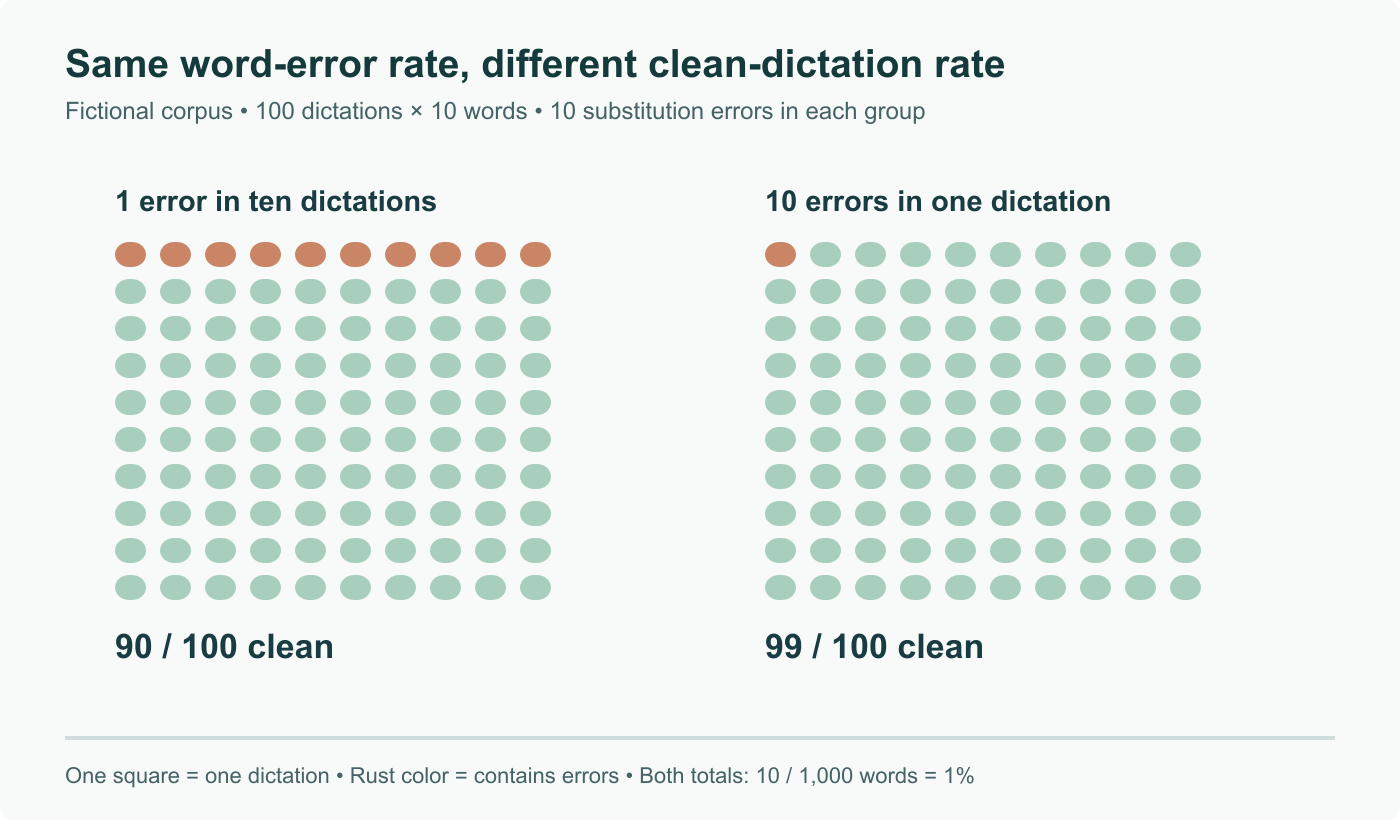
The metric the company says it optimises for is what deserves attention. Speech recognition has been benchmarked on word error rate for decades, which measures the fraction of words a system gets wrong across a test corpus. Wispr argues the number that actually determines whether dictation is useful is the zero edit rate: the share of dictations that come out needing no correction at all.
Once you look at the arithmetic, the argument is hard to dispute. A system at ninety five percent word accuracy sounds excellent and misses about one word in twenty. A paragraph of a hundred words therefore contains roughly five errors, which means essentially every paragraph you speak requires going back to fix something. And going back is the whole problem. The speed advantage of dictation comes from never touching the keyboard, so a single correction per paragraph does not cost you five percent of the benefit, it costs you most of it. You end up in the worst configuration: speaking, then proofreading, then typing, which is slower than just typing.
Measuring the fraction of clean first passes rather than the fraction of correct words puts the target on the right thing. It is also a much harder target, because it is dominated by the tail: unusual names, technical terms, background noise, accents, the moments where a model is least confident. Optimising average accuracy lets you ignore that tail. Optimising clean passes does not.
This generalises past dictation, incidentally. Any interface where a small error forces a mode switch back to manual work has the same structure, and the fraction of interactions that complete without intervention is usually a better health metric than the average error rate. It is the same reasoning behind measuring how often a build passes first time rather than the average number of failing tests.
Where this fits for developers
Dictating code remains a bad idea, and nothing here changes that. Code is dense with symbols, casing conventions and identifiers that speech models handle poorly, and the correction overhead swamps the speed gain.
Dictating prompts to a coding agent is a genuinely different task, and it is one that has quietly become a large part of many working days. Prompts are mostly ordinary prose with a scattering of technical terms, which is the workload speech recognition is actually good at. Two of Canto's features matter specifically there. Personal dictionaries let you register your own service, library and project names so the model stops guessing at them, which is the single biggest source of correction in technical dictation. Code switching matters if you think in one language and write commits, issues or documentation in another, a pattern that describes a large share of engineers outside the United States and one that most dictation tools still handle badly.
The market around this is crowded and getting more so, with several well funded products chasing the same use case, so treat the accuracy figures as vendor claims until you have run your own comparison. The useful move is to test on your own worst case rather than a quiet room: your actual desk, your actual accent, your actual project vocabulary. Then count how many dictations came out clean, not how many words were right.
Sources and further reading
- Wispr raises $280M at $2B valuation as it looks beyond dictation, TechCrunch, August 17, 2026
- Our Series B, and what it means for you, Wispr Flow, August 17, 2026
- Wispr raises $280M to power up natural speech-to-text using AI, SiliconANGLE, August 17, 2026
- Wispr talks its way to a $2 billion valuation, Fortune, August 17, 2026
- AI Dictation Startup Wispr Closes $280M Series B at $2B Valuation, The AI Insider, August 17, 2026
Frequently asked questions
What did Wispr announce on August 17, 2026?
Two things on the same day. First, a two hundred eighty million dollar Series B at a two billion dollar valuation, led by Menlo Ventures, which brings total capital raised to three hundred sixty one million dollars. Returning investors include Notable Capital, NEA, Neo Ventures, 8VC and MVP Ventures, joined by new backers including Acrew, Activate, Forerunner, Goodwater, Peak XV, Together Fund and PLUS Capital. Second, and more relevant to anyone using the product, a new in house speech recognition model called Canto. The company also says users have written about sixty billion words through Flow, its dictation product, across more than ten thousand enterprises.
What does Canto actually change?
Accuracy under bad conditions, which is where dictation normally falls apart. Wispr states that in noisy environments Canto takes the share of misrecognised words from more than thirty percent down to somewhere between five and ten percent. Across everyday use it expects roughly a thirty to thirty five percent reduction in the number of edits needed after dictation. It also handles code switching, meaning a speaker moving between languages inside a single sentence, and supports multilingual vocabularies plus personal dictionaries. The context here matters: users had reported quality problems with dictation output in the weeks before launch, so Canto is a fix as much as a feature.
What is a zero edit rate and why does it matter more than word error rate?
Word error rate measures the fraction of words a system gets wrong across a corpus. Zero edit rate measures the fraction of dictations that come out needing no correction at all. They diverge sharply in practice. A system at ninety five percent word accuracy misses roughly one word in twenty, which means almost every paragraph you dictate contains at least one error, so almost every paragraph needs a trip back to the keyboard. That single correction is what destroys the speed advantage of speaking, because it breaks flow and puts your hands back on the keys. Optimising for the share of clean first passes targets the thing that actually determines whether dictation is faster than typing.
Is this useful for developers specifically?
More than it used to be, for one specific reason: prompting. Writing code by voice remains awkward because code is full of symbols, casing rules and identifiers that speech models handle badly. Writing prompts to a coding agent by voice is a different task, and it is mostly ordinary prose with a few technical terms, which is exactly the workload dictation is good at. The two Canto features that matter for that are personal dictionaries, which let you register your own project, library and service names, and code switching, which matters a lot if you think in one language and write documentation or commits in another.
What platforms does Flow run on, and what is the company building next?
Flow runs on Apple platforms, Windows and Android. Beyond dictation, Wispr has added a meeting note taking tool and has partnerships with hardware makers, including the Oasis ring. It also launched Wispr Interface Labs, a research group led by Ariya Rastrow, who previously worked on Amazon Alexa, tasked with exploring new human computer interaction models. The stated ambition is to build an intelligence layer for human and AI interaction, starting with voice and extending into other modalities and hardware. That is a broad ambition, and the near term substance is the model that shipped this week.