DevNews

YouTube Doubles What New Creators Need to Get Monetized

On this page
  1. The numbers per day, which is how they will feel
  2. Existing partners keep their seat, with one condition attached
  3. The deadline that is not about performance
  4. What else was in the announcement
  5. What we would do
  6. Sources and further reading

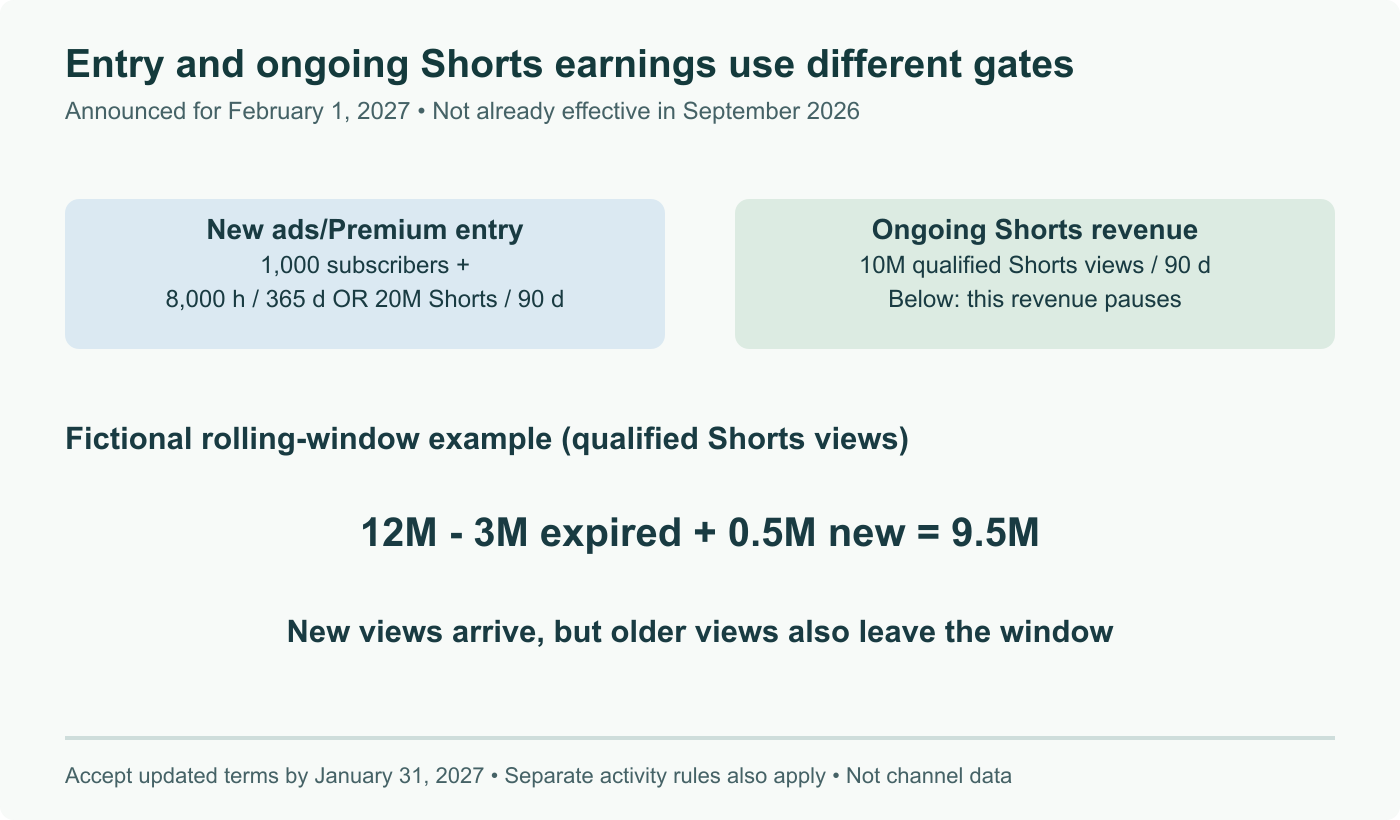
YouTube announced on August 10, 2026 that Partner Program entry requirements double on February 1, 2027. New applicants will still need 1,000 subscribers, but the second condition becomes 8,000 qualified public watch hours over 365 days or 20 million qualified Shorts views over 90 days, against 4,000 and 10 million today. Creators already in the programme are not affected by the new thresholds. A separate rule does affect them: Shorts ad and subscription revenue now requires 10 million qualified Shorts views on a rolling 90 day window, and drops away automatically when you fall below it. Terms must be accepted in YouTube Studio by February 1, 2027.

The short answer

YouTube announced on August 10, 2026 that the Partner Program entry bar doubles on February 1, 2027. New applicants need 1,000 subscribers plus either 8,000 qualified public watch hours over 365 days or 20 million qualified Shorts views over 90 days. Existing partners are grandfathered on entry, but Shorts ad and subscription revenue now needs 10 million qualified Shorts views on a rolling 90 day window. Updated terms must be accepted in YouTube Studio by February 1, 2027.

8,000qualified watch hours to apply, up from 4,000
20Mqualified Shorts views to apply, up from 10 million
Feb 12027, when the new thresholds and terms take effect
Answer card: from February 1, 2027 the YouTube Partner Program requires new applicants to have 1,000 subscribers plus either 8,000 qualified public watch hours over the last 365 days or 20 million qualified Shorts views over the last 90 days, doubling the current 4,000 hours and 10 million views, while existing partners are grandfathered and Shorts revenue requires 10 million qualified views on a rolling 90 day window.
The announcement of August 10, 2026 in one card. Source: the official YouTube blog. PNG

If you have a channel sitting somewhere between two and four thousand watch hours, the finish line moved on Monday and it moved by a factor of two.

YouTube published the change on August 10, 2026. From February 1, 2027, a new applicant to the Partner Program needs 1,000 subscribers, which is unchanged, plus either 8,000 qualified public watch hours over the previous 365 days or 20 million qualified Shorts views over the previous 90 days. The current figures are 4,000 and 10 million. The company describes these as the first significant changes to the programme since 2018 and notes it has passed three million creators.

The announcement from YouTube's own updates account.

The numbers per day, which is how they will feel

Annual and quarterly thresholds are easy to underestimate. Dividing them is the fastest way to understand what you are being asked for.

Eight thousand watch hours across 365 days is roughly 22 hours of watch time every day, held for a year. Twenty million Shorts views across 90 days is roughly 222,000 views every day, held for three months. Those are not milestones you reach and then relax, because both windows roll forward and discard what falls out of the back.

That rolling behaviour is the design, not an accident of the maths. A fixed lifetime total rewards a channel for one video that did well in 2023. A rolling window rewards a channel that is still publishing.

Comparison chart of YouTube Partner Program entry requirements before and after February 1, 2027: subscribers unchanged at 1,000, qualified public watch hours rising from 4,000 to 8,000 over 365 days, and qualified Shorts views rising from 10 million to 20 million over 90 days.
Entry requirements before and after February 1, 2027. Figures from the official YouTube announcement. PNG

Existing partners keep their seat, with one condition attached

YouTube has been clear that the new entry thresholds do not push anyone out. If you are in the programme, you stay in it.

There is a separate rule that does reach existing members, and it is the one worth reading twice. To earn ad and subscription revenue on Shorts, a channel now has to maintain 10 million qualified Shorts views over the previous 90 days. Drop below and Shorts payouts pause. You remain in the Partner Program, long form earnings continue untouched, and Shorts revenue sharing resumes automatically when you cross back over.

We would rather have an automatic pause than a removal and a reapplication, and it is worth saying so, because the alternative design would have been considerably worse for anyone whose output is seasonal. But a payout that can switch off without a decision being made is still a payout you cannot plan around, and it turns a quiet quarter into a revenue event.

The deadline that is not about performance

Buried under the threshold news is an administrative item with a hard date. Creators have to review and accept updated Partner Program terms in YouTube Studio by February 1, 2027.

This is the one to handle now rather than in January. It costs a few minutes, it depends on nothing except logging in, and it is the only part of the announcement where inaction alone can cost you something. Set a reminder, do it, forget it.

What else was in the announcement

The rest of the post reads as a deliberate counterweight to the threshold increase, which does not make it untrue.

Premium Lite is expanding to every country where YouTube Premium is available. Creators earn 60 percent of net subscription revenue from that tier, distributed according to member watch time and views on a split of 55 percent to long form and 45 percent to Shorts. YouTube also described bonuses tied to YouTube Shopping, incentives for brand deals, and earnings boosts for starting and growing trends, and said it expects to pay more to creators in 2027 than in 2026.

The common thread is that none of those routes carry the view thresholds. That is presumably the intended message: the ad revenue door is narrower, and the company would like you to look at the other doors.

What we would do

If you are below 8,000 hours today, the useful question is not whether you can double your output. It is whether your existing catalogue is fully public. Unlisted and private videos contribute nothing to qualified watch hours, and channels accumulate more of those than they remember. Auditing that costs an afternoon and can move the number without producing anything new.

If you are running the Shorts path, treat the 10 million per 90 days line as an operating constraint rather than a target, and know how close to it you normally sit. The failure mode here is a channel that averages 11 million and has one slow month.

And if you are building tooling around any of this, the rolling windows are the part your code has to model. A daily snapshot of the trailing 90 and 365 day figures, stored somewhere you can query, turns a surprise into a chart. Platforms changing the terms of monetisation is a recurring theme rather than a one off, and we looked at another form of it when Cloudflare shipped a gateway for charging machines to read content.

Sources and further reading

Frequently asked questions

What counts as a qualified public watch hour?

Watch time on public long form videos on your own channel, which is narrower than the number in your analytics dashboard. Private and unlisted videos do not count, deleted videos take their hours with them, and time on Shorts is counted separately under the Shorts view metric rather than added to your hours. Live stream watch time does count while the stream is public and archived. The practical consequence is that channels which unlist or clean up old content are quietly reducing their own eligibility, which matters more now that the bar is 8,000 hours instead of 4,000.

I am already in the Partner Program. What actually changes for me?

The entry thresholds do not apply to you, and YouTube has been explicit that existing members are not removed because of them. One thing does apply: earning ad and subscription revenue on Shorts now requires maintaining 10 million qualified Shorts views over the previous 90 days. Fall below and Shorts payouts pause while you keep the programme and keep earning on long form, and they resume automatically once you cross the line again. You also have to review and accept updated terms in YouTube Studio by February 1, 2027, which is the item most likely to catch people out because it is administrative rather than performance based.

How much daily traffic do the new numbers actually represent?

Do the division, because the headline figures hide it. Eight thousand watch hours across 365 days is about 22 hours of watch time per day, sustained for a year. Twenty million Shorts views across 90 days is about 222,000 views per day, sustained for three months. The rolling 10 million view requirement for Shorts revenue works out to roughly 111,000 views per day. The Shorts path was always the harder one on a per view basis, and doubling it does not change the shape of the trade, only the size.

Why would YouTube raise the bar now?

The stated framing is that the programme has passed three million creators and that these are the first significant changes since 2018. The mechanical reason is that a revenue pool split across more participants pays each of them less, and Shorts made it very cheap to generate view counts that qualify. Raising the floor and adding a rolling continuity requirement filters for channels that keep producing rather than channels that crossed a threshold once. Whether that is fair depends on whether you are above the new line or below it.

Is there anything in the announcement that is good news for smaller channels?

Some, though it is not the ad revenue path. YouTube said it is expanding Premium Lite to every country where Premium is available, with creators taking 60 percent of net subscription revenue from that tier, distributed by member watch time and views on a split of 55 percent to long form and 45 percent to Shorts. It also described bonuses tied to YouTube Shopping, incentives for brand deals, and earnings boosts for starting and growing trends. Those routes do not have the same view thresholds attached, which is the point of mentioning them in the same announcement.