Sonnet 5 costs less per token, but an Opus 5 rerun adds to the bill. A simple calculation shows when a Sonnet-first strategy stops saving money.
The current comparison
This comparison now covers Sonnet 5 and Opus 5. The older Opus 4.8 benchmark table has been removed: it cannot establish how the current models compare. This is a documented feature and cost comparison, not a hands-on performance test.
The official Sonnet 5 specifications and Opus 5 specifications give both models a 1M-token context window and up to 128K output tokens per standard request. Their API identifiers are claude-sonnet-5 and claude-opus-5.
| Standard API price, USD per million tokens | Sonnet 5 | Opus 5 |
|---|---|---|
| Input | $2 | $5 |
| Output | $10 | $25 |
| Cache read | $0.20 | $0.50 |
Prices checked September 8, 2026. The previously planned Sonnet increase to $3/$15 in September was cancelled. At identical token volumes in these categories, Sonnet costs 60% less. This does not mean it completes every task for 60% less: output length, repeated attempts, tool fees and human corrections change the total.
When is a second attempt worth paying for?
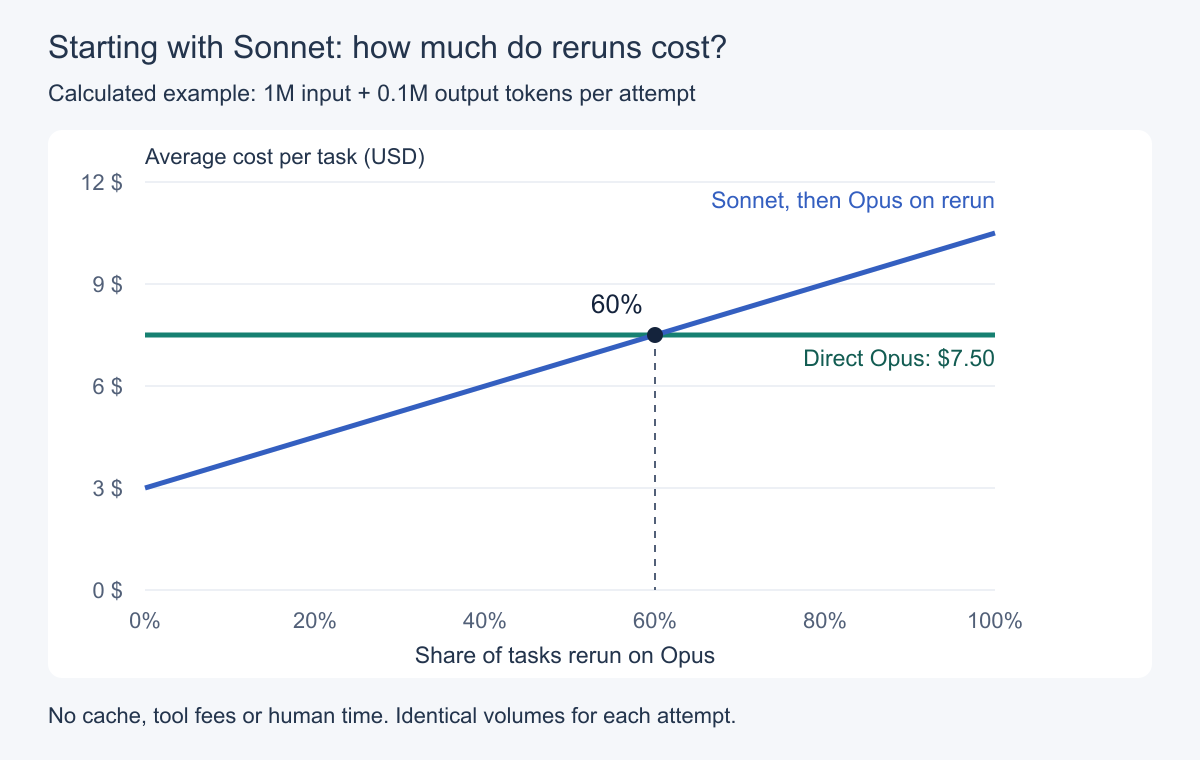
Consider an illustrative workload with 1M uncached input tokens and 0.1M output tokens. At standard rates it costs $3 on Sonnet and $7.50 on Opus. These are chosen volumes, not measurements of typical usage.
Suppose you first run every task on Sonnet and rerun a fraction of them on Opus. If the Opus rerun has exactly the same token volume as a direct Opus attempt, the average token cost is 3 + 7.50 × rerun fraction. Running Opus directly costs $7.50 in this example.
| Tasks rerun on Opus | Sonnet-first average | Direct Opus |
|---|---|---|
| 0% | $3.00 | $7.50 |
| 20% | $4.50 | $7.50 |
| 60% | $7.50 | $7.50 |
| 100% | $10.50 | $7.50 |
The graph makes the limitation visible: a cheaper first attempt is not automatically a cheaper workflow. Beyond 60% reruns, that strategy costs more in this particular example. Different cache usage or output volumes move the crossing point. Additional review time and latency are not included.
Build a routing rule from observable failures
An application needs a reliable way to decide whether a result is acceptable. For code, use relevant checks and review the change. For extraction, validate the schema and compare a sample against labelled answers. For research, verify the cited evidence. Asking a model whether its own answer is correct is not an independent acceptance test.
Keep the failure record: wrong result, invalid format, unsupported claim, incomplete tool sequence or excessive review time. Measure the rerun rate per task type. Mixing easy formatting jobs with difficult repository refactors can hide the part of the workload where the expensive model pays for itself.
Before switching, check your request parameters. Sonnet 5 uses adaptive thinking by default; manual thinking budgets and non-default sampling parameters are not supported, according to its model documentation. Run a small regression set before changing a production default.
Choose Sonnet when it reliably meets your acceptance criteria at a lower measured total cost. Choose Opus for categories where it saves enough failed attempts or review work. If difficult cases still resist, our Fable 5.1 versus Opus 5 comparison explains the next step and its different cache economics.
Updated for Opus 5 and September Sonnet 5 prices. Chart calculated from explicit assumptions; no independent benchmark claimed.