AMD has signed fifteen year leases with Core Scientific covering roughly 530 megawatts of US data center capacity across five campuses, with more than $14 billion in base contracted revenue and a reservation right over an additional 1,925 megawatts through the end of 2028. The interesting part is not the number, it is the direction. A chip company is now signing power leases directly, taking on the role its customers used to play, and the capacity is earmarked for Instinct GPUs, EPYC processors and the ROCm stack. Core Scientific, meanwhile, keeps converting bitcoin mining sites into AI colocation.
The short answer
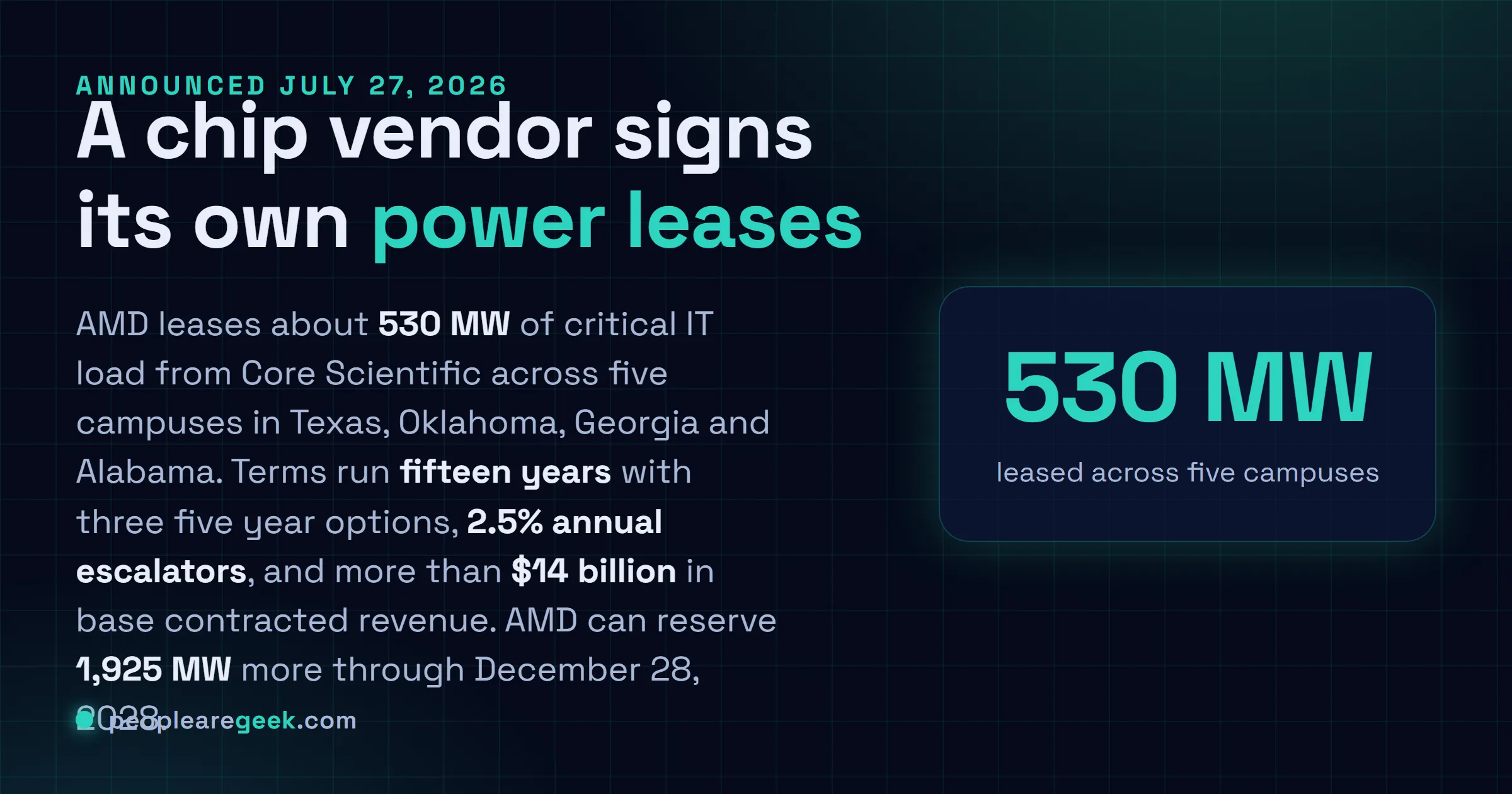
Core Scientific and AMD announced a fifteen year infrastructure partnership on July 27, 2026. AMD gets roughly 530 megawatts of critical IT load across Pecos and Hunt County in Texas, Muskogee in Oklahoma, Dalton in Georgia and Auburn in Alabama, with 377 megawatts leased directly to AMD and 152 megawatts leased to neocloud operators running AMD hardware. Base contracted revenue exceeds $14 billion, escalating 2.5% a year. Delivery starts in the first half of 2027 and completes by the end of 2028.
There is a version of this story that is only about a big number, and it is the less interesting version. What changed this week is who signs the power lease. For most of the last decade that was a cloud provider, or a company like OpenAI that needs somewhere to put models. Here it is the company that makes the accelerators.
What is actually under contract
The headline capacity is about 530 megawatts of critical IT load, spread across five campuses in four states, and it does not all belong to AMD in the same way.
Roughly 377 megawatts is leased directly to AMD: 185 megawatts at Pecos in Texas, 110 megawatts in Hunt County in Texas, and 82 megawatts at Muskogee in Oklahoma. The remaining 152 megawatts, 120 at the third phase of the Dalton campus in Georgia and 32 at Auburn in Alabama, is leased to neocloud operators that will run AMD hardware for customers. Same silicon, different tenant on the paper.
Every lease runs fifteen years with three five year renewal options, and carries a 2.5% annual escalator. Base contracted revenue across the set exceeds $14 billion.
The option is bigger than the contract

Alongside the leases, AMD holds a right to reserve up to 1,925 megawatts more of Core Scientific capacity, exercisable through December 28, 2028. That is where the 2.5 gigawatt figure in most coverage comes from, and it is worth keeping the two apart. One is a contract with revenue attached. The other is a call on future capacity that AMD can walk away from.
Reserving optionality is rational when the underlying good is scarce and slow to build. You cannot conjure 2 gigawatts of interconnected, powered shell in eighteen months, so the companies that expect to need it in 2029 are queueing for it in 2026.
Why this ramp takes until 2028
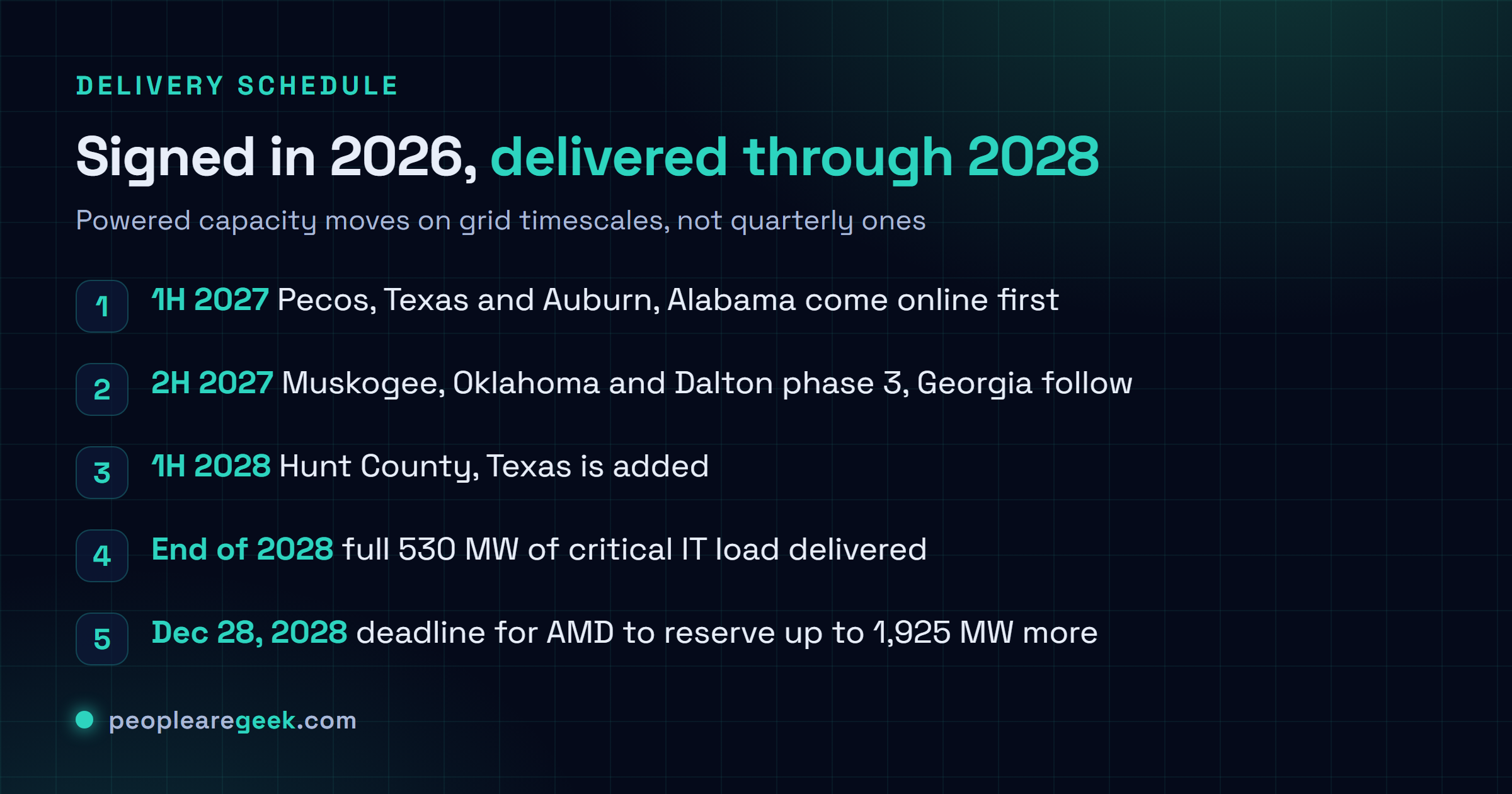
Delivery is phased. Pecos and Auburn come online in the first half of 2027, Muskogee and Dalton in the second half, Hunt County in the first half of 2028, with the full 530 megawatts scheduled by the end of that year.
If you have watched a datacenter get built, none of that is surprising. If you have not, the useful takeaway is that the constraint has moved. Accelerators are constrained by production, but production is a manufacturing problem with a known cadence. Interconnect queues, transformer lead times and substation construction run on grid timescales, and no amount of capital compresses them past a point. This is the same dynamic behind the Virginia grid event we covered in one line fault that dropped 3 GW of data center load: the electrical side of AI is now the side with the interesting engineering constraints.
The ROCm angle is the quiet one
The partnership covers collaboration on data center design plus deployment of Instinct GPUs, EPYC processors and the ROCm software platform. That last item is easy to skim past and probably matters most to anyone writing code.
ROCm's long standing weakness has never really been the compiler or the kernels in isolation. It has been the shortage of places where a developer can casually rent an Instinct card and find out whether their stack works on it. Half a gigawatt of AMD leased capacity, some of it fronted by neoclouds whose entire business is renting GPUs by the hour, changes the availability picture over the next two years in a way that no amount of library work would.
What Core Scientific is becoming
For Core Scientific this is the continuation of a pivot rather than a surprise. The bitcoin mining operation is winding down, the sites are being converted to AI colocation, and this deal roughly doubles leased AI capacity to about 1.1 gigawatts while pushing the contracted portfolio past $24 billion.
The warrant structure is the detail we would look at first. AMD receives warrants for up to 30 million common shares at $23.47, vesting at 12,222 shares per megawatt of critical IT load and expiring in July 2031, with around 6.5 million vesting immediately. That ties AMD's equity upside to delivered megawatts rather than announced ones, which is a better designed incentive than most of the announcements in this sector carry.
The market read it about as you would expect on the day: Core Scientific shares rose in premarket trading, AMD's slipped along with the rest of the chip complex.
Sources and further reading
- Core Scientific and AMD announce infrastructure partnership (Business Wire)
- Core Scientific 8-K filing detailing the lease and warrant terms
- Data Center Dynamics: Core Scientific secures AMD as customer at five sites
- Data Center Knowledge: Core Scientific doubles AI capacity to 1.1 GW in $14B AMD deal
- CoinDesk: Core Scientific lands AMD AI deal as bitcoin mining winds down
Frequently asked questions
What exactly did AMD sign, and for how much capacity?
Core Scientific and AMD announced an infrastructure partnership covering approximately 530 megawatts of critical IT load across five US campuses, on fifteen year lease terms with three five year renewal options and base contracted revenue above $14 billion. The 530 figure splits in two. About 377 megawatts is leased directly to AMD at Pecos in Texas, Hunt County in Texas and Muskogee in Oklahoma. The remaining 152 megawatts sits at Auburn in Alabama and the third phase of Dalton in Georgia, leased to neocloud operators that will run AMD hardware. The leases carry 2.5% annual escalators, which is the standard way a colocation contract keeps pace with cost inflation over a term that long.
Where does the 2.5 gigawatt number come from?
It is the ceiling, not the contract. On top of the 530 megawatts under lease today, AMD holds a right to reserve up to an additional 1,925 megawatts of Core Scientific capacity, exercisable through December 28, 2028. Add the two and you land just under 2.5 gigawatts, which is the figure most headlines used. Treat it the way you would treat any option: it prices in optionality on future capacity at a moment when nobody can buy powered shell space quickly, and it commits AMD to nothing beyond the 530 megawatts already signed. Whether the option gets exercised depends on how well Instinct sells between now and the end of 2028.
When does any of this capacity actually come online?
Not immediately, which is the part worth internalising. Delivery starts in the first half of 2027 at Pecos and Auburn. Muskogee and Dalton follow in the second half of 2027. Hunt County lands in the first half of 2028, and the full 530 megawatts is scheduled to be delivered by the end of 2028. That is a two and a half year ramp for capacity signed today, and it is a fair description of the whole industry right now. The bottleneck stopped being chips a while ago. It is powered land, transformers, substations and grid interconnect queues, all of which run on timelines measured in years rather than quarters.
Why is a chip vendor leasing data centers instead of selling chips?
Because selling a GPU into a market with no room to plug it in does not work. AMD is doing what NVIDIA and OpenAI have been doing in their own ways: reserving the physical envelope that its silicon needs, so that a customer who wants Instinct capacity can get it without first solving a power procurement problem. The partnership explicitly covers collaboration on data center design alongside deployment of Instinct GPUs, EPYC CPUs and the ROCm software platform, which suggests AMD wants influence over the rack, cooling and power layout rather than just a tenancy. The trade is capital intensity. A chip company with fifteen year lease obligations has a different balance sheet than one that only ships parts.
What does Core Scientific get out of it?
A second life. Core Scientific spent years as a bitcoin miner, and it is now winding that business down and converting its sites to AI colocation, where the revenue per megawatt is steadier and contracted years in advance. This deal roughly doubles its leased AI capacity to about 1.1 gigawatts and lifts its contracted portfolio past $24 billion. It also issued AMD warrants for up to 30 million common shares at $23.47 each, vesting at 12,222 shares per megawatt of critical IT load delivered and expiring in July 2031. That structure ties AMD's upside to Core Scientific actually shipping the megawatts, which is a more honest incentive than a signature on a term sheet.