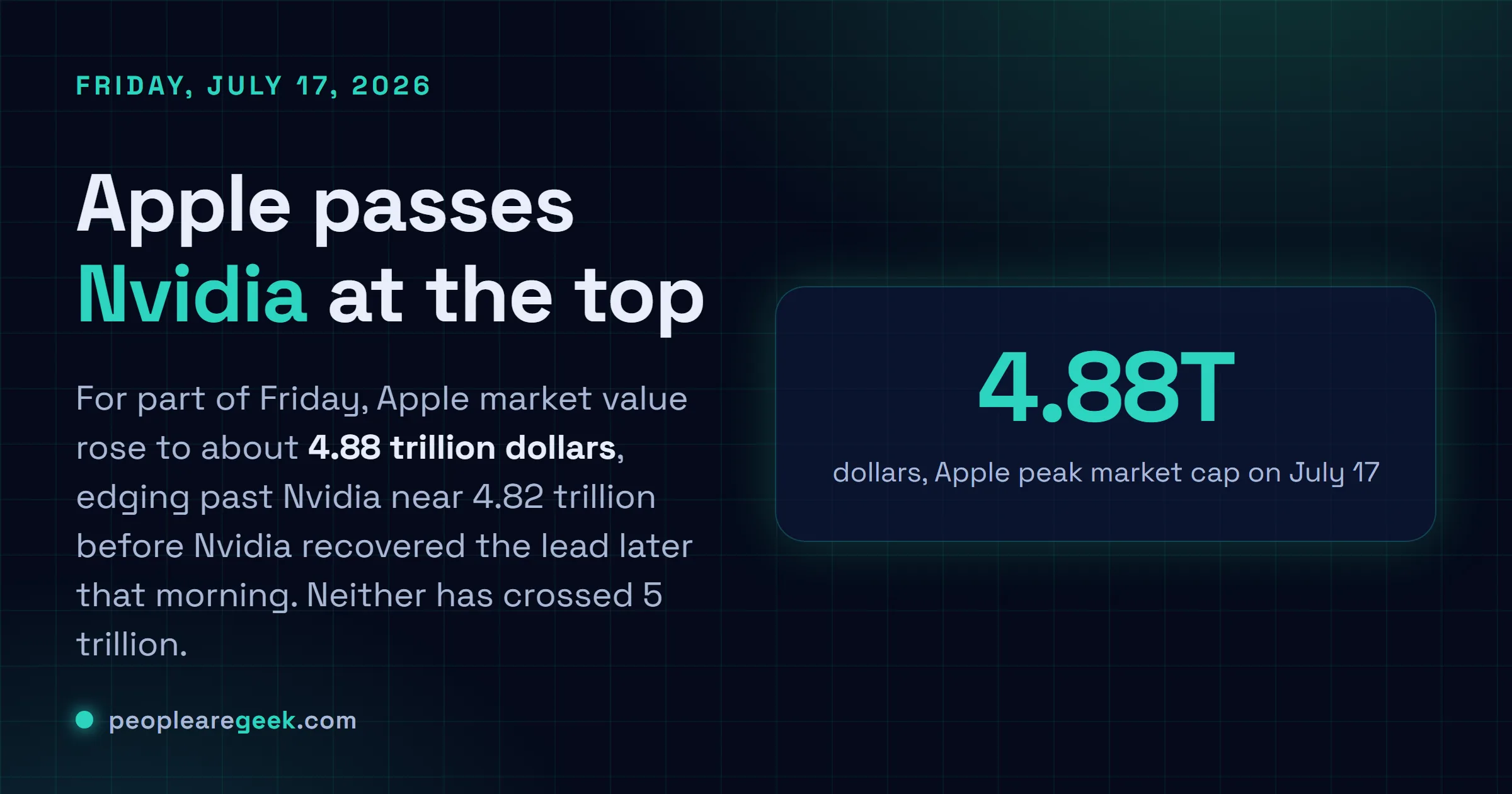
For part of Friday, July 17, 2026, Apple pushed past Nvidia to become the world's most valuable public company, its market value climbing to roughly 4.88 trillion dollars before Nvidia clawed back the top spot later in the morning. Nvidia shares slid about 3.9 percent at the open, trimming its valuation to around 4.82 trillion dollars and leaving the two giants separated by a rounding error. Neither has yet crossed 5 trillion dollars, a line Nvidia was the first to touch last October. The lead changed hands on a quiet trading day with no product launch behind it, which is exactly why it is worth a closer look: the swap is less about one Friday and more about where the market now thinks the value of the AI build out actually lands.
The short answer
For part of Friday, July 17, 2026, Apple overtook Nvidia to become the world's most valuable public company, reaching about 4.88 trillion dollars before Nvidia recovered the lead later in the morning. Neither has crossed 5 trillion dollars yet. The swap arrived on a quiet trading day with no launch behind it, which is what makes it interesting: the market is starting to price AI value across the whole stack, not only in the chips that train the models.
The two largest companies on earth are now a chipmaker and a phone maker, and for a few hours on July 17 they swapped places. That framing sounds like a stock market curiosity, and on any single day it mostly is. But step back and the pair tells you something about how the industry reads its own bet on artificial intelligence. One company sells the engines that train the models. The other sells the devices that people actually hold. The market has decided, for now, that those two things are worth almost exactly the same.
What the numbers say
On Friday morning, Apple market value rose to roughly 4.88 trillion dollars, enough to pass Nvidia and reclaim the title of the world's most valuable public company. Nvidia had opened the day down about 3.9 percent, which pulled its valuation to around 4.82 trillion dollars. That is a gap of tens of billions of dollars between two companies worth trillions each, which in practice means they are tied. By later in the session Nvidia had recovered and moved back ahead.
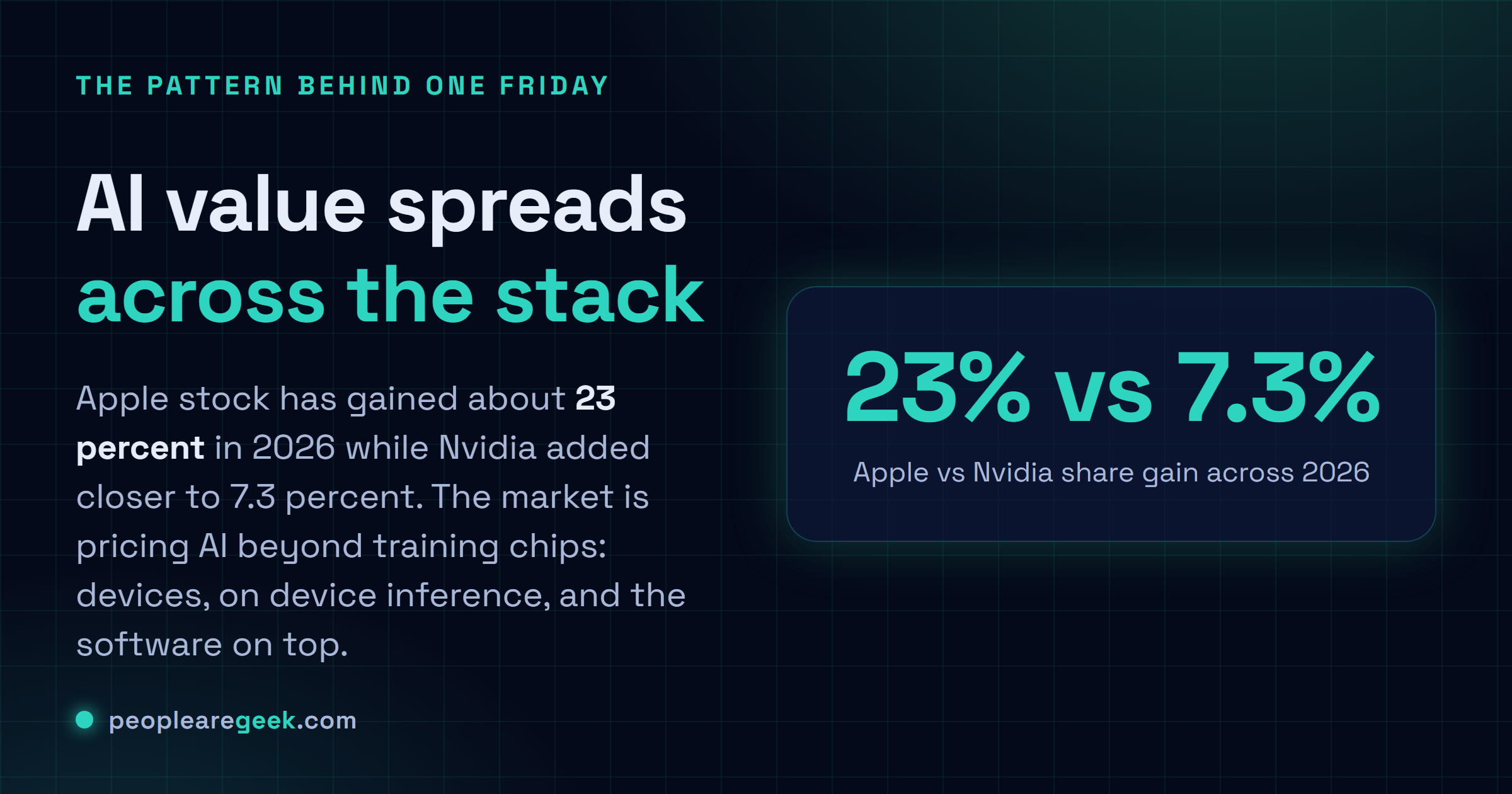
Two details matter more than the headline. First, neither company has crossed 5 trillion dollars. Nvidia was the first business in history to touch that mark, back in October, and Apple is climbing toward it without having arrived. Second, the year to date picture is lopsided: Apple stock has gained roughly 23 percent across 2026, while Nvidia has added closer to 7.3 percent. The crown changed hands not because Apple surged on the day but because the distance between them had already narrowed to almost nothing.

Two different bets on the same technology
It helps to see these companies as two answers to the same question. If artificial intelligence is going to be enormous, where does the money end up?
Nvidia is the answer that says the value sits in the training. Someone has to build and sell the accelerators that turn electricity into model weights, and for the past few years Nvidia has been almost the only credible supplier at scale. That position made it the most valuable company in the world and the clearest proxy for the AI trade. When investors wanted exposure to the boom, they bought the shovel maker.
Apple is the answer that says the value sits closer to the person. Apple does not train frontier models to sell access to them. It builds silicon for phones, tablets, and laptops, and it has been moving more inference onto those devices so that features run locally rather than in a distant data center. That is a slower, quieter strategy, and for most of the past two years it looked like the less exciting one. The July swap is a sign that patience is being repriced.
Why a quiet day matters more than a loud one
Milestones that arrive with a keynote are easy to read. This one arrived with nothing. There was no Apple launch on July 17 and no Nvidia stumble beyond ordinary profit taking. When a lead changes hands on a day like that, it is the underlying trend showing through rather than a single event moving the tape.
The trend worth naming is diversification. For a long time the market concentrated its AI optimism in the company that makes the training hardware. Spreading that optimism across devices, software, and services is a healthier and more durable way to price a technology that is going to touch every layer of computing. It also means the single number everyone watched as a proxy for AI, the Nvidia market cap, is no longer the whole story.
What we would actually take from this
We would not trade on it, and this is not advice to. A brief lead that already reversed within a morning is not a signal about next quarter. What it is good for is calibration.
- The AI trade is broadening. The value of the build out is starting to be priced across the stack, not just in the accelerators. If you plan around AI, plan for it to matter on the edge and in ordinary software, not only in the data center.
- On device inference is a real strategy, not a consolation prize. Apple slow move to run models locally is being taken seriously by the market. For builders, that is a reminder that where a model runs is becoming a product decision with real weight.
- Do not over read one session. Two companies worth almost the same amount will trade the lead back and forth. The interesting fact is the tie itself, not who happened to be ahead at ten in the morning.
The story of the AI boom has had a single main character for a while. The events of July 17 are a small sign that the cast is getting larger.
Sources and further reading
- Forbes: Apple becomes world's largest company, surpassing Nvidia
- CNBC: Apple, Nvidia vie for title of world's most valuable company
- Bloomberg via BNN: Apple unseats Nvidia as world's most valuable company as AI bets shift
- 9to5Mac: Apple overtakes Nvidia as it barrels toward 5 trillion dollars
- MacRumors: Apple passed Nvidia to become world's most valuable company again
Frequently asked questions
What actually happened on July 17, 2026?
For part of the trading morning on Friday July 17, 2026, Apple market capitalization rose to about 4.88 trillion dollars, edging past Nvidia to become the world's most valuable public company. Nvidia had opened down roughly 3.9 percent, cutting its value to around 4.82 trillion dollars. Nvidia recovered the top spot later in the session, so the lead was brief. The two companies are now close enough that the crown can change hands on an ordinary day of trading.
Did Apple reach 5 trillion dollars?
No. Apple has climbed close to 4.9 trillion dollars but has not crossed the 5 trillion line. Nvidia was the first company in history to touch a 5 trillion dollar valuation, which it did last October. So the July milestone is about which company is larger right now, not about a new record high for the whole market.
Why did Nvidia slip while Apple climbed?
Reporting around the swap tied it to a shift in AI expectations rather than any single event. Apple stock has gained roughly 23 percent across 2026, well ahead of the broad tech market, while Nvidia has added closer to 7.3 percent over the same stretch. Investors appear to be spreading their bets across the AI stack rather than concentrating them in the chips that power data center training. A single day of profit taking in Nvidia was enough to close the small remaining gap.
What does this mean for the AI hardware market?
It does not change what Nvidia sells or how much of it ships. Nvidia still supplies the accelerators that most large models are trained on, and demand for that hardware remains high. What the swap signals is that the market no longer treats data center silicon as the only place AI value accrues. Devices that run models on the edge, the software that sits on top, and the services that wrap around both are all part of the same story now.
Is Apple permanently ahead of Nvidia now?
Not in any settled sense. The two are separated by a very small margin, and the lead has already traded back and forth within a single morning. Reading a durable trend into one session would be a mistake. The more useful takeaway is that two very different bets on artificial intelligence, one built on devices and one built on data center chips, are now valued at almost exactly the same enormous number.