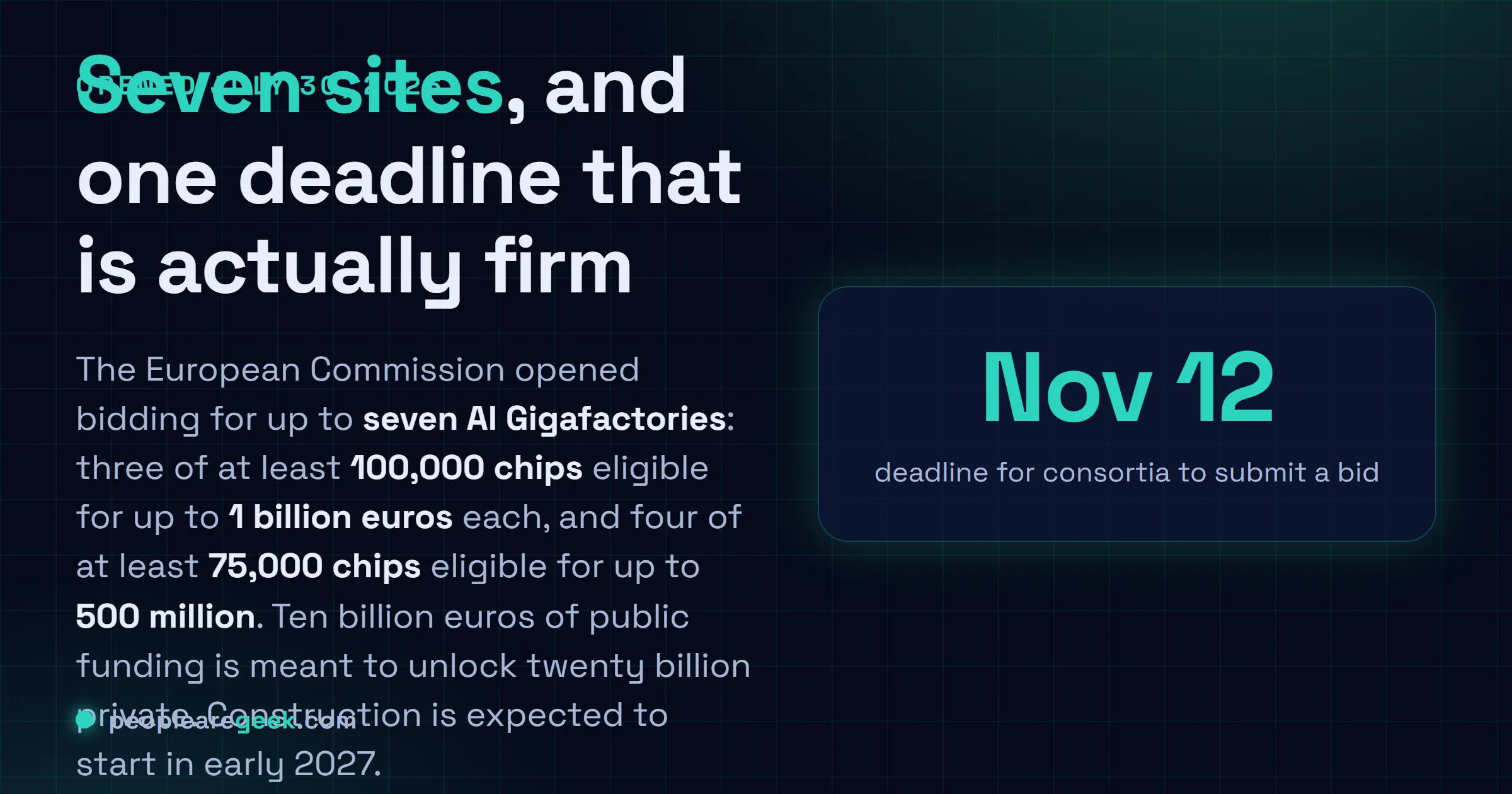
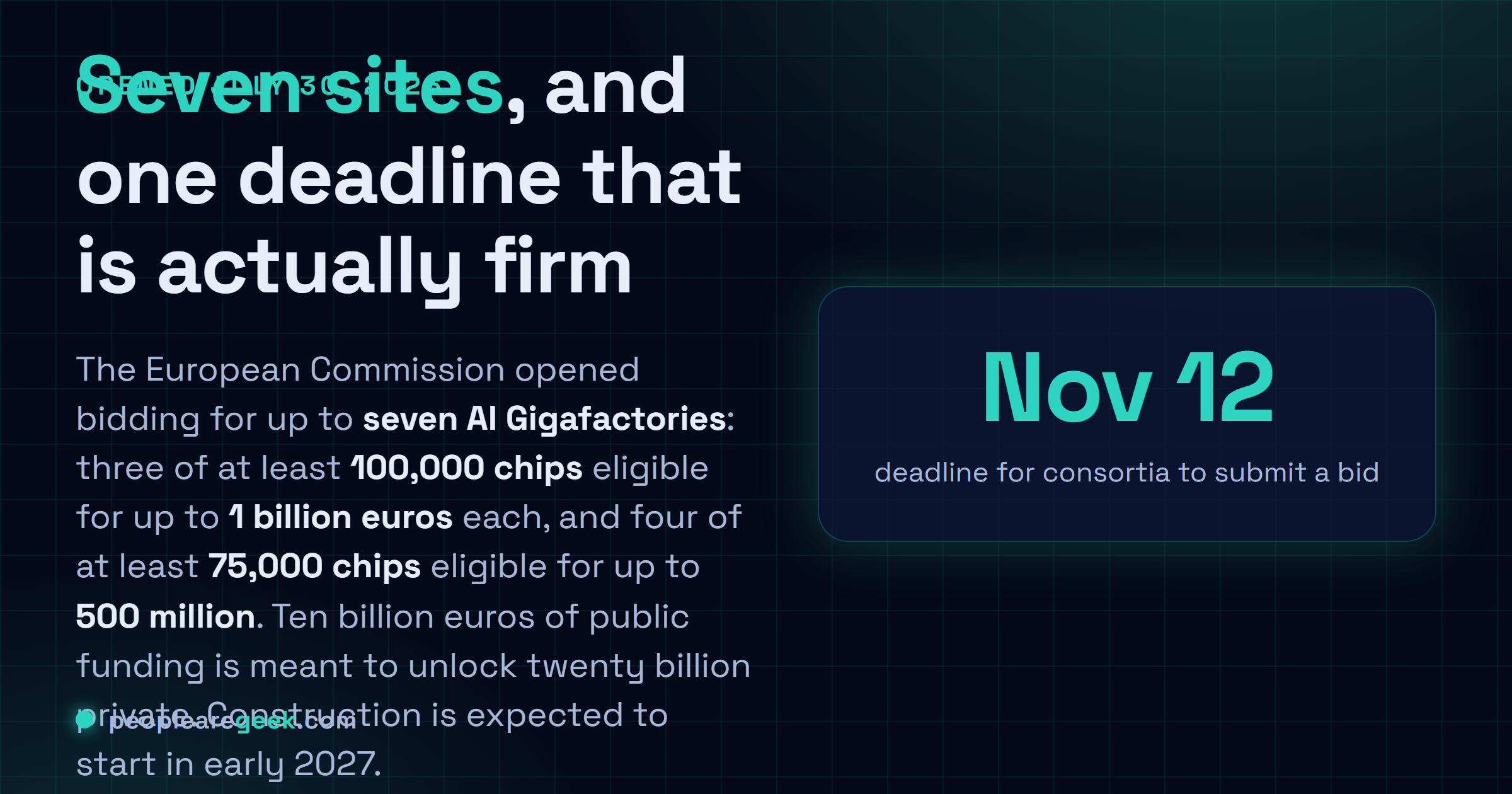
The European Commission opened the AI Gigafactories call on July 30, 2026, and the numbers are specific enough to be worth reading. Up to seven sites, split into three large facilities with at least 100,000 AI chips each and four smaller ones with at least 75,000, eligible for up to one billion and 500 million euros of public money respectively. Ten billion euros of public funding is meant to unlock twenty billion in private capital. Consortia have until November 12, 2026 to bid, construction is expected to start in early 2027, and only two billion of the public envelope is actually available today.
The short answer
The European Commission opened its AI Gigafactories call on July 30, 2026, inviting consortia to bid for up to seven large scale AI compute facilities. Three larger sites are expected to host at least 100,000 AI chips each and qualify for up to one billion euros of public funding. Four smaller sites need at least 75,000 chips and qualify for up to 500 million euros. Ten billion euros of EU and national funding is intended to mobilise at least twenty billion in private investment. Bids close on November 12, 2026, construction is expected to start in early 2027, and letters of intent are already signed with Nvidia, AMD and Qualcomm on hardware supply.
European industrial programmes usually arrive as a communication with no numbers attached. This one arrived with chip counts, funding caps and a submission deadline, which makes it possible to assess rather than just react to.
What was actually opened
On July 30, 2026, the Commission published the call for AI Gigafactories, the mechanism through which private consortia bid to build and operate large AI compute sites across the bloc with public co-funding.
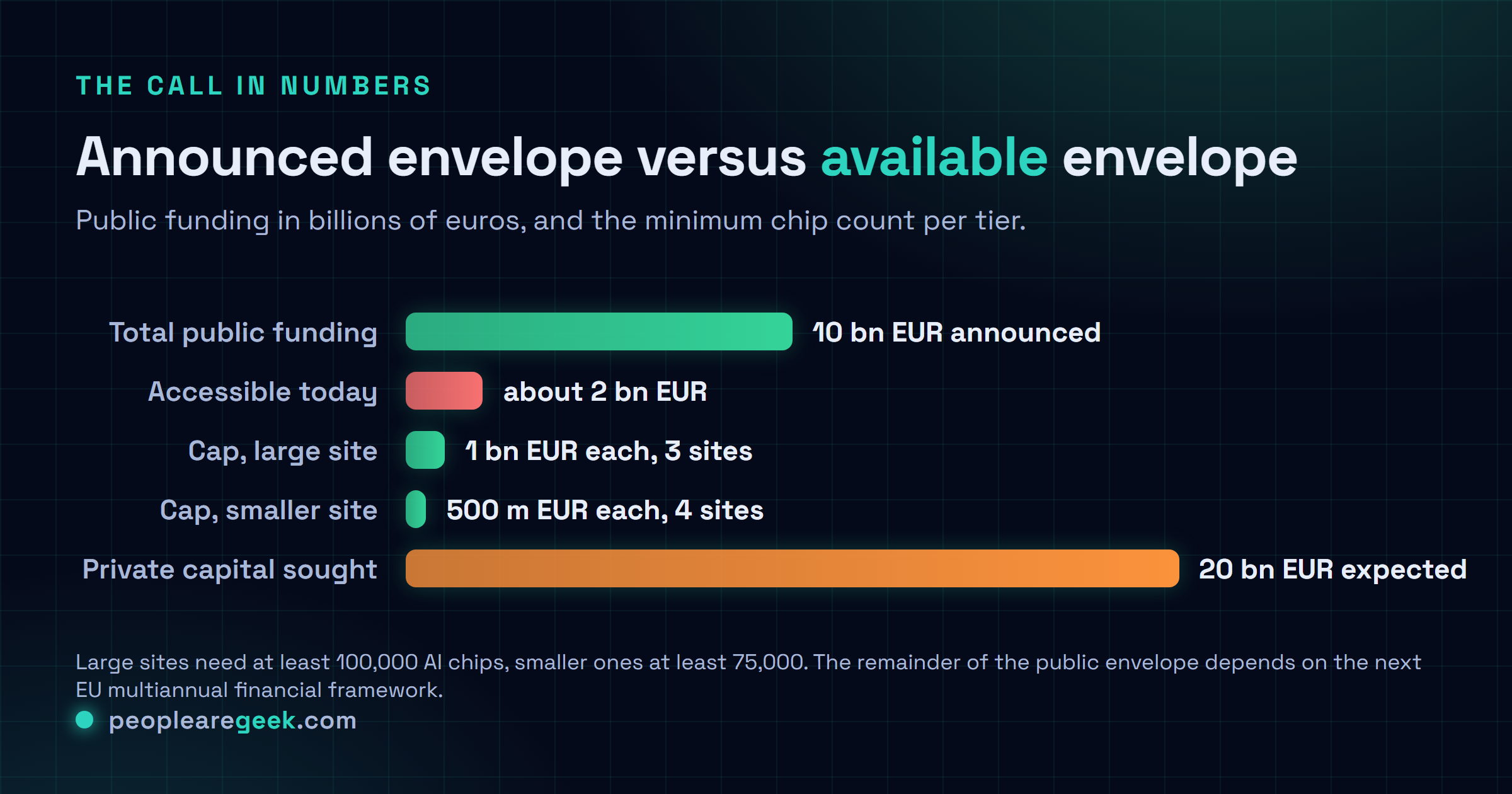
The structure is two tiers. Three larger gigafactories, each expected to host a minimum of 100,000 AI chips, are eligible for up to one billion euros in public support. Four smaller facilities, each with a minimum of 75,000 chips, are eligible for up to 500 million euros. Public funding totals around ten billion euros, roughly five billion from the EU budget and five billion from member states, and the Commission expects that to pull in at least twenty billion of private capital for a headline figure above thirty billion.
Consortia and special purpose vehicles have until November 12, 2026 to submit. Ten member states have already signalled interest: Germany, Italy, France, Poland, Czechia, Denmark, Finland, Greece, Portugal and Spain. The Commission says it received 76 preliminary expressions of interest from the private sector before the call opened.
Henna Virkkunen, Executive Vice-President for Technological Sovereignty, framed it as a strategic necessity, saying that access to the raw scale of computing power inside AI Gigafactories is what Europe needs as AI development accelerates.
The two numbers that qualify everything else

The first is 100,000 accelerators. That floor is not symbolic. A site of that size is in the same class as the large AI campuses being built by hyperscalers, and it puts the programme in a genuinely different category from Europe's existing EuroHPC machines, which are excellent scientific instruments and were never sized for frontier model training.
The second is two billion. Of the ten billion euros of public support in the headline, reporting indicates only about two billion is actually accessible now. The rest depends on the next multiannual financial framework, the EU's seven year budget, which is under negotiation. A Commission official was direct about it, saying they cannot pre-empt decisions about the next MFF and that the figure given is their best estimate of what would be available to support phase two.
That is not a scandal, it is how EU budgeting works. But it changes how a consortium should read the offer. The money for the first movers is committed. The money for the rest is an intention with a political dependency attached, and any financial model built on the full envelope is building on a forecast.
Sovereignty at the facility layer, not the silicon layer
The most revealing line in the package is the hardware supply arrangement. The Commission has signed letters of intent with Nvidia, AMD and Qualcomm so that winning bidders can actually get accelerators.
Read that against the stated goal of technological sovereignty and the shape becomes clear. Europe is buying the ability to own and operate the compute, not the ability to make it. Consortia may source from European or like minded country suppliers, and some capacity is expected to be reserved for start-ups and scale-ups, but the accelerators in these buildings will overwhelmingly be American designed.
That is a defensible position. Owning the facility, the operations and the access rules is a real form of control: it determines who can queue for capacity, under what terms, and under whose jurisdiction the data sits. It is simply a much narrower claim than the word sovereignty suggests, and it is worth being precise about which layer is actually being secured. The same dependency shapes every large build worldwide, which is why chip vendors keep signing multi gigawatt supply and lease arrangements directly with operators.
The constraint will be power, not interest
Seventy six expressions of interest before the call even opened, and ten member states volunteering, means demand is not the bottleneck.
Power is. A 100,000 accelerator site is a load measured in hundreds of megawatts, and European grid connection queues in the countries most likely to bid are already long. The programme targets construction starting in early 2027 with facilities operational around mid 2028, which is aggressive for a datacenter of this scale anywhere, and particularly so in jurisdictions where a grid connection agreement can take longer than the building.
Anyone who has watched the US market knows this pattern. Announced capacity and energised capacity are different quantities separated by years, which is why regional grid operators are now tracking AI datacenter load as a first order planning problem. The bid deadline of November 12 is a date. Mid 2028 is a hope.
What to actually watch
If you work in or around European infrastructure, three things are worth tracking over the next four months.
Who consortiums up. These bids need a hyperscaler or a large neocloud, an energy partner, and a national champion or state backer. The composition of the winning groups will tell you more about the next five years of European compute than the funding numbers do.
The reserved capacity rules. The promise that part of the compute goes to start-ups and scale-ups is the only clause in this programme that a small team will ever touch directly. How that reservation is defined, priced and allocated is the detail that decides whether it is real.
Grid connection commitments in the bids. A proposal without a firm energisation date is a proposal to build a building.
What to take from it
This is a serious call with real money behind the first phase and a credible plan to get hardware, aimed at a genuine gap. Europe has been short of frontier scale training capacity, and no amount of regulation addresses that.
It is also a programme whose headline number is roughly five times its currently available funding, whose sovereignty claim covers operations rather than silicon, and whose 2028 timeline runs through grid queues that do not care about deadlines. Both of those readings are true simultaneously. The date to put in the calendar is November 12, and the one to be sceptical about is everything after it.
Sources and further reading
- European Commission press release on the AI Gigafactories call
- Euronews: EU opens call for seven gigafactories to train next generation AI technologies
- Sifted: EU opens applications for the ten billion euro AI gigafactory scheme
- Eunews: EU launches call for tenders for seven gigafactories worth thirty billion euros
- Silicon Republic: EU launches call to build seven AI Gigafactories
Frequently asked questions
How many gigafactories are planned, and what size are they?
Up to seven, in two tiers. Three large facilities are each expected to host at least 100,000 AI chips and can receive up to one billion euros of public funding. Four smaller ones are each expected to host at least 75,000 chips and can receive up to 500 million euros. Those chip counts are floors rather than targets, and they are the entry ticket to the call rather than a description of what winning bids will actually deploy. For scale, a single 100,000 accelerator site sits in the same bracket as the large hyperscaler AI campuses currently under construction in the United States, so the ambition is not modest.
When do bids close, and when does anything get built?
Consortia or special purpose vehicles have until November 12, 2026 to submit. The Commission has indicated awards in early 2027, with construction expected to begin in early 2027 and a rollout in phases, and reporting points at facilities being operational around mid 2028. Treat the 2028 date with the scepticism any datacenter delivery schedule deserves, particularly one that depends on grid connections, permits and accelerator allocations across seven separate national contexts. The bid deadline is the only hard date in this announcement.
Is the ten billion euros of public funding actually available?
Not all of it, and this is the most important caveat in the package. Reporting indicates that roughly two billion euros of the promised public support is accessible today, with the remainder dependent on the negotiation of the EU's next multiannual financial framework. The headline splits into about five billion from Brussels and five billion from member states, with the Commission having firmly committed one billion so far. A Commission official put it plainly, saying they cannot pre-empt decisions about the next MFF and gave their best estimate of what would be available to support phase two. So the first tranche is real and the rest is a political intention.
Where would the chips come from, given export and supply constraints?
The Commission has signed letters of intent, described in some coverage as memoranda of understanding, with Nvidia, AMD and Qualcomm, so that successful bidders can actually obtain hardware. That is a notable detail for a sovereignty programme: the compute independence is at the facility and operations layer, not at the silicon layer. Consortia may source from European or like minded country providers, and part of the capacity is expected to be reserved for start-ups and scale-ups. Anyone reading this as European chip independence is reading it wrong. It is European chip access, which is a different and more achievable goal.
What does this mean for engineers rather than for policy watchers?
Three practical things. First, if seven sites of this size get built in Europe between 2027 and 2029, the constraint on training capacity in the region shifts from availability to price and queueing, which changes where European teams can realistically train rather than fine tune. Second, the reserved capacity for start-ups and scale-ups is the mechanism worth tracking, because that is the part a small team could ever access. Third, ten member states have expressed interest and 76 preliminary expressions of interest came in from the private sector, so the constraint on this programme is unlikely to be demand. It will be power, permits and money.