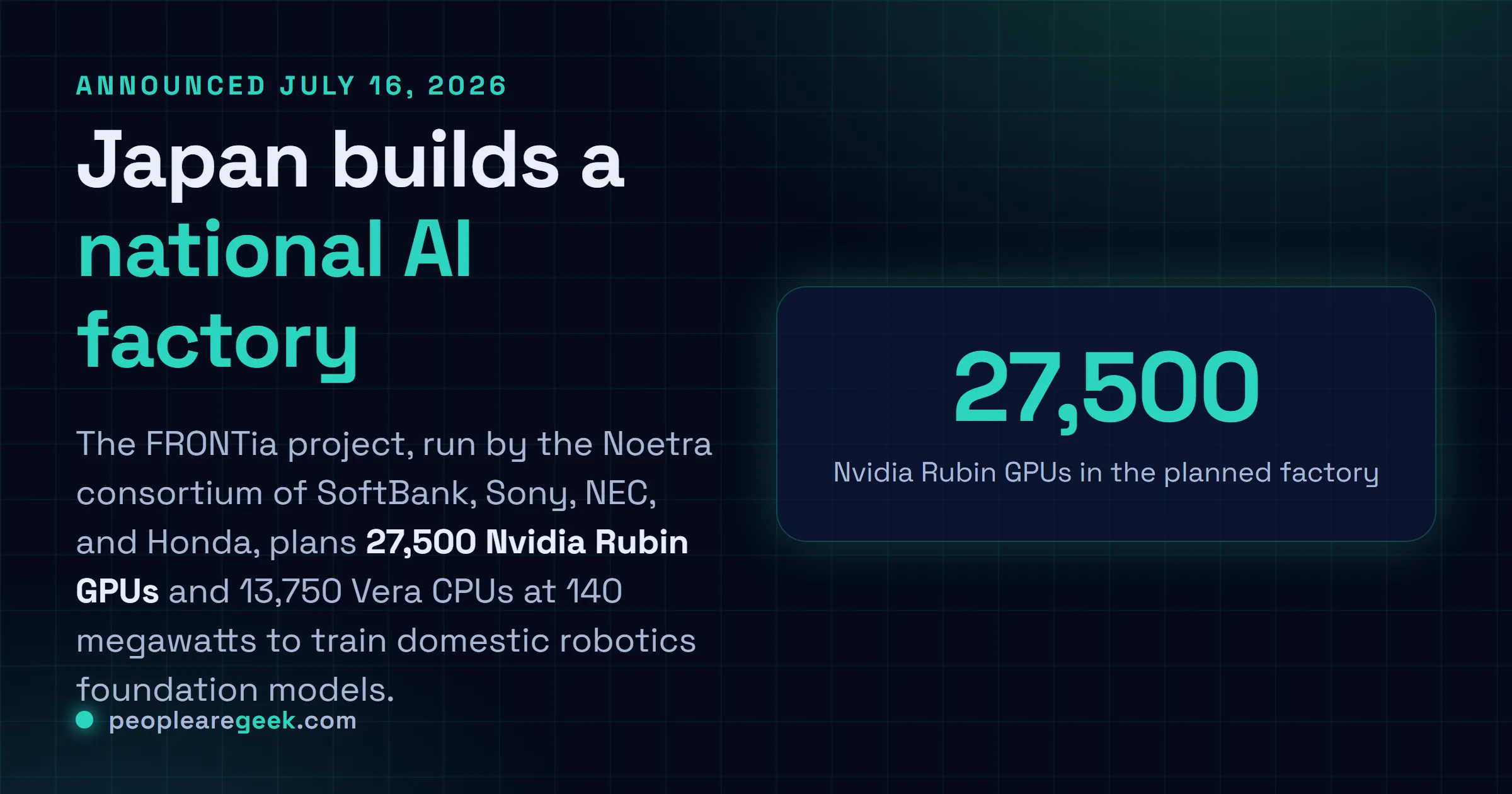
On July 16, 2026, Japan announced what it calls the world's first national AI infrastructure: a single, government backed AI factory built to train the country's own foundation models for robotics. The build sits inside a project named FRONTia, commissioned by the trade ministry and run by a new consortium called Noetra that brings together SoftBank, Sony, NEC, Honda, and around forty four other Japanese companies and institutions. The hardware is not modest. The site is designed to draw 140 megawatts and to hold 27,500 Nvidia Rubin GPUs paired with 13,750 Nvidia Vera CPUs, wired together by an NVLink 6 fabric moving 260 terabytes per second. Funding runs up to one trillion yen, roughly 6.2 billion dollars, over five years. For anyone who works on infrastructure, this is a rare look at what a nation state now considers table stakes for staying in the AI race.
The short answer
On July 16, 2026, Japan unveiled FRONTia, a government backed AI factory it calls the world's first national AI infrastructure. Run by a new consortium named Noetra that includes SoftBank, Sony, NEC, and Honda, the site is designed for 27,500 Nvidia Rubin GPUs and 13,750 Vera CPUs at 140 megawatts, linked by a 260 terabytes per second NVLink fabric. The goal is not another chatbot: it is domestic foundation models for robots, factories, and logistics.
Most AI announcements this year have been about a model or a funding round. This one is about a building. Japan has decided that the way to stay in the AI race is not to license a foreign model or rent capacity by the hour, but to pour concrete, install tens of thousands of accelerators, and train its own foundation models for the machines it is already good at making. That is a different kind of bet, and it is worth understanding on its own terms.
What Japan actually announced
On July 16, 2026, the country launched FRONTia, a program commissioned by the Ministry of Economy, Trade and Industry and described as the world's first national AI infrastructure. The name is a mouthful in full, but the intent is simple: build multimodal foundation models with a view to AI robotics and physical AI, and build them at home.
The delivery vehicle is a newly formed consortium called Noetra Corp. Its membership reads like a cross section of Japanese industry: SoftBank and NEC on the telecom and systems side, Sony on electronics, Honda on automotive and robotics, plus around forty four other companies and research institutions. That composition is the tell. You do not assemble carmakers and electronics firms to build a chatbot. You assemble them to build models that will run on factory lines, in warehouses, and in hospitals.
The hardware, and why the interconnect is the story
The specifications are what make an infrastructure person sit up. The factory is designed to draw 140 megawatts, the power budget of a serious industrial site. Inside it, the plan calls for 27,500 Nvidia Rubin GPUs paired with 13,750 Nvidia Vera CPUs.
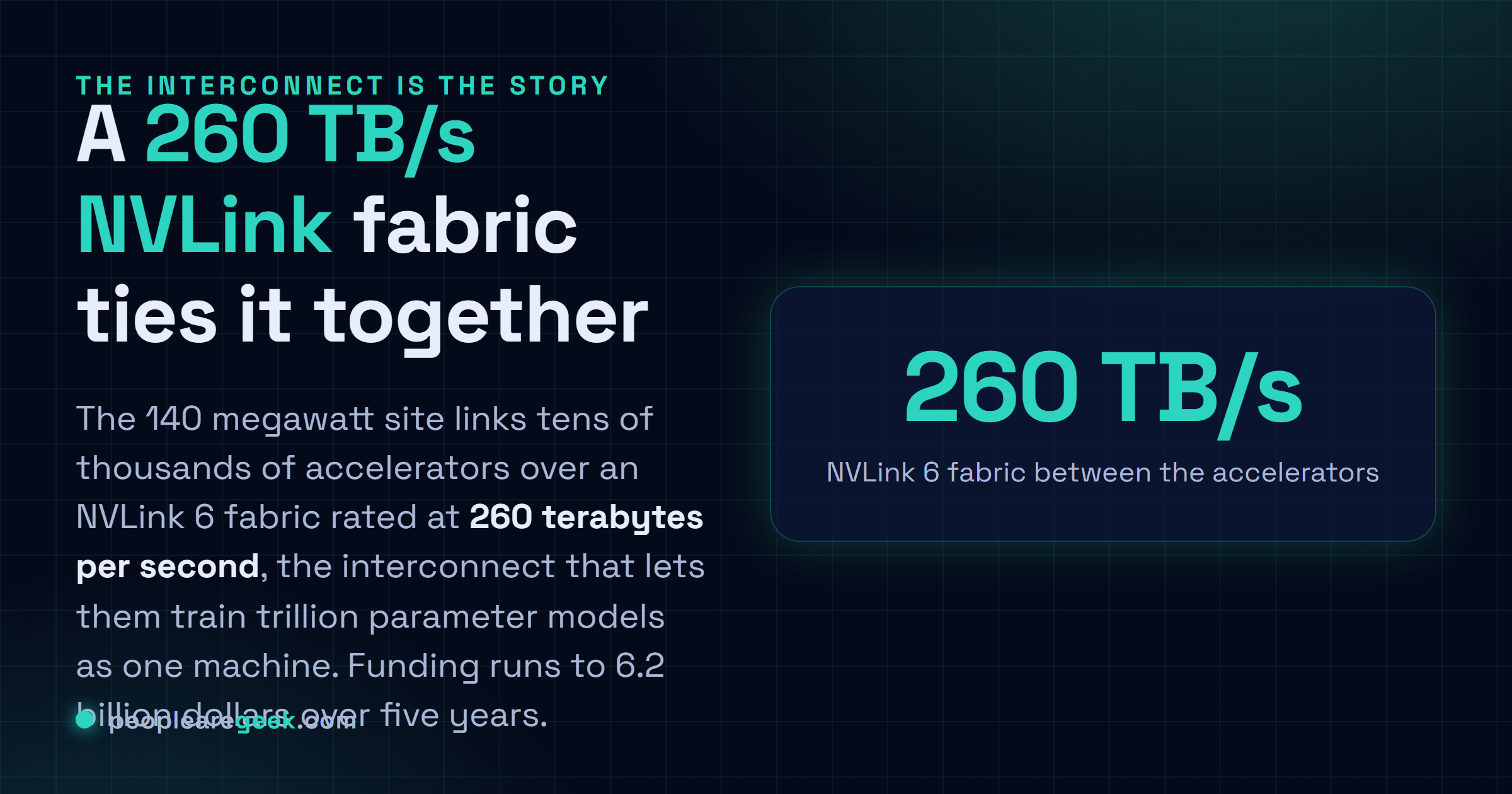
The number that matters most is not the GPU count but the fabric that ties them together: an NVLink 6 interconnect rated at 260 terabytes per second. Training a trillion parameter model is not a job you can split neatly across machines that talk over ordinary networking. The GPUs need to exchange gradients constantly, and the speed of that exchange sets the ceiling on how large a model you can train without the interconnect becoming the bottleneck. A fabric like this is what lets tens of thousands of accelerators behave, for the duration of a training run, like a single enormous computer. When people say compute is the constraint in AI, this is the layer they often forget: the network inside the factory is as much the product as the chips.

Physical AI, not another chatbot
The point of all this hardware is a category that gets less attention than chat models: physical AI. These are models that reason about and act in the physical world rather than only generating text. Think of a robot arm that adapts to an unfamiliar part, a warehouse system that plans around a blocked aisle, or a hospital machine that responds to a real environment. Training that kind of model needs multimodal data, images, sensor readings, motion, and a great deal of compute to learn from it.
Japan has an obvious reason to want this. It has one of the deepest manufacturing and robotics bases in the world, and physical AI is the technology most likely to compound that advantage. Owning the factory and the foundation models, rather than renting both from abroad, is a way to keep that advantage domestic. The stated target domains, manufacturing, logistics, and healthcare, are exactly where an aging, highly industrial economy feels the most pressure.
Why sovereignty is the quiet theme
Read the structure and one word keeps surfacing: sovereignty. A national factory, a domestic consortium, government funding through the research agency NEDO, and open foundation models trained at home. Japan is not just buying compute. It is trying to own the full stack of a strategic technology so that its industrial future does not depend on capacity or models controlled elsewhere.
The funding backs that up. The government is committing up to one trillion yen, roughly 6.2 billion dollars, over five years, with 387.3 billion yen earmarked for the 2026 fiscal year. That is a real, multi year line item, not a press release number.
What we take from it
You are not going to schedule a job on FRONTia, but the shape of it is instructive for anyone who builds or runs infrastructure.
- The interconnect is the constraint, not just the GPU. A 260 terabytes per second fabric is the part of this build that makes trillion parameter training possible. When you size any cluster, the network between the nodes deserves as much attention as the accelerators in them.
- Physical AI is the next large compute sink. Chat models drove the first wave of AI factories. Robotics and physical reasoning are shaping the next one, and they are hungrier for multimodal data and compute, not less.
- Sovereignty is becoming an architecture decision. Nations, and increasingly large enterprises, are choosing to own the factory and the models rather than rent them. Where your models train and who controls that capacity is turning into a first order design question.
FRONTia will take years to prove out, and a spec sheet is not a working model. But as a statement of intent, it is clear: Japan thinks the way to matter in AI is to build the factory yourself.
Sources and further reading
- NVIDIA Newsroom: Japan government, industrial leaders and NVIDIA launch the world's first national AI infrastructure
- Tom's Hardware: NVIDIA and Japan's Noetra consortium to build 140MW Rubin AI factory with 27,500 GPUs
- The Next Web: Japan is building a 140MW AI factory for robots, and Nvidia is supplying all of it
- Engineering.com: NVIDIA and Noetra plan Vera Rubin AI factory in Japan
- GlobeNewswire: Japan government, industrial leaders and NVIDIA launch the world's first national AI infrastructure
Frequently asked questions
What is the FRONTia project?
FRONTia is a national program commissioned by Japan's Ministry of Economy, Trade and Industry to develop domestic multimodal foundation models aimed at AI robotics and physical AI. Rather than rent capacity abroad or depend entirely on foreign models, Japan is funding its own large scale AI factory and its own open foundation models for robotics. The project was announced on July 16, 2026, and is described as the world's first national AI infrastructure of its kind.
Who is actually building it?
The work runs through a new consortium named Noetra Corp. Its members include SoftBank, Sony Group, NEC, and Honda Motor, alongside roughly forty four other Japanese companies and research institutions. That mix matters: it pairs telecom and cloud operators with electronics and automotive firms, which is exactly the blend you want if the goal is foundation models for factories, logistics, and robots rather than chatbots.
What hardware does the factory use?
The factory is sized at 140 megawatts and is planned to hold 27,500 Nvidia Rubin GPUs and 13,750 Nvidia Vera CPUs. Those accelerators are connected by an NVLink 6 fabric rated at 260 terabytes per second, the interconnect that lets tens of thousands of GPUs behave like one machine during training. The scale is aimed at trillion parameter models, the size researchers associate with robust real world physical reasoning.
What is physical AI and why does it need a national factory?
Physical AI refers to models that reason about and act in the real world: robots on a factory line, machines in a warehouse, systems in a hospital. Training those models needs multimodal data and very large compute, and the payoff is strategic for a country with a large manufacturing and robotics base. Japan is betting that owning the factory and the models gives it a durable position in manufacturing, logistics, and healthcare automation.
How is the project funded?
The Japanese government is committing up to one trillion yen, about 6.2 billion dollars, over five years, channeled through the national research and development agency NEDO. Of that, 387.3 billion yen is committed for the 2026 fiscal year. The funding covers the AI factory build and the development of the domestic foundation models it is meant to train.