Nscale, the AI cloud operator that builds its own data centres and generates its own power, agreed on July 30, 2026 to acquire Anyscale, the company founded by the creators of Ray. The deal moves roughly 200 people across the United States, Europe and India into the London based company, and it is expected to close in the second half of 2026 subject to regulatory approval. The part worth reading carefully is not the price, which was not disclosed. It is what happens to Ray, and the answer is less alarming than an acquisition headline usually implies.
The short answer
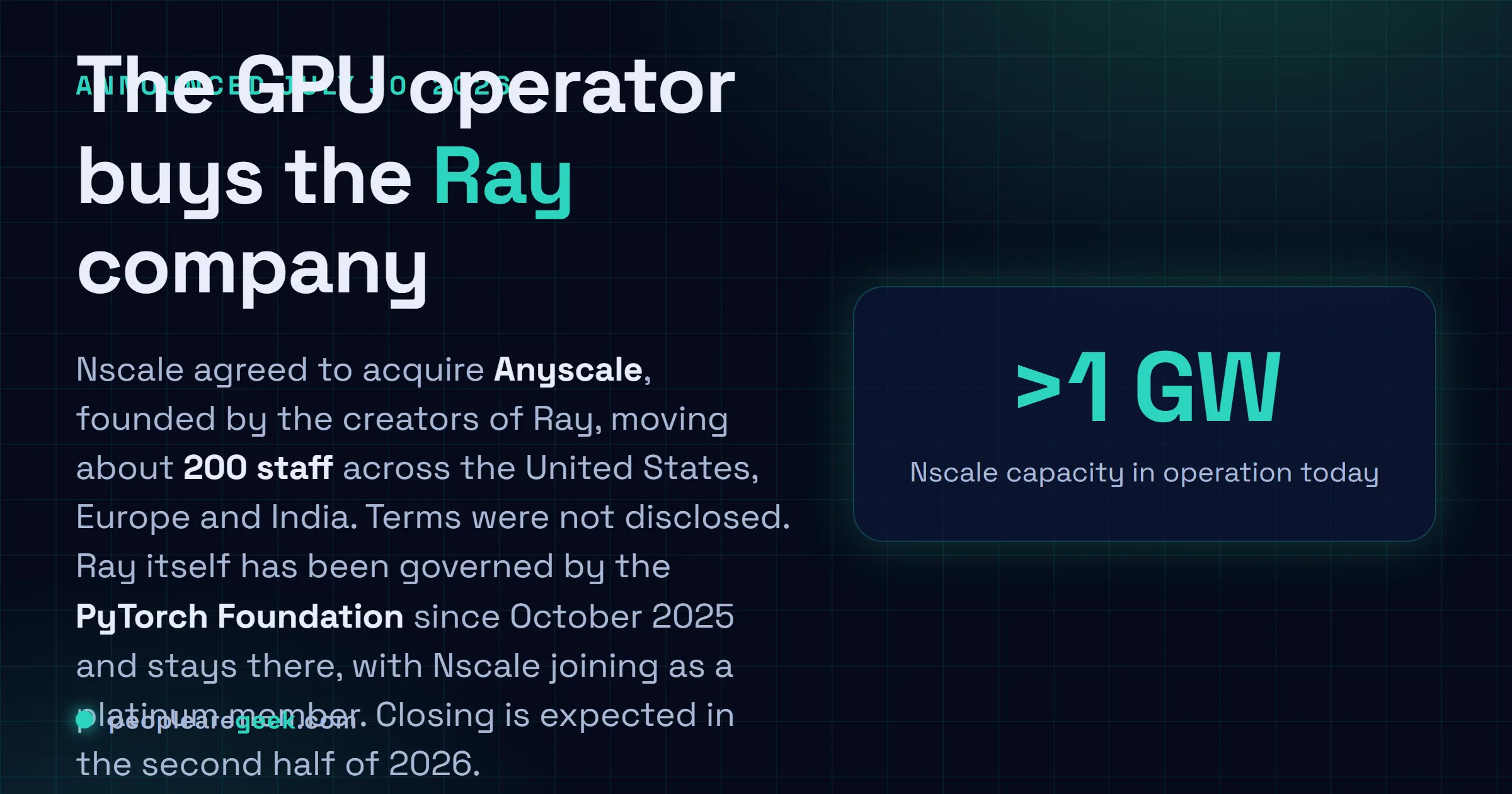
Nscale agreed on July 30, 2026 to acquire Anyscale, the commercial company founded by the creators of Ray. Financial terms were not disclosed, though Bloomberg reported a figure near $1.65 billion. Ray itself has been governed by the PyTorch Foundation since October 2025 and stays there, with Nscale joining the foundation as a platinum member. The Anyscale platform continues to run across all major clouds after closing. The deal puts a workload orchestration layer on top of an operator that runs more than a gigawatt of capacity and generates part of its own power.
When the company behind a widely used open source project gets acquired, the first question from anyone with it in production is always the same, and it is rarely about the buyer. It is whether the project survives the transaction intact. Here the answer was largely settled nine months before the deal was signed.
Ray was already out of the building
Ray moved to the PyTorch Foundation on October 22, 2025, joining PyTorch and the vLLM inference engine under Linux Foundation governance, with 237 million downloads recorded at the time of the transfer. Anyscale was the company built around Ray, offering a managed platform and employing many of its maintainers, but it was not the project's owner at the point of sale.
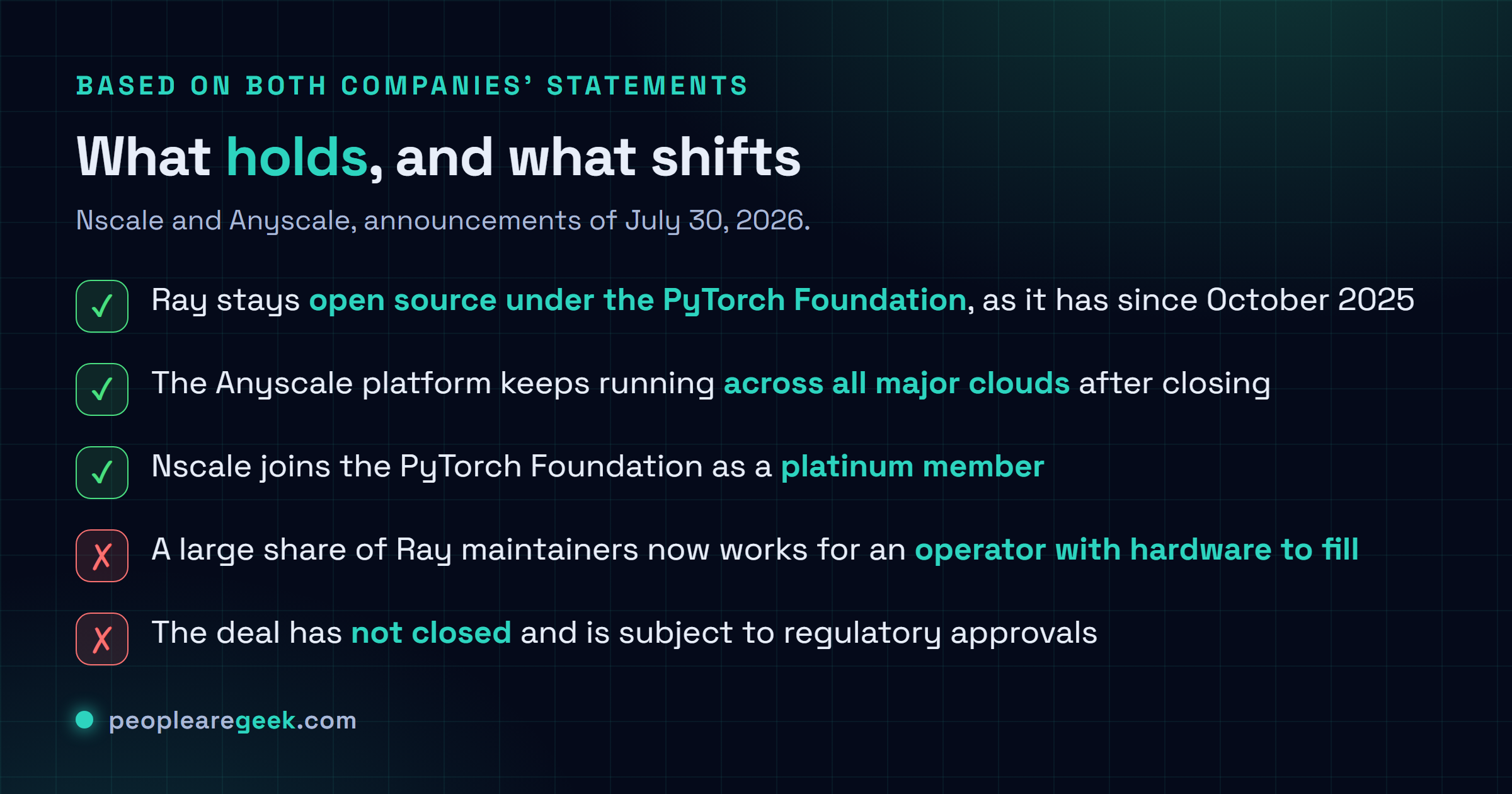
That distinction is the whole difference between this and the acquisitions that end badly. There is no relicensing lever to pull, because the licence sits with a foundation. Nscale says it will join the PyTorch Foundation as a platinum member and invest in Ray's continued development, which is the expected move for a buyer whose value now depends on the project staying healthy.
What does change is employment concentration. A large share of the people who maintain Ray will work for an infrastructure operator with its own hardware to fill. Foundation governance constrains what can be done to the licence and the trademark; it does not constrain which features get engineering time. That is the thing to watch over the next several releases, and it is a slower and quieter risk than a licence change.

What Nscale brings to the other side
Nscale is not a reseller of someone else's capacity. It operates more than a gigawatt today, holds a letter of intent with Microsoft covering 1.35 GW at the Monarch campus in Mason County, West Virginia, and is building that campus around NVIDIA Vera Rubin NVL72 systems with delivery tranches beginning in late 2027. It generates part of its own power using Caterpillar natural gas generators, scaling toward 2 GW by the first half of 2028, and has committed $2.5 billion to data centre investment in the United Kingdom. On July 7, 2026 it closed a $900 million revolving credit facility syndicated by J.P. Morgan, Goldman Sachs, Morgan Stanley and MUFG.
That profile is the point of the deal. Owning power, buildings and racks without owning the layer engineers touch means competing on price per GPU hour, which is a difficult place to be. The same logic explains why Vera Rubin capacity is being contracted years ahead of delivery and why hyperscalers keep saying demand exceeds capacity. Everyone building at this scale is trying to move up the stack, because the bottom of it is a commodity.
The roadmap items worth noting
Anyscale published the technical priorities for the combined company, and they are unusually concrete for a merger announcement. GPU native data processing and GPU memory management. A large scale inference platform. Topology aware scheduling. Deeper Kubernetes integration. Deployment on next generation accelerators including GB300 NVL72 systems.
Topology aware scheduling is the one that should catch a systems engineer's eye. Once a job spans multiple NVL72 racks, the interconnect is no longer uniform, and two Ray actors that exchange tensors constantly will behave very differently depending on whether they landed inside the same NVLink domain or across a slower hop. Ray's scheduler has historically treated resources fairly abstractly. A vendor that owns the fabric layout has both the information and the motivation to fix that, and it is exactly the kind of improvement that is hard to build without hardware access.
The GPU native data preparation work has a similar flavour. Anyone who has run a Ray Data pipeline into a training job knows that host memory and CPU side decoding become the ceiling long before the GPUs are saturated.
What to do about it if you run Ray
Nothing this quarter. The deal has not closed, it is subject to regulatory approvals, and the open source project's governance is unchanged. Ray Summit takes place in San Francisco in August 2026 and both companies have said more detail arrives there, which makes it the natural checkpoint.
For teams on the managed Anyscale platform, the sensible posture is to note that multi cloud portability has been publicly stated as a roadmap commitment and to verify it at renewal rather than assume it. For teams running open source Ray on their own Kubernetes, this is closer to good news than bad: a well funded operator now has a direct commercial interest in Ray scaling cleanly across large accelerator fabrics, and that work lands in the same repository everyone else pulls from.
Sources and further reading
- Nscale press release: Nscale acquires Anyscale, enhancing its full stack AI cloud platform
- Anyscale blog: Anyscale signs definitive agreement to join Nscale
- Unite.AI: Nscale buys Anyscale to move up the AI compute stack
- HPCwire: Nscale acquires Anyscale, enhancing its full stack AI cloud platform
- PR Newswire: the full announcement text
Frequently asked questions
Does Ray stop being open source?
No, and the governance structure is the reason. Ray was donated to the PyTorch Foundation on October 22, 2025, joining PyTorch and the vLLM inference engine under the Linux Foundation umbrella, with 237 million downloads recorded at the time of the move. That transfer happened before this acquisition and is not affected by it. Anyscale was the commercial company built around Ray, not the owner of the project. Nscale says it will join the PyTorch Foundation as a platinum member and invest in maintaining and improving Ray. The practical read is that the licence and the governing body are unchanged, and what changes is who employs a large share of the maintainers.
What happens to the Anyscale managed platform and existing customers?
Anyscale says the platform continues to run across all major cloud providers after closing, and that multi cloud portability remains core to the roadmap. Existing customers, a list that publicly includes Coinbase, Runway and Bedrock Robotics, also gain access to Nscale capacity. That commitment is worth reading as a statement of intent rather than a guarantee. Vertical integration creates a natural pull toward the owner's own hardware over time, and the honest position for anyone running Anyscale in production is that nothing changes this quarter and the roadmap deserves a check at the next renewal.
What does Nscale actually own on the infrastructure side?
More than a gigawatt of operating capacity, plus a letter of intent with Microsoft covering 1.35 GW at the Monarch campus in Mason County, West Virginia, built around NVIDIA Vera Rubin NVL72 systems with tranches starting late 2027. Nscale generates part of its own power, with Caterpillar natural gas generators scaling toward 2 GW by the first half of 2028, and has committed $2.5 billion to data centre investment in the United Kingdom. On the financing side, it closed a $900 million revolving credit facility on July 7, 2026, syndicated by J.P. Morgan, Goldman Sachs, Morgan Stanley and MUFG. That is the fleet Ray workloads would be scheduled onto.
What is the technical roadmap for the combined company?
Anyscale listed the priorities in its own announcement, and they read like a list of the things that hurt when you run Ray at scale. GPU native data processing and GPU memory management, so that data preparation stops bottlenecking on host memory. Large scale inference platform work. Topology aware scheduling, which matters enormously once a job spans several NVL72 racks and the interconnect layout stops being uniform. Deeper Kubernetes integration. Deployment on next generation accelerators including GB300 NVL72 systems. If you have ever debugged a Ray job that was slow because two actors that talk constantly landed on opposite ends of a fabric, topology aware scheduling is the line that matters.
Was a price disclosed?
Not officially. Both companies said financial terms were not disclosed. Bloomberg reported a valuation of roughly $1.65 billion citing a person familiar with the matter, and that figure has circulated widely, but it is not a company statement and should be treated as reporting rather than fact. What both sides did disclose is more useful for judging the deal anyway: Anyscale reported over 70% quarter on quarter revenue growth in its last quarter, and the entire team of about 200 people is moving across.