Microsoft reported its fiscal fourth quarter on July 29, 2026, and Azure passed $100 billion in annual revenue for the first time, growing 43% in the quarter. The sentence worth reading twice came from CFO Amy Hood, who said customer demand for cloud services still exceeds available capacity. That is the same company that spent about $41 billion on capital expenditure and finance leases in a single quarter, and that guides above $50 billion for the next one. If you plan capacity on Azure, the constraint you keep hitting is not a billing problem. It is physics, and Microsoft is telling you so on the record.
The short answer
Microsoft published its fiscal 2026 fourth quarter on July 29, 2026. Revenue was $90.0 billion, up 18%, with net income of $35.8 billion and diluted earnings per share of $4.81. Azure passed $100 billion of annual revenue for the first time and grew 43% in the quarter. Capital expenditure and finance leases reached about $41 billion, and the company guides above $50 billion for the first quarter of fiscal 2027. CFO Amy Hood said demand for cloud services still exceeds available capacity, and that roughly two thirds of the spending goes to CPUs and GPUs rather than buildings.
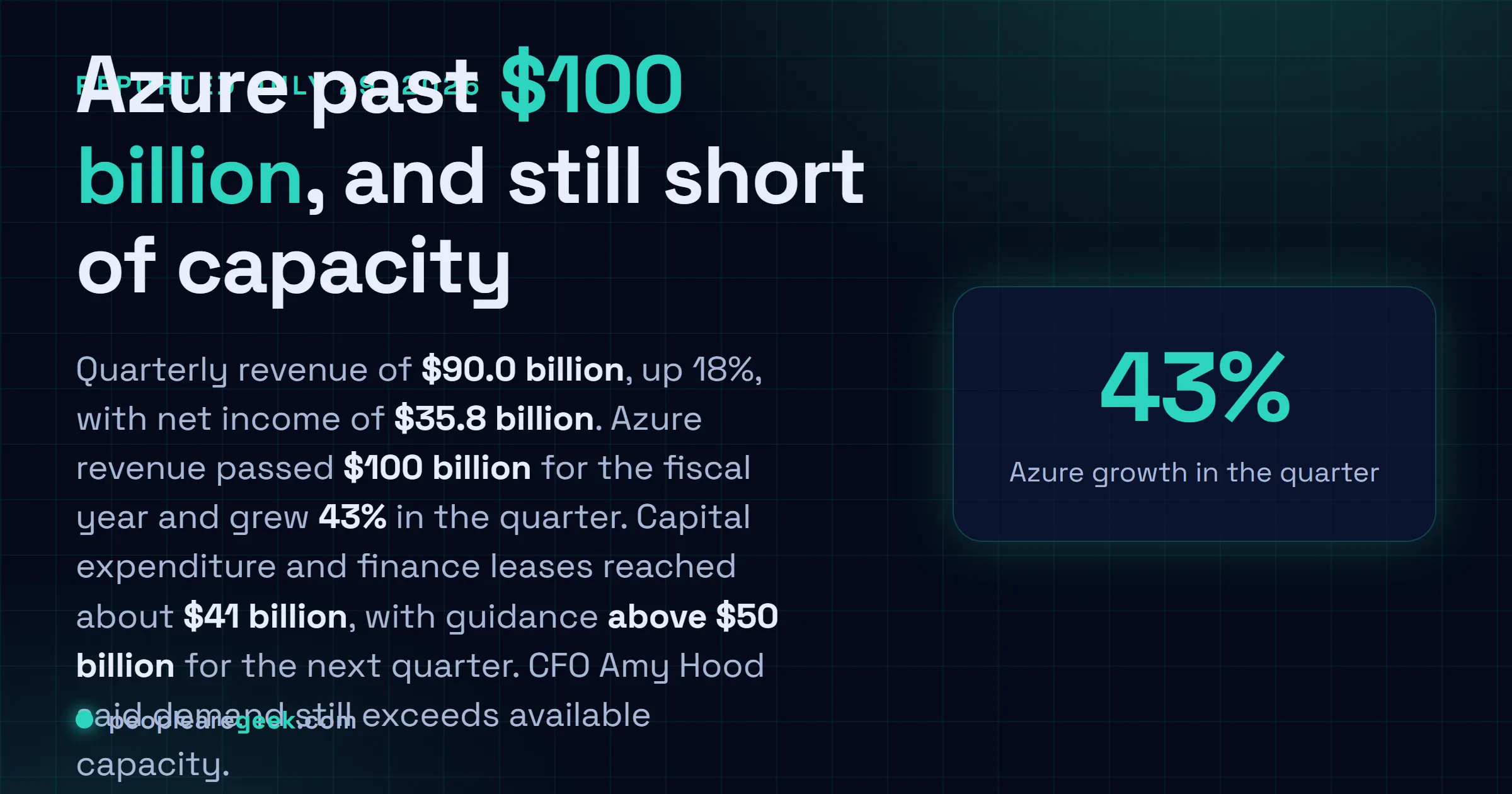
Earnings coverage usually stops at the growth rate, and for a cloud engineer the growth rate is the least useful number in the release. The line we went back to twice was Amy Hood saying that customer demand for cloud services currently exceeds available capacity. A vendor that just spent $41 billion in ninety days is telling its customers, on a public call, that it cannot serve everyone who wants to buy.
What is in the numbers
Revenue for the quarter ending June 30, 2026 was $90.0 billion, up 18% year over year. Operating income rose 18% to $40.6 billion, net income rose 31% to $35.8 billion, and diluted earnings per share reached $4.81, up 32%. Operating cash flow was $55.4 billion, up 30%.
Microsoft Cloud, which folds Azure together with the commercial slices of Microsoft 365, Dynamics and LinkedIn, brought in $59.3 billion, up 27%. The Intelligent Cloud segment reported $39.3 billion, up 32%. Azure and other cloud services grew 43%, comfortably past the 39% to 40% Microsoft had guided.
The milestone is the annual figure. Microsoft confirmed that Azure revenue passed $100 billion across fiscal 2026, up from around $75 billion a year earlier. Microsoft rarely discloses an Azure total at all, which is part of why the number travelled.
Two smaller items are worth noting. Microsoft 365 Copilot is now above 30 million paid seats, up about 50% from the prior quarter. And the quarter included a gain of roughly $3.2 billion on the Anthropic investment, which is not operating income and should not be read as one.
The capacity sentence is the story

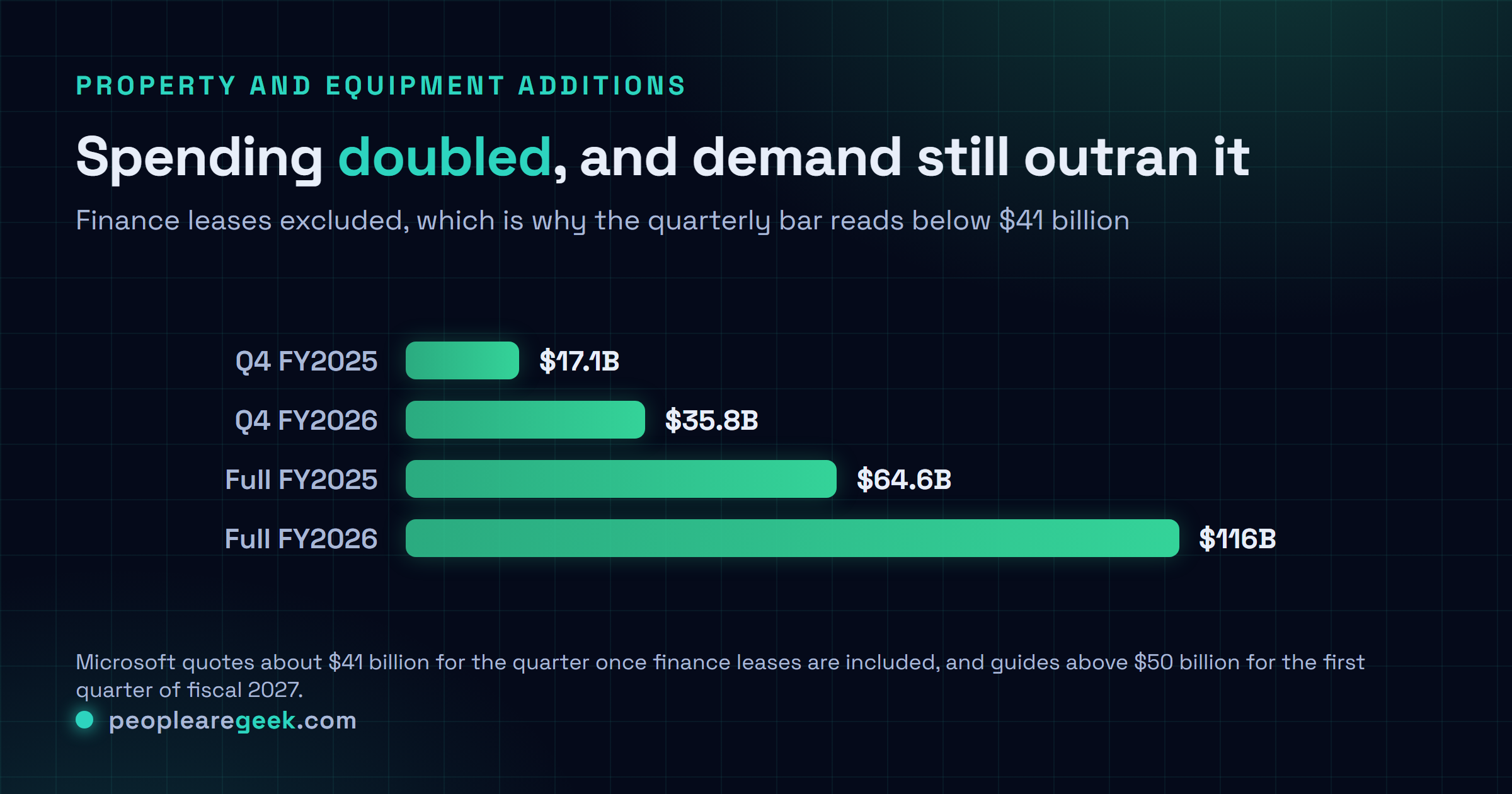
Property and equipment additions were $35.8 billion in the quarter, more than double the $17.08 billion of the same quarter last year. Including finance leases, Microsoft puts the total at about $41 billion, up 69%. Across the fiscal year, property and equipment additions came to roughly $116 billion against $64.6 billion in fiscal 2025. Guidance for the first quarter of fiscal 2027 is above $50 billion.
And demand still exceeds capacity. That combination is the useful signal, because it tells you the shortage is not going to be solved by a bigger cheque next quarter. We wrote about the same wall from the other direction when AMD started signing its own fifteen year power leases and when a single line fault dropped 3 GW of data center load in Virginia. Substations, transformers and interconnect queues run on multi year clocks, and capital does not compress them past a point.
Two thirds of it is silicon, not concrete
Hood's breakdown is the detail we would keep. About two thirds of the capital expenditure goes to short lived assets, which in practice means CPUs and GPUs, with the remaining third in land, shells and long lived plant.
That ratio is good news for anyone waiting on capacity, up to a point. Servers arrive faster than substations, so a spend mix weighted toward silicon converts into billable capacity sooner than a spend mix weighted toward buildings. The catch is that it only works where the shell and the power already exist. Racking accelerators into a site that has not been energised does nothing, which is why the two thirds figure and the demand constraint coexist without contradiction.
Read the capex line carefully this year
Microsoft made two accounting adjustments that change how the same spending looks on paper.
The assumed useful life of office and data center buildings goes from 15 years to 25 years. Depreciation for a given asset therefore spreads across a longer period, and the annual charge falls without anything changing physically. Separately, more future data center leases will be booked as operating leases rather than finance leases, which shifts them out of the finance lease line.
The practical consequence for anyone tracking hyperscaler spend across quarters is mundane but easy to get wrong: check whether the number in front of you includes finance leases. The gap between $35.8 billion and about $41 billion for the same quarter is entirely definitional.
What we would change in a capacity plan
If a vendor says on the record that demand exceeds supply, the correct response is to stop treating on demand availability as a given.
Three things worth doing. Get accelerator capacity committed contractually ahead of the project rather than in parallel with it, because the queue is real and it is longer than a procurement cycle. Qualify a second region for every workload that can tolerate one, so a capacity denial in your primary region is an inconvenience rather than a stall. And keep GPU family selection in configuration rather than in code, so substituting a part you can actually get does not turn into an engineering project.
The $678 billion commercial remaining performance obligation, up 84%, is the number that makes this concrete. That is contracted revenue Microsoft has not yet delivered, and a large share of it is capacity that has been promised to somebody. When you are queueing for a region, you are queueing behind that book.
Sources and further reading
- Microsoft FY26 Q4 earnings press release and webcast
- The Register: Microsoft earnings Q4 26, cloud brings revenue rain
- CNBC: Microsoft jumps 8% as it boosts capital spending plans, citing demand
- Fortune: Azure crosses $100 billion in annual revenue
- Benzinga: Amy Hood on surging capex and GPU spending
Frequently asked questions
What did Microsoft actually report for its fiscal fourth quarter?
Revenue of $90.0 billion, up 18% year over year, with operating income of $40.6 billion, also up 18%. Net income was $35.8 billion, up 31%, and diluted earnings per share came in at $4.81, up 32%. Microsoft Cloud, the bucket that bundles Azure with the commercial parts of Microsoft 365, Dynamics and LinkedIn, reached $59.3 billion for the quarter, up 27%. The Intelligent Cloud segment reported $39.3 billion, up 32%. Across the full fiscal year, revenue was $331.8 billion, operating income $155.2 billion and net income $133.7 billion. The quarter ended June 30, 2026, and the results were published on July 29.
Does Microsoft break out Azure revenue on its own?
Not line by line in the quarterly statement, which is why the $100 billion milestone is notable as a disclosure rather than as a number. Microsoft normally reports Azure as a growth percentage inside Microsoft Cloud, and it confirmed that Azure revenue surpassed $100 billion for the first time across fiscal 2026, up from roughly $75 billion the year before. The quarterly growth figure was 43% for Azure and other cloud services, ahead of the 39% to 40% the company had guided. Treat the annual total as the useful anchor and the quarterly percentage as the trend line, because the two are measured differently.
How much is Microsoft spending on infrastructure, and on what?
Property and equipment additions were $35.8 billion in the quarter, more than double the $17.08 billion of the year ago quarter. Add finance leases and the figure Microsoft quotes is about $41 billion, up 69%. For the full fiscal year, property and equipment additions came to roughly $116 billion against $64.6 billion in fiscal 2025. Amy Hood said about two thirds of that spend goes to short lived assets, meaning CPUs and GPUs rather than concrete and steel. That split matters because servers depreciate on a much shorter schedule than shells, so the mix tells you how quickly the spending converts into billable capacity.
What is the accounting change about buildings and leases?
Two adjustments, both about how existing spending appears rather than how much of it there is. Microsoft is extending the assumed useful life of office and data center buildings from 15 years to 25 years, which spreads depreciation over a longer period and reduces the annual charge for the same asset. Separately, more future data center leases will be recorded as operating leases instead of finance leases, which changes where they land on the balance sheet and in the capital expenditure line. Neither change adds a server. When you compare capex numbers across quarters this year, check whether the figure you are reading includes finance leases, because the headline moves by several billion depending on the answer.
If demand exceeds capacity, what should I do differently on Azure?
Plan as if the SKU and the region you want may not be available on the day you need it, because that is what a capacity constraint means in practice. Reserve accelerator capacity ahead of the project rather than alongside it, keep a second region qualified for the workloads that can tolerate one, and design so that a GPU family substitution is a configuration change rather than a rewrite. It is also worth asking your account team for committed capacity in writing instead of relying on on demand availability. The $678 billion commercial remaining performance obligation, up 84%, is a good proxy for how much of the pipeline is already promised to someone else.