NVIDIA’s August filing is a snapshot of reportable holdings on June 30. Its largest positions deserve a closer look, but market value should not be confused with money newly invested.
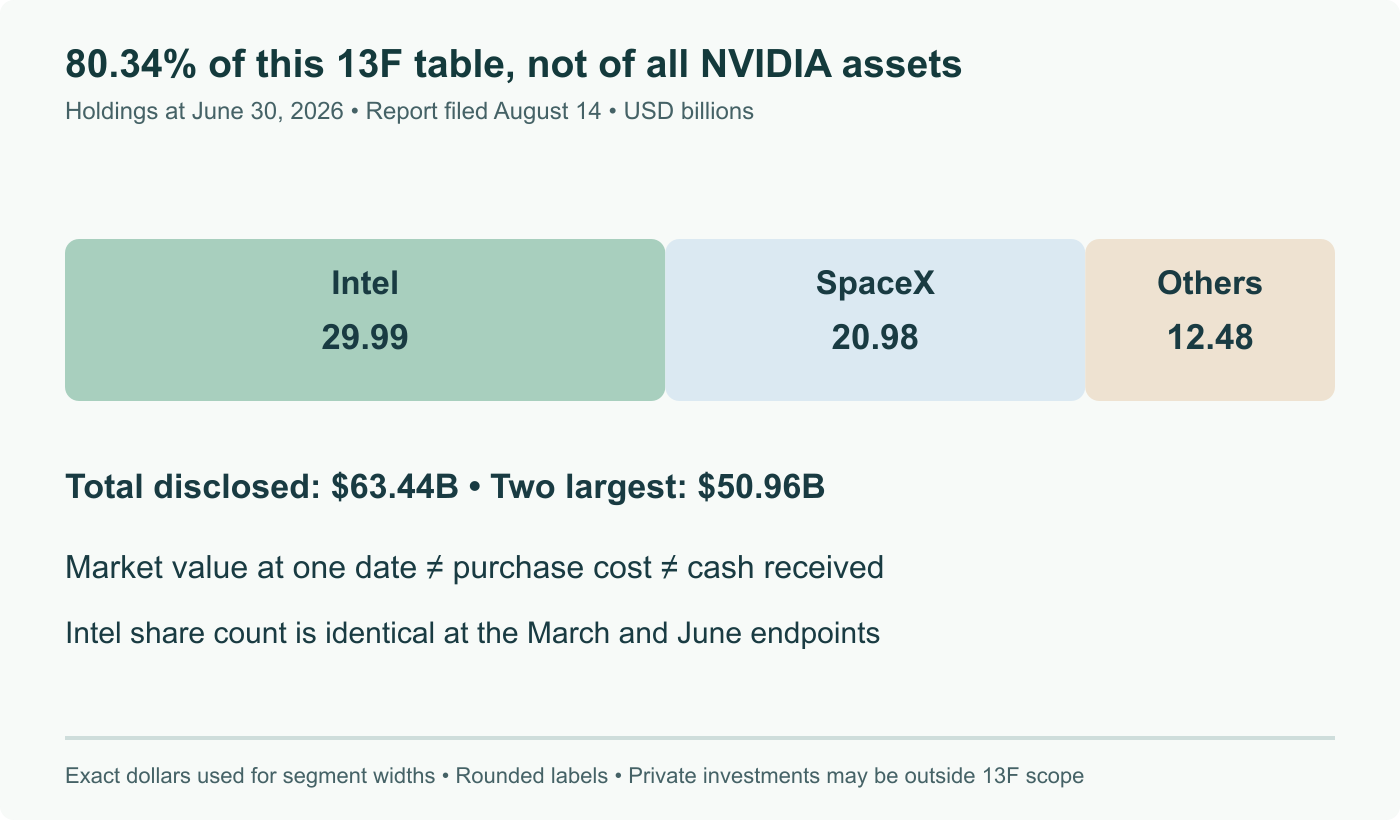
Read shares and value in separate columns
The June information table lists 214,776,632 Intel shares worth $29.99 billion and 122,764,805 SpaceX shares worth $20.98 billion. Against the cover sheet's $63.44 billion total, the pair represents about 80.34%. That denominator is this 13F table, not NVIDIA's total assets or every private investment.
The report provides values at a historical date. It is neither a current valuation feed nor a complete list of transactions during the quarter. A first appearance in a report does not, on its own, establish when an investment was originally made.
Intel illustrates why the distinction matters
Intel's December 2025 filing records issuing 214,776,632 shares to NVIDIA for $5 billion cash. NVIDIA's March 31 table shows that same share count, valued at $9.48 billion. June again shows the same count at a much higher value.
Equal endpoint counts do not exclude offsetting trades between the dates. They do show why the increase in reported value cannot simply be labelled a new purchase of the entire amount. Nor is a larger market value equivalent to cash proceeds from a sale. The earlier article attributed the increase to a particular business recovery without establishing that cause from the filing.
Arm was already absent from the March table
Neither of the two quarterly tables includes Arm. The June snapshot therefore does not support presenting an Arm exit as a newly established second-quarter transaction. Its timing requires earlier records, not an inference from one missing row.
Likewise, share ownership alone does not prove an exclusive supply contract, priority allocation or the lead time offered to another hardware buyer. Those questions require commercial announcements and actual delivery evidence.
Keep the Ohio guarantee in its own document
The earlier article combined the 13F with changing reports about an OpenAI infrastructure backstop. The later primary disclosure belongs to a different arrangement: see our review of the $105 billion PORTS-Pike guarantee.
A holdings table, a purchase agreement and a guarantee disclosure each answer a different question. Keeping their dates, units and scope explicit produces a more useful map of NVIDIA's relationships than combining every large dollar figure into one spending total.
Read June and March primary 13F tables; calculate concentration in report scope, distinguish Intel purchase cost from market value, correct Arm already absent in March and separate Ohio guarantee.