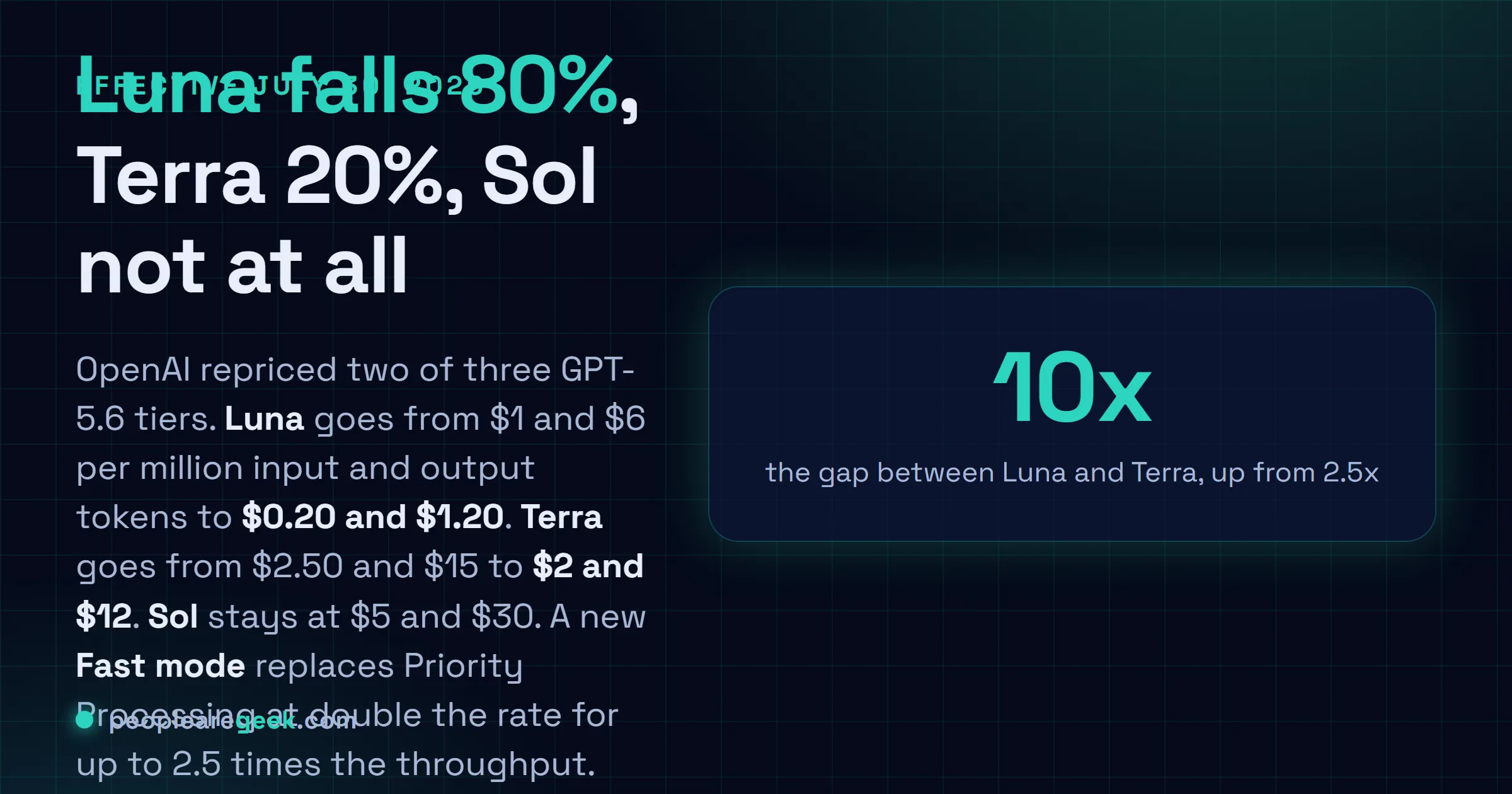
OpenAI repriced two of its three GPT-5.6 tiers on July 30, 2026. Luna now costs 20 cents per million input tokens and $1.20 per million output tokens, down from $1 and $6, an 80% cut on both sides of the meter. Terra drops 20%, to $2 and $12. The flagship Sol stays at $5 and $30. The family only reached general availability on July 9, so this is a repricing three weeks into its commercial life, and it changes the arithmetic of tier selection more than most price cuts do.
The short answer
OpenAI lowered the API price of two GPT-5.6 tiers on July 30, 2026. Luna fell 80%, from $1 and $6 per million input and output tokens to $0.20 and $1.20. Terra fell 20%, from $2.50 and $15 to $2 and $12. The flagship Sol is unchanged at $5 and $30. A new Fast mode replaces Priority Processing, offering up to 2.5 times the throughput at double the standard rate. OpenAI credits serving optimisations, including GPU kernel rewrites worth 20% of end to end cost and speculative decoding gains above 15%.
Price cuts are usually boring to write about, because the useful reaction is to multiply your invoice by a number and move on. This one is different, and the reason has nothing to do with the size of the discount. It is that the cut was applied unevenly across the family, and uneven cuts change routing decisions in ways uniform cuts do not.
The numbers, and the ratio that matters
Three weeks ago the GPT-5.6 family reached general availability with a fairly conventional ladder: Luna at $1 and $6 per million input and output tokens, Terra at $2.50 and $15, Sol at $5 and $30. Each rung cost roughly two and a half times the one below it.

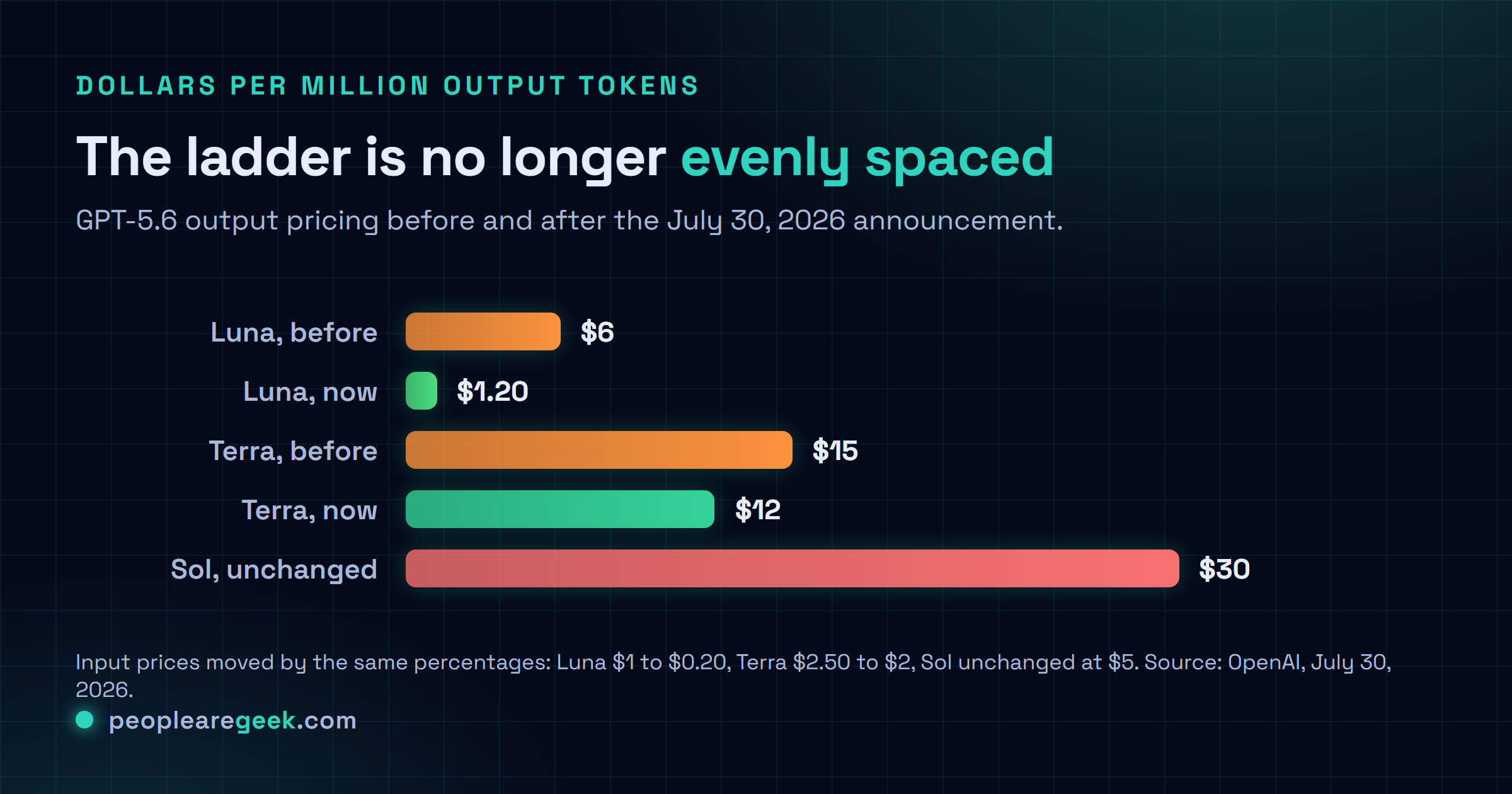
After July 30 the ladder is no longer evenly spaced. Terra costs ten times Luna. Sol costs twenty five times Luna. The gap between the cheapest and most expensive tier went from 5x to 25x on both sides of the meter.
If you run a high volume classification, extraction or routing workload, that is the whole story. Under the old rate card, defaulting to Terra because it was a little more reliable cost you 2.5x, which most teams accepted as insurance. Under the new one, the same defensive habit costs 10x. On a pipeline pushing fifty million input tokens a day, that is the difference between roughly $100 and roughly $10 per day on input alone.
Where the savings came from
OpenAI's explanation is unusually specific for a pricing post, and it is worth reading as an engineering statement rather than marketing. Two figures were given. Rewritten GPU kernels reduced end to end serving cost by 20%. Improvements to speculative decoding raised token generation efficiency by more than 15%. The company added that GPT-5.6 Sol contributed to the kernel rewrites itself.
Neither number on its own explains an 80% cut, and OpenAI did not claim it did. A reduction that large is a margin decision layered on top of a cost improvement, which is the normal way these announcements work. What the disclosed figures do tell you is where the industry's attention has moved. Serving cost per token, not benchmark position, is what the frontier labs are currently optimising, and the same shift is visible in Anthropic halving the price of its top tier earlier this month.
Fast mode changes the latency calculation
Alongside the cuts, Priority Processing has been retired in favour of Fast mode. The deal is simple: up to 2.5 times standard throughput, at exactly double the standard rate. Luna Fast is $0.40 and $2.40, Terra Fast is $4 and $24, Sol Fast is $10 and $60.
The interesting comparison is diagonal rather than vertical. Luna in Fast mode costs less than a fifth of standard Terra. If what you needed from the middle tier was responsiveness rather than reasoning, the cheaper path is now to buy speed at the bottom of the ladder rather than capability in the middle. That was not true a week ago, when Luna Fast at $2 and $12 was priced identically to standard Terra.
There is also a smaller detail worth noting: Luna in Fast mode today costs less than Luna in standard mode did on July 29. Anyone who was already paying for Priority Processing on the cheap tier gets both a discount and a throughput change in the same move.
What to actually do this week
Re-run the routing evaluation. That is the only action item that carries real money.
Most production stacks that use a model family end up with a static routing rule written during the first week of integration, usually erring upward because the cost delta was small and the reliability delta was not measurable yet. The delta is no longer small. If you have never measured what percentage of your traffic Luna handles correctly against your own evaluation set, the value of that measurement just increased by roughly a factor of four.
Two practical cautions. First, prices that move this fast in one direction can move in the other, so avoid rearchitecting around a single tier. Second, a repricing three weeks after general availability is a reminder that per token cost is now a soft number, and anything you commit to in an annual contract should be sized against that volatility. The tier by tier capability differences have not changed, only what they cost, so any evaluation you ran at launch is still valid on quality and obsolete on economics.
Sources and further reading
- CNBC: OpenAI cuts prices for two of its GPT-5.6 AI models as companies grow sensitive to costs
- VentureBeat: AI price wars, OpenAI cuts GPT-5.6 Luna prices by 80%
- Unite.AI: OpenAI cuts API prices on its two cheaper GPT-5.6 tiers
- Axios: OpenAI discounts GPT-5.6 Luna and Terra
- OpenAI: advancing the price performance frontier with GPT-5.6
Frequently asked questions
What exactly changed, and when does it take effect?
OpenAI announced the new API rates on July 30, 2026, effective immediately. GPT-5.6 Luna moved from $1 per million input tokens and $6 per million output tokens to $0.20 and $1.20, which is an 80% reduction on both. GPT-5.6 Terra moved from $2.50 and $15 to $2 and $12, a 20% reduction on both. GPT-5.6 Sol, the flagship, was left at $5 and $30. Because each cut applies equally to input and output, you can compute your new bill by multiplying your current spend on those models by 0.2 for Luna and 0.8 for Terra, whatever your input to output ratio happens to be.
Why did OpenAI say it could afford this?
Efficiency work on the serving stack, not a change in model architecture. OpenAI attributed the reduction to optimisations across inference and the agent harness, and gave two specific numbers: rewritten GPU kernels cut end to end serving costs by 20%, and improvements to speculative decoding raised token generation efficiency by more than 15%. The company also said GPT-5.6 Sol itself did some of the kernel rewriting. Treat that last claim as a vendor statement rather than a measured result, but the direction is consistent with what everyone serving large models is doing right now: the frontier moved from training tricks to serving cost per token.
What is Fast mode and should we use it?
Fast mode replaces the old Priority Processing option. It delivers up to 2.5 times standard throughput at exactly double the standard price, so Luna Fast is $0.40 and $2.40, Terra Fast is $4 and $24, and Sol Fast is $10 and $60. The comparison worth making is not Fast versus standard, it is Fast versus the tier above. Luna in Fast mode costs $0.40 and $2.40, which is well under Terra at $2 and $12, so if your bottleneck is latency rather than reasoning depth, buying speed at the bottom tier is now considerably cheaper than buying capability at the middle one. Note also that Luna Fast is still cheaper than Luna was at standard rates yesterday.
Does this change which tier we should default to?
It changes the shape of the decision. Before the cut, Terra cost 2.5 times Luna on both input and output, which is a gap small enough that many teams simply defaulted upward for safety. After the cut, Terra costs 10 times Luna, and Sol costs 25 times Luna. A margin that used to be a rounding error is now the dominant line item on a high volume workload. The practical move is to re-run your routing evaluation rather than assume yesterday's answer holds: measure what fraction of your traffic Luna actually handles correctly, because the cost of being wrong about that fraction just got ten times more expensive in the other direction.
Is this a response to competition?
Partly, and OpenAI has not been shy about the framing. Sam Altman posted on X that the company wants to offer the best price and intelligence tradeoff at every level. Reporting around the announcement consistently cites two pressures: enterprise buyers becoming sensitive to AI line items after a year of unbudgeted growth, and cheaper models from Chinese labs closing the gap at the low end. Anthropic moved in the same direction earlier this month when it halved the price of its top tier. The pattern across the market is that headline capability is no longer the only axis vendors compete on, and cost per million tokens is now moving fast enough that annual contracts are a liability.