GPT-5.6 is not one model, it is three: Sol, Terra and Luna, previewed by OpenAI on June 26, 2026. That is the useful thing to understand up front, because the tiers are not just fast versus slow, they are a deliberate price ladder aimed at different jobs. Sol is the frontier flagship with a new ultra mode. Terra is the workhorse that matches the previous GPT-5.5 at roughly half the price. Luna is the cheap, fast tier for high-volume plumbing. Picking the wrong one either wastes money or underpowers the task, so the real skill is routing. Here is what separates the three, and how to send each job to the tier it belongs in. One caveat up front: GPT-5.6 is still a limited preview, so most of this is about planning, not shipping yet.
The short answer
GPT-5.6 is three tiers, not one. Sol is the frontier flagship with a new ultra mode and subagents, for hard reasoning, agents and complex code. Terra matches the previous GPT-5.5 at about half Sol's price and covers most production work. Luna is the cheap, fast tier for high-volume, simple requests. Route by the job. And note: it is all still a limited preview.
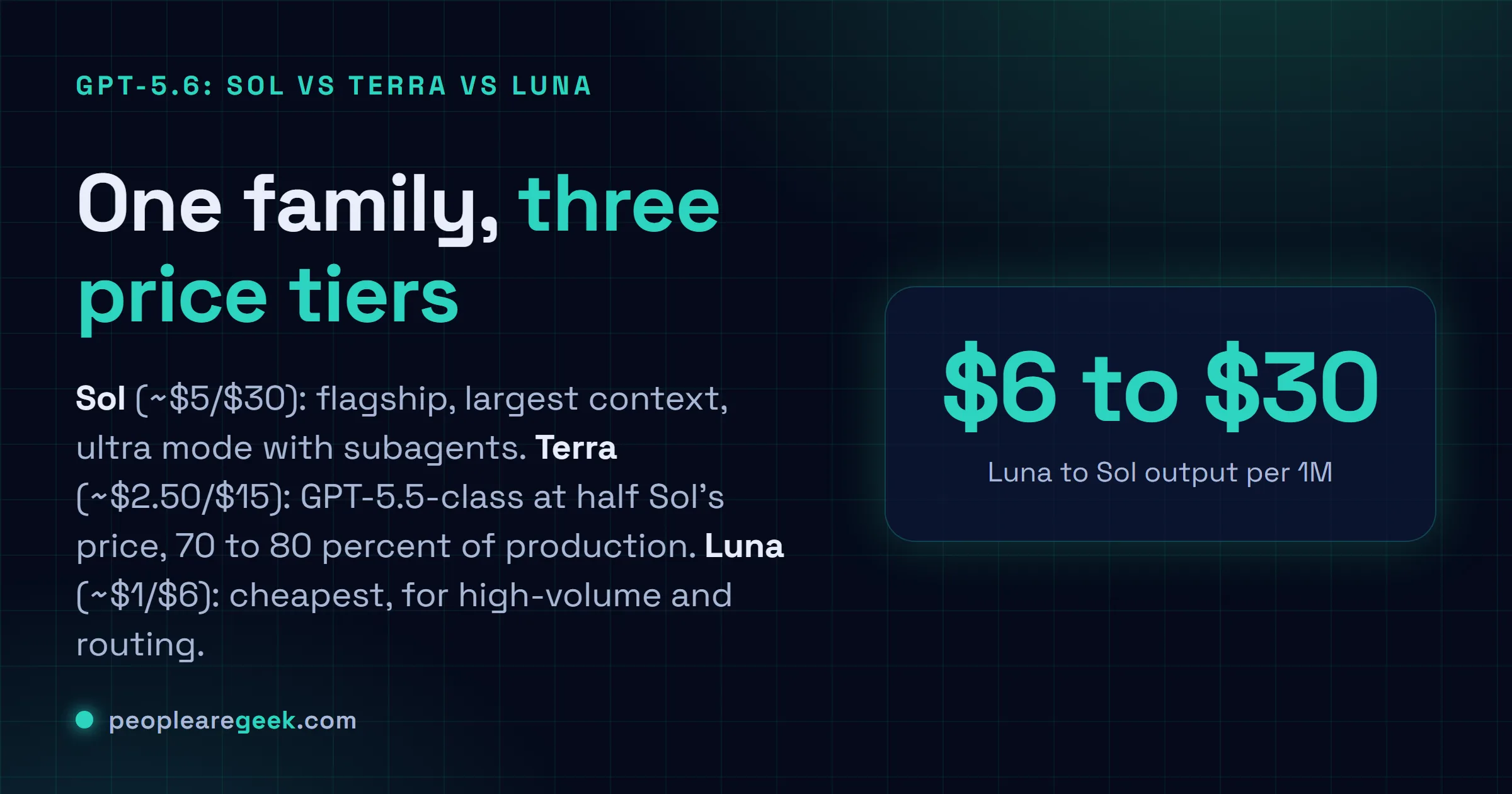
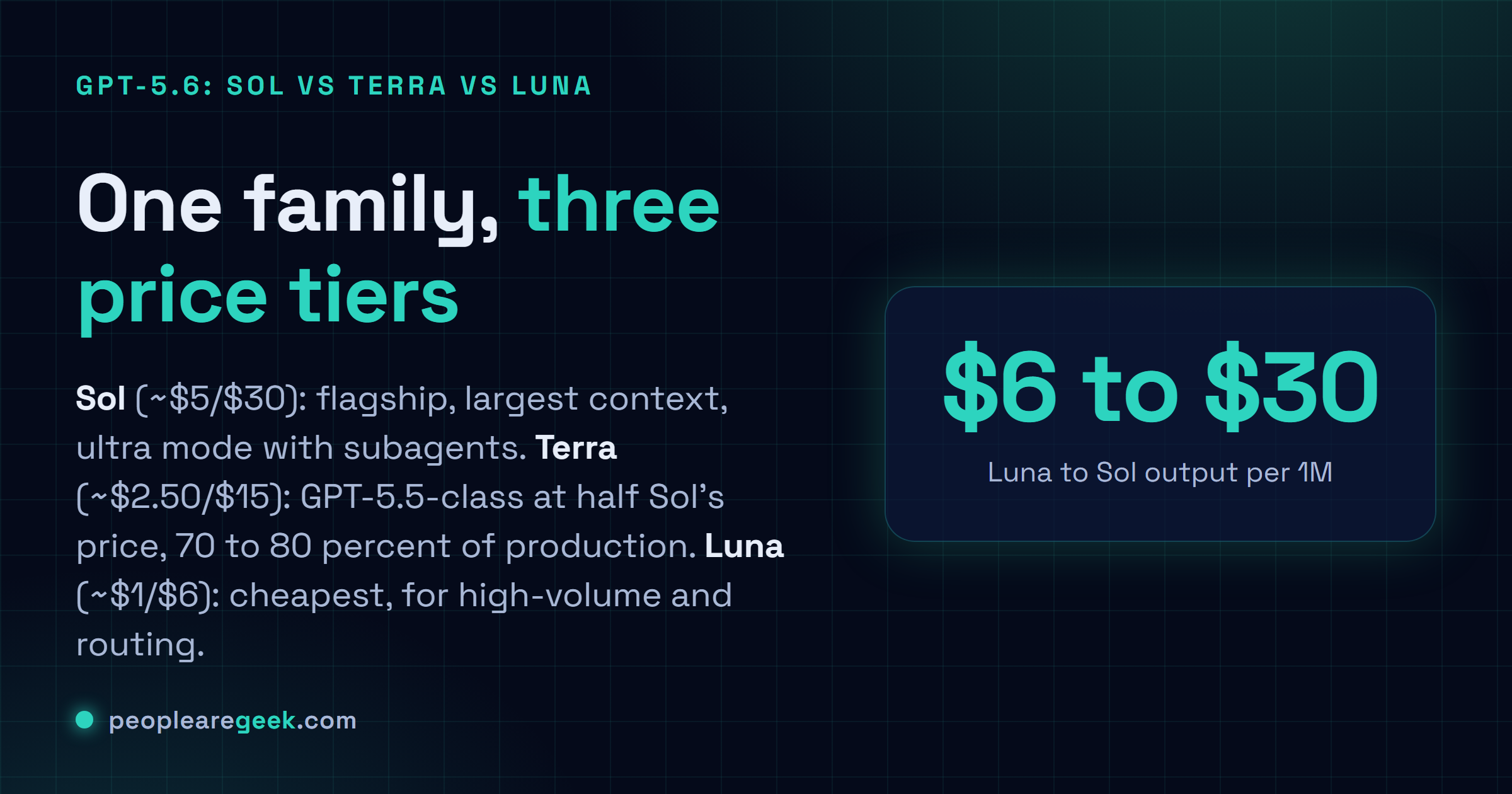
When OpenAI previewed GPT-5.6 on June 26, 2026, the news was not a single new model but a family split into three tiers, each aimed at a different job and a different budget. That structure is the whole point: instead of one model you pay flagship rates for whether the task is hard or trivial, you route. Get the routing right and you can cut a bill dramatically without losing quality where it matters. Get it wrong and you either overpay for simple work or underpower the hard stuff. So this is less a "which is best" comparison (Sol, obviously, on raw capability) than a guide to sending each job to the right door.
The three tiers at a glance
| Tier | Price, per 1M (in/out) | Best for | Notes |
|---|---|---|---|
| Sol | ~$5 / $30 | Autonomous agents, hard reasoning, complex code, research | Flagship; ultra mode with subagents; largest context |
| Terra | ~$2.50 / $15 | Chatbots, RAG, standard production APIs | Matches GPT-5.5 at about half Sol; ~70 to 80% of production |
| Luna | ~$1 / $6 | Classification, routing, preprocessing, high volume | Fastest and cheapest tier |
The ladder is clean: each step is roughly half the price of the one above it. That is what makes tier routing worth the effort, the savings are large and predictable.
Sol: the flagship
Sol is the model you picture when you think GPT-5.6. It has the largest context window of the three and the strongest scores across reasoning, coding, and multi-step problem solving. Its headline feature is ultra mode, which goes beyond a single agent by orchestrating subagents, paired with a new maximum reasoning effort for the hardest problems. On Terminal-Bench 2.1 it scores 88.8, and ultra mode reaches 91.9, the top of the current field.
Sol is the right pick when the task genuinely needs the frontier: autonomous agents that execute long multi-step plans, complex code generation, and research or scientific analysis where the extra reasoning depth and the largest context pay off. It is also the most expensive by a wide margin, so the discipline is to reserve it for the jobs that actually justify 30 dollars per million output.
Terra: the workhorse
Terra is the tier most teams will live in. It delivers roughly the previous GPT-5.5's quality at about half of Sol's price, which turns out to cover the large majority of real production work: customer-facing chatbots, retrieval-augmented pipelines, and standard production APIs. OpenAI's framing, and most early testing, put it at handling 70 to 80 percent of production workloads without a noticeable quality drop.
The practical read: if you were going to default to the flagship for everything, Terra is the tier that says do not. Send the bulk of your traffic here, and only escalate the genuinely hard requests to Sol. For most applications, Terra is the sensible default and the biggest single lever on your bill.
Luna: the volume tier
Luna is the cheapest and fastest, and it is built for a specific shape of work: high volumes of relatively simple requests. Think preprocessing pipelines, classification, and routing layers, the code that decides which downstream model should handle a request, or that cleans and tags data before a bigger model sees it. At about 1 dollar input and 6 output per million, it is roughly a fifth of Sol's price.
The classic pattern is to put Luna at the front of a pipeline as a router: it triages every incoming request cheaply and escalates only the ones that need Terra or Sol. Used that way, Luna is not competing with the bigger tiers, it is what makes running them affordable at scale.
How to route
The whole family becomes simple once you stop thinking about it as three models and start thinking about it as a routing decision.

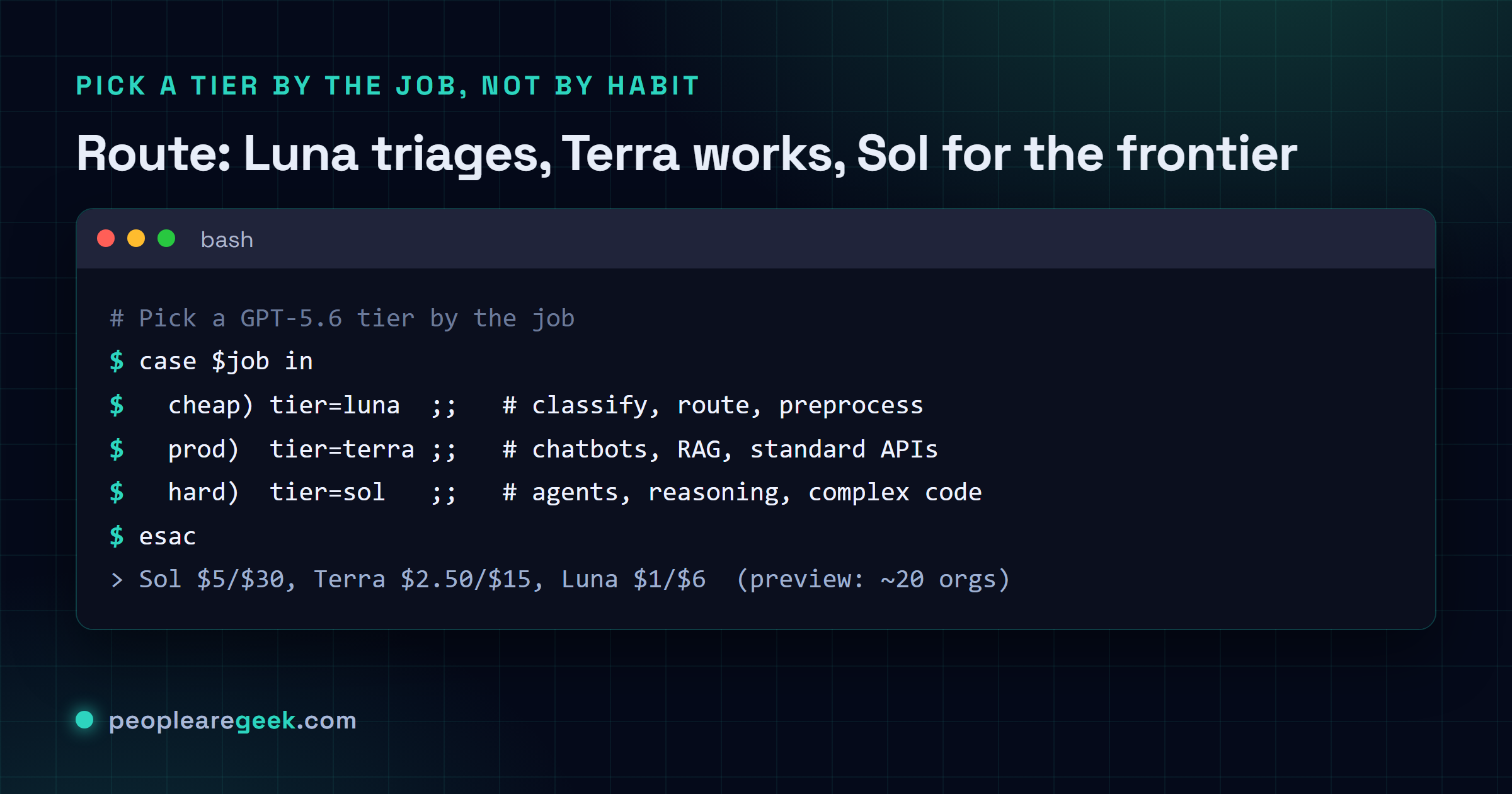
That is the entire strategy: a cheap tier triages, a workhorse tier handles the bulk, and the flagship is reserved for the small share of work that genuinely needs it. It is the same play smart teams already run across model families, and GPT-5.6 packages it inside one.
So which should you use?
If you could use it today, most teams would default to Terra, escalate the hardest jobs to Sol, and put Luna at the front as a cheap router. That three-tier routing is the whole design, and it is a genuinely good one. The catch, and it is a big one right now, is access: GPT-5.6 is a limited preview for about 20 organizations, not something in ChatGPT, with general availability promised in the coming weeks.
Until it opens up, the practical move is to plan your routing now and, if you need a comparable model you can actually ship on today, look at Claude Sonnet 5, which we put head to head with GPT-5.6 in Claude Sonnet 5 vs GPT-5.6, and rank against the rest in our best AI model for coding in 2026 guide.
Sources and further reading
- OpenAI, previewing GPT-5.6 Sol
- GPT-5.6 Sol, Terra and Luna explained (DataCamp)
- GPT-5.6 pricing: Sol, Terra, Luna tiers (Finout)
- OpenAI unveils GPT-5.6, limited preview (VentureBeat)
Frequently asked questions
What is the difference between GPT-5.6 Sol, Terra and Luna?
They are three tiers of one model family. Sol is the flagship, the most capable, with the largest context, the strongest benchmarks, and a new ultra mode that uses subagents, at about 5 dollars per million input and 30 per million output. Terra is the balanced middle, delivering roughly the previous GPT-5.5's quality at about half of Sol's price (2.50 and 15). Luna is the cheapest and fastest, built for high-volume, straightforward requests, at about 1 and 6. Same family, three very different price and capability points.
Which GPT-5.6 tier should I use?
Route by the job. Use Luna for high volumes of simple work like classification, routing, and preprocessing, where cost per call dominates. Use Terra for most production traffic, chatbots, retrieval-augmented pipelines, and standard APIs, since it handles an estimated 70 to 80 percent of production workloads without a noticeable quality drop. Use Sol for the frontier, autonomous multi-step agents, hard reasoning, complex code, and research. A common pattern is a cheap tier that decides which requests to escalate to Sol.
How much does GPT-5.6 cost?
Per million tokens, Sol is about 5 dollars input and 30 output; Terra is about 2.50 and 15; and Luna is about 1 and 6. So Terra is roughly half of Sol, and Luna is roughly a fifth. These are preview rate cards and may shift before general availability, so confirm the current numbers, but the shape of the ladder, each step about half the one above it, is the useful part for planning a budget.
Can I use GPT-5.6 yet?
Not generally. As of its June 2026 preview, GPT-5.6 is limited to a narrow set of about 20 organizations, after OpenAI shared the models and its release plans with the U.S. government. Access is through the API and the Codex tool, not ChatGPT, and a general release is planned for the coming weeks. If you need a comparable model you can actually use today, Claude Sonnet 5 is generally available, and we compare the two in our Claude Sonnet 5 vs GPT-5.6 breakdown.
What context window does GPT-5.6 have?
OpenAI has not officially confirmed the context window at preview. The previous GPT-5.5 shipped a one-million-token window, and GPT-5.6 is widely expected to match it, with Sol carrying the largest of the three tiers. Treat the exact number as unconfirmed until OpenAI publishes final specifications, but plan on a roughly one-million-token class for the flagship.