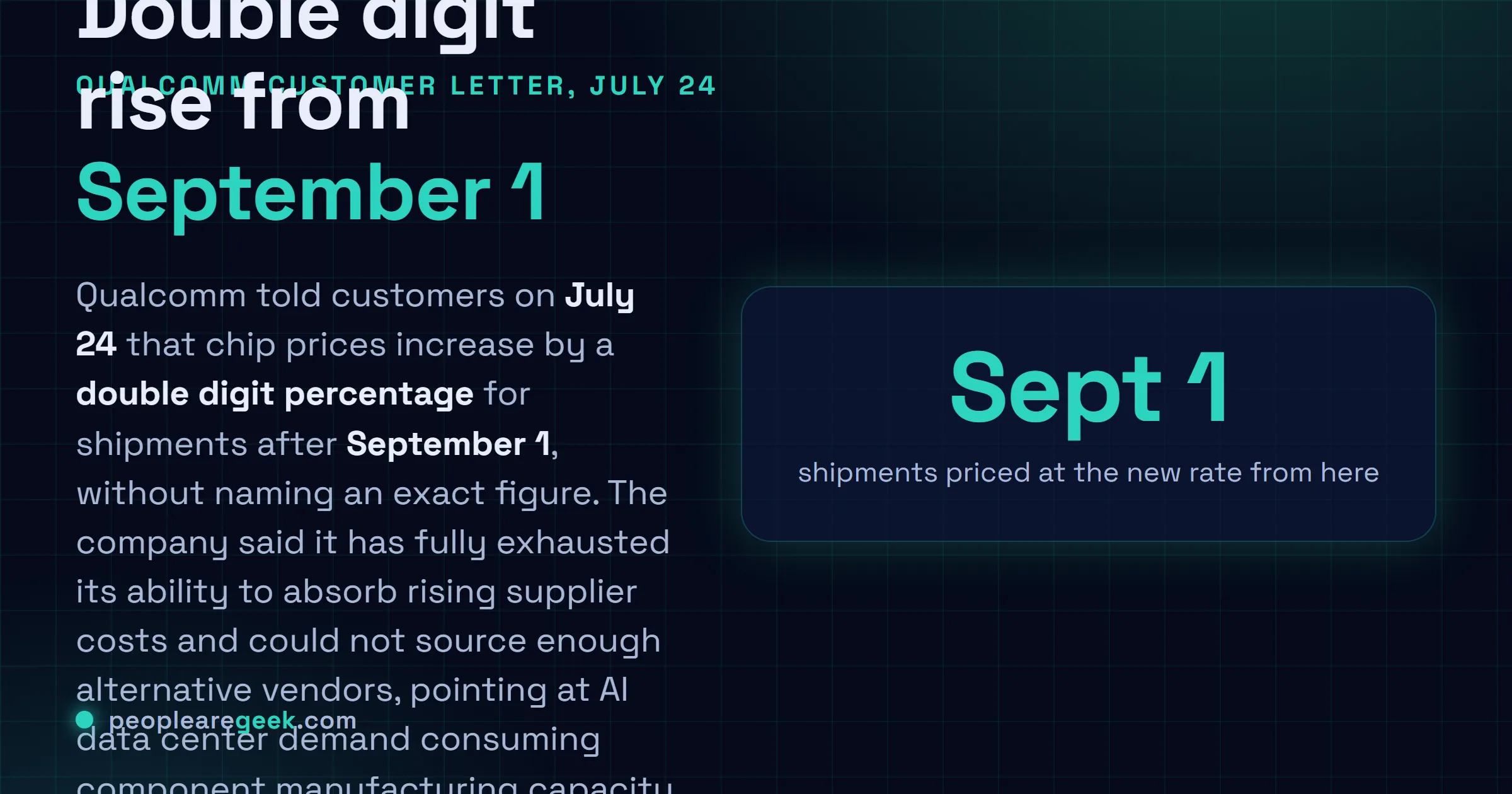
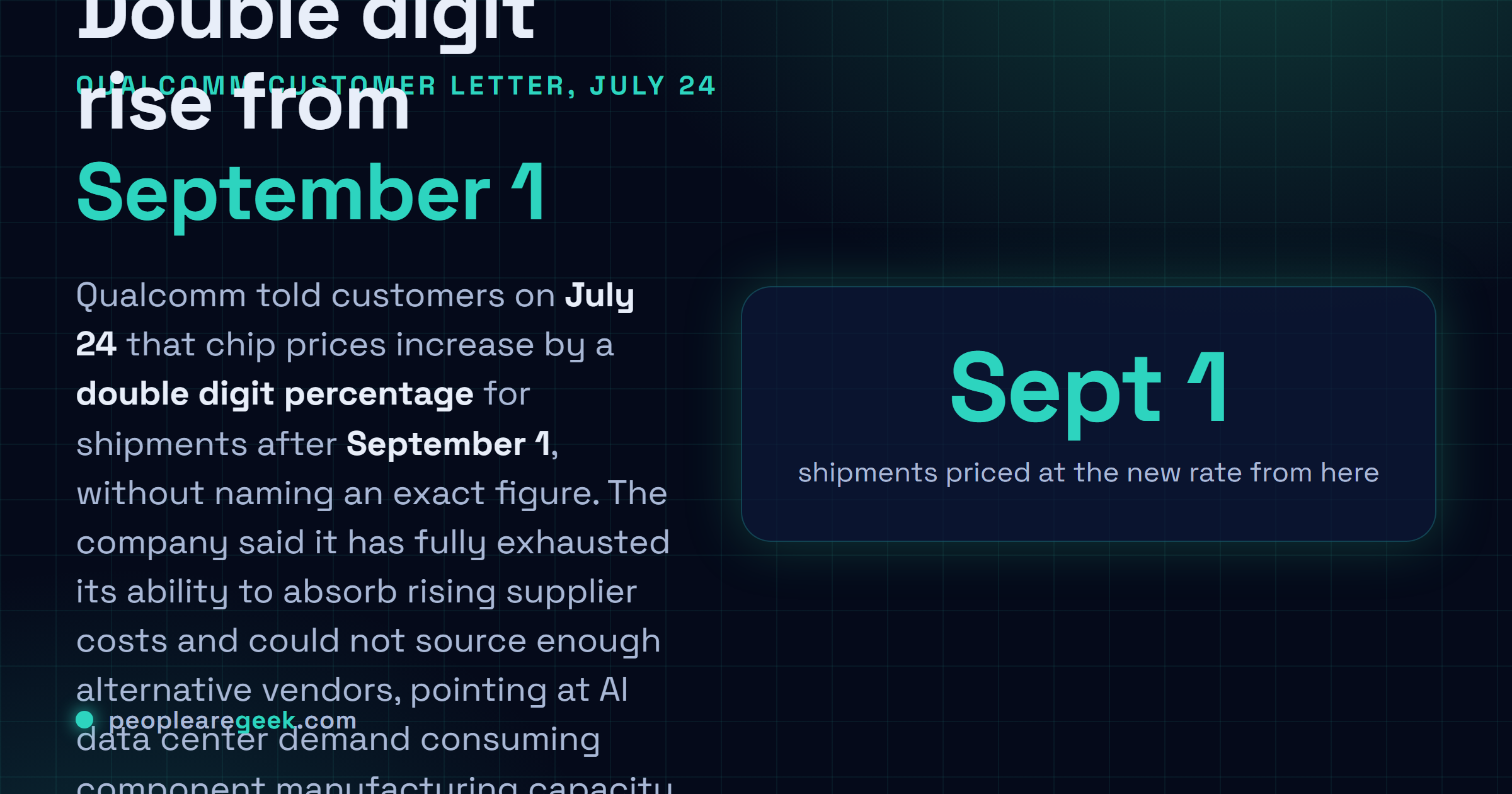
Qualcomm sent a letter to its customers on Friday, July twenty fourth telling them that chip prices go up by a double digit percentage for shipments after September first. The company did not put a precise figure on it beyond that phrase, and it gave a reason that is worth reading twice: it has fully exhausted its ability to absorb rising supplier costs, and it could not find enough alternative vendors. The stated cause is demand for AI data center infrastructure consuming component manufacturing capacity across the industry. This is the point where a story about accelerator buildouts stops being a data center story and starts showing up in ordinary hardware budgets.
The short answer
Qualcomm notified customers on Friday, July twenty fourth that chip prices increase by a double digit percentage for shipments after September first, without naming an exact figure. The company said it has fully exhausted its ability to absorb rising supplier costs and could not source enough alternative vendors, pointing at AI data center demand consuming component manufacturing capacity. Qualcomm supplies the processor in most premium Android phones, so the cost eventually reaches device prices, though not one to one and not immediately. Refresh budgets for 2027 are the thing to revisit.
We have spent two years reading about the AI buildout as something that happens in other people's data centers. Qualcomm's letter is the moment that stops being true, because the bill is arriving in a market that has nothing to do with training runs.
What was actually said
On Friday, July twenty fourth, Qualcomm wrote to customers to say that prices rise by a double digit percentage for shipments after September first. Bloomberg reported the letter first, having seen a copy. The company did not give a precise percentage beyond the phrase double digit, and no per product breakdown was reported.
The justification is the interesting part. Qualcomm said it has fully exhausted its ability to absorb escalating supplier costs, and that it could not find sufficient alternative vendors. Read plainly, that is a company saying it has been eating upstream increases for some time, has run out of room, and has no second source to switch to at the volumes it needs.
The stated cause is capacity competition
Qualcomm attributes the upstream pressure to demand for AI data center infrastructure absorbing component manufacturing capacity, which constrains supply across the rest of the technology sector.
That claim is easy to check against the rest of the week's news rather than taken on trust. Intel reported data center revenue up 59% year over year and said in the same breath that demand continues to outpace its growing supply. Memory makers have been repricing steadily, which is the backdrop to moves like the CXMT memory listing. Fabrication, advanced packaging and memory are shared resources, and when a buyer with effectively unlimited budget takes a larger share of them, everyone else pays more for what remains. That is not a conspiracy, it is an auction.

Where and when this lands
A chip price rise is not a device price rise, and treating them as the same thing will make you plan badly.
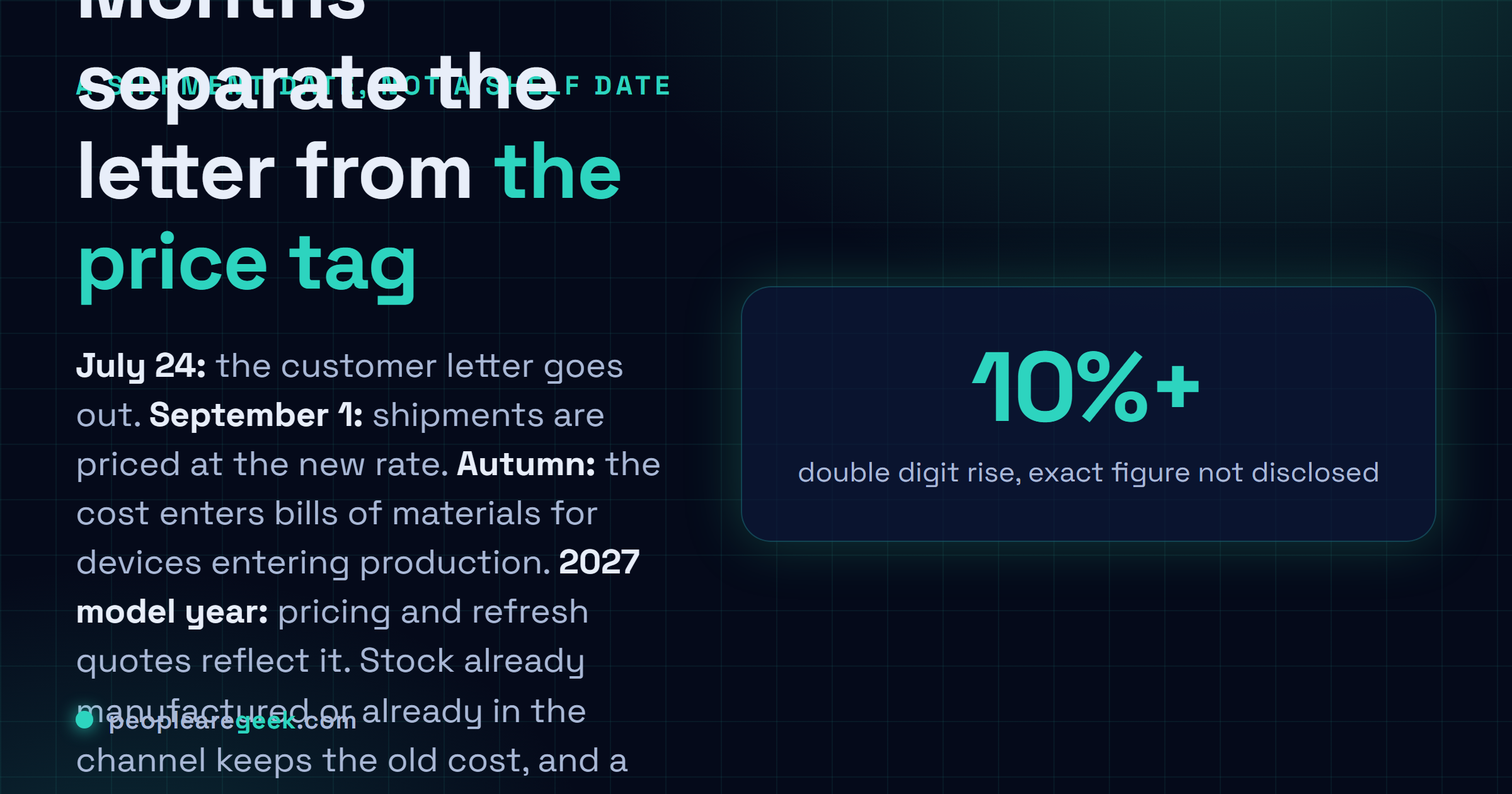
The new rate applies to shipments after September first, so it enters the bill of materials for devices built in the autumn. Those devices reach buyers over the months that follow. Anything already manufactured, or already sitting in the channel, carries the old cost. On top of that, the processor is one line item among many, and manufacturers make different choices about absorbing, deferring or passing on a component increase depending on the model, the segment and the market. Premium devices have more room to swallow it than mid range ones, which is exactly where it will be most visible.
The realistic expectation is that this shows up in 2027 model year pricing and in refresh quotes negotiated late this year, not in next week's retail price for a device that already exists.
What to actually do about it
If you manage a device fleet, there are three responses worth the time, and none of them require you to predict anything.
Bring forward the ordering decision on any refresh that is already approved. The September first line is a shipment date, so it is not something you negotiate around after the fact, and an order placed against current pricing is simply a cheaper order. This is the same discipline the server market is asking for right now, for the same underlying reason.
Revisit your 2027 device budget while you still have room to adjust it. A double digit component increase does not become a double digit device increase, but it does not become nothing either, and the worst time to discover the gap is halfway through a planning cycle that has already been signed off.
Then look again at lifecycle length. Keeping a working device an extra twelve months is the cheapest available response to a hardware price increase, it requires no supplier cooperation, and in a year where component costs are rising for reasons entirely outside your control, it is frequently the correct answer rather than the reluctant one.
Sources and further reading
- Bloomberg: Qualcomm raises chip prices by double digits citing supply chain costs
- 9to5Google: Snapdragon chip prices going up by double digits
- Android Headlines: Qualcomm's chip prices are increasing, which means phone prices will too
- XenoSpectrum: Qualcomm notifies customers of double digit price increase starting September 1 shipments
Frequently asked questions
What exactly did Qualcomm tell its customers?
In a letter sent on Friday, July twenty fourth, 2026, Qualcomm informed customers that prices increase by a double digit percentage for shipments made after September first. The company did not publish a specific number beyond describing the rise as double digit, and it did not break the increase down by product line. The reasoning given was that Qualcomm has fully exhausted its ability to absorb escalating supplier costs and was unable to secure sufficient alternative vendors. Bloomberg reported the letter first, having seen a copy of the document.
Why is Qualcomm raising prices now?
The reason Qualcomm gave is upstream cost, not margin ambition. Demand for AI data center infrastructure is absorbing component manufacturing capacity across the industry, from advanced packaging through to memory, which pushes up what every other buyer pays for the same capacity. Qualcomm says it has been carrying those increases itself and can no longer do so, and that switching to other suppliers at the volumes it needs was not possible. Whether or not you accept the framing, the underlying capacity competition is well documented and is visible in results across the sector this quarter.
Which products does this affect?
Qualcomm supplies the processor in most premium Android phones and a large share of mid range models, so the immediate effect lands on Android device makers and, eventually, on retail prices. The company also sells into automotive, industrial, networking and compute segments, and the letter was not reported as being limited to a single line. Note that a chip price increase does not translate one to one into a device price increase, because the processor is one line item among many and manufacturers absorb, defer or pass on cost differently depending on the model and the market.
When will this reach the price I actually pay?
Not immediately, and not evenly. The new pricing applies to shipments after September first, which means it enters the bill of materials for devices being built in the autumn, and those devices reach shelves over the following months. Products already manufactured or already in the channel carry the old cost. In practice you should expect the effect to show up in 2027 model year pricing and in refresh quotes negotiated late this year, rather than in what you would pay for the same device next week.
What should I do about it if I manage a hardware budget?
Three things, none of them dramatic. First, if a device refresh was already approved for this year, ask whether the order can be placed against current pricing rather than left until the new quarter, since the September first line is a shipment date and not a negotiation. Second, revisit your 2027 device budget assumptions now while there is time to adjust them, rather than discovering the gap during the next planning cycle. Third, extend your normal lifecycle review, because a device kept twelve months longer is the cheapest response available and often the right one.