ASML published two things on July 15, 2026, and the second one matters more than the first. The numbers were good, with nine point three billion euros of net sales in the second quarter and a full year outlook raised to between forty three and forty five billion. The other release said Intel Foundry has begun high volume manufacturing of some Panther Lake processors using High NA EUV on the Intel 18A node. That is the first time anyone has shipped a high volume logic product made with the tool, which moves High NA from a research curiosity to something that prints chips you can buy.
The short answer
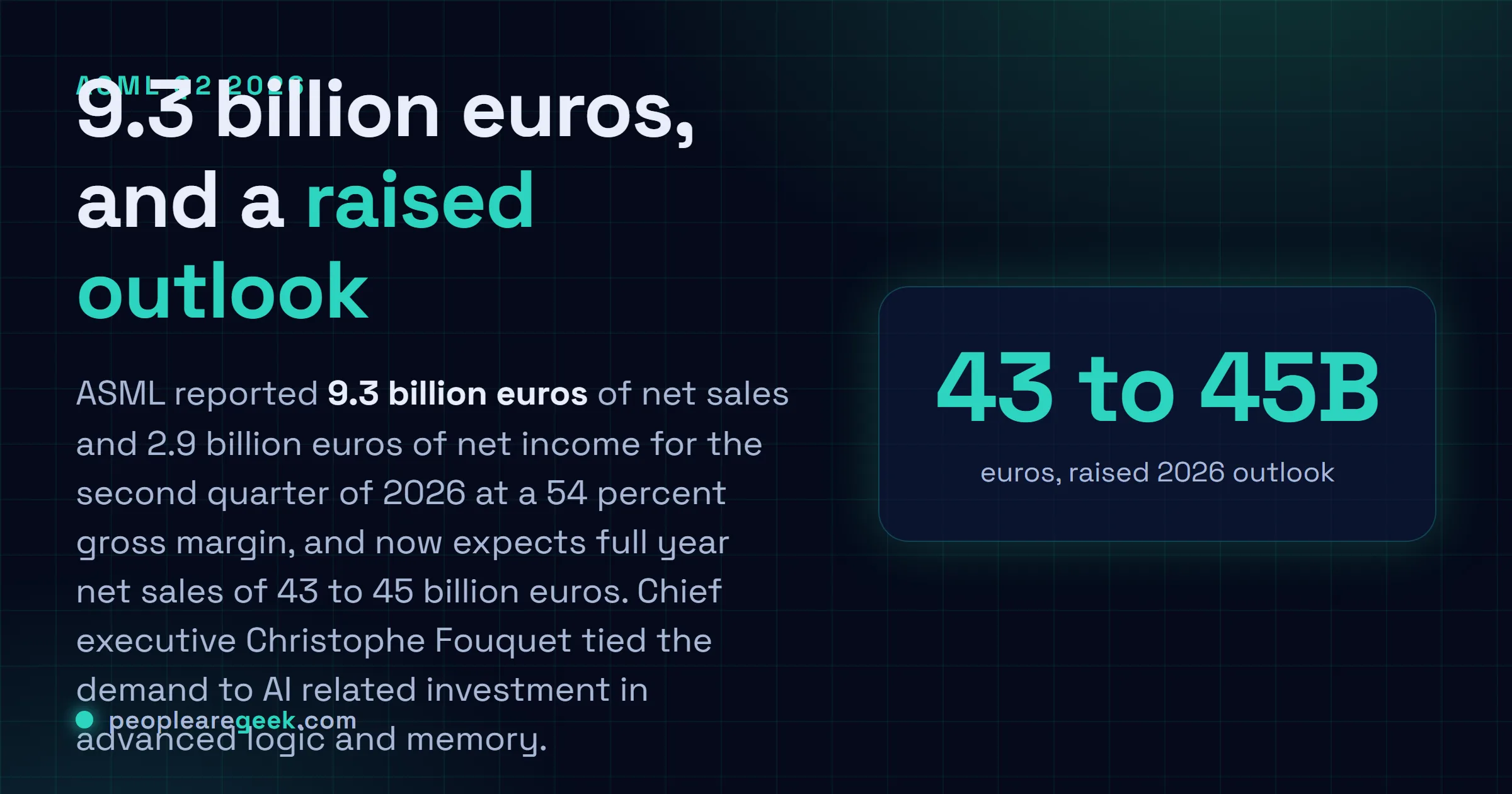
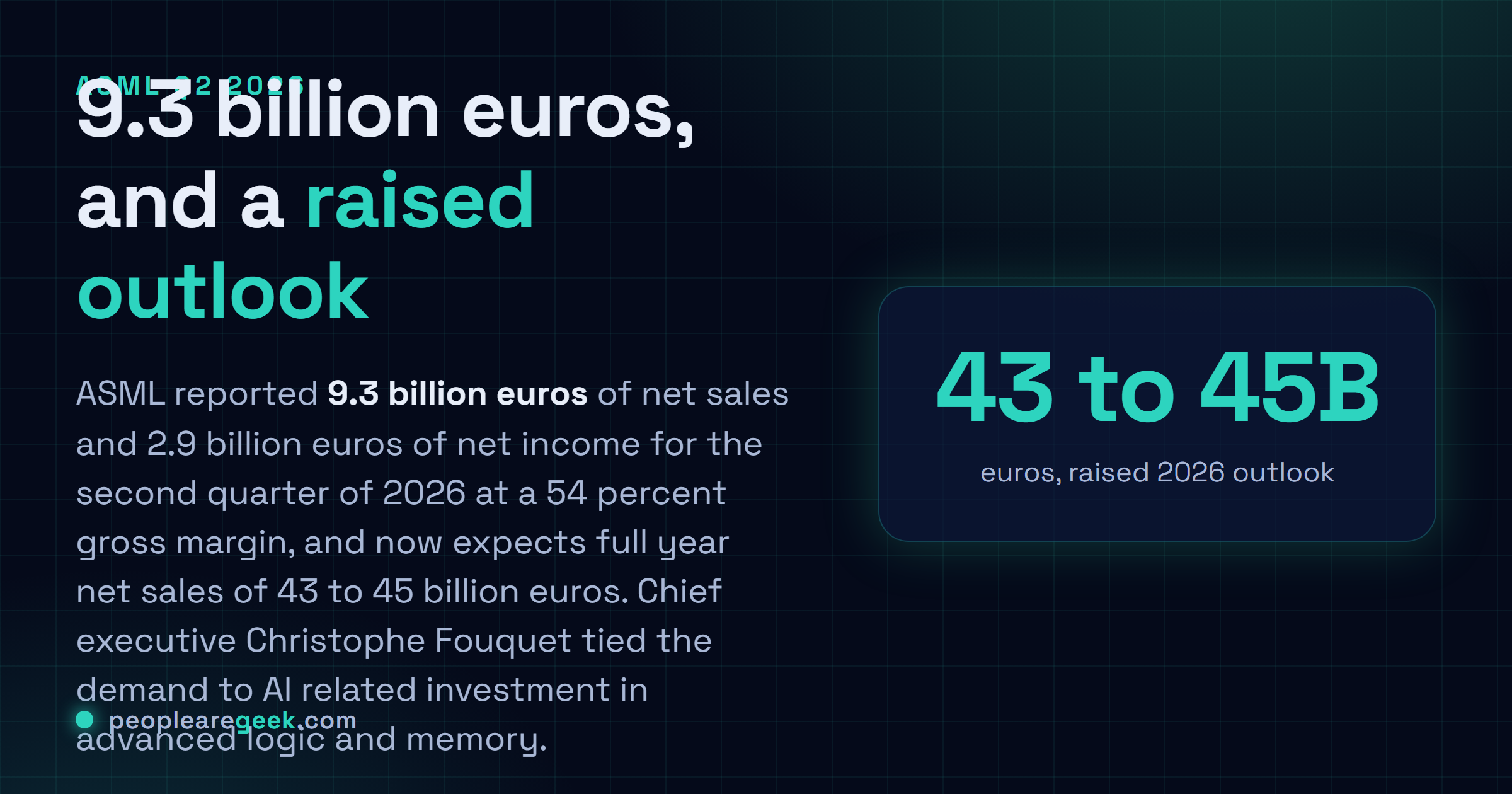
ASML reported nine point three billion euros of net sales and two point nine billion euros of net income for the second quarter of 2026, at a fifty four percent gross margin, and raised its full year outlook to between forty three and forty five billion euros. A separate release the same day said Intel Foundry has entered high volume manufacturing on a subset of Panther Lake processors using High NA EUV on the Intel 18A node, the first high volume logic product made with the tool. ASML says those parts ship at yields matched to its existing NXE EUV platform.
There is a habit in this industry of treating lithography as weather. It happens somewhere upstream, it is very expensive, and eventually chips arrive. We think that is a mistake, because the moments when a genuinely new tool starts printing shipping product are rare, and they set the ceiling for everything downstream. One of those moments landed on July 15, 2026, and it arrived quietly, in a second press release, underneath a good earnings report.
The numbers first
ASML reported nine point three billion euros of total net sales for the second quarter of 2026 and two point nine billion euros of net income, at a gross margin of fifty four percent. Basic earnings per share came to seven point five nine euros. The company sold eighty six new lithography systems in the quarter, and installed base management sales, which is the servicing and upgrade business attached to machines already in the field, contributed two point seven six two billion euros.
The guidance is where the confidence shows. For the third quarter ASML expects between eleven and twelve billion euros of net sales at a gross margin of fifty five to fifty seven percent. For the full year it now expects between forty three and forty five billion euros, with a gross margin between fifty four and fifty six percent. Chief executive Christophe Fouquet put the cause plainly, saying that ongoing AI related investments and continued progress in AI technologies are driving demand for advanced logic and memory chips.
On capacity, ASML expects to ship around sixty five low NA EUV machines this year, supporting EUV business growth of roughly forty five percent. It plans to add about thirty percent to that low NA capacity for 2027, and is investigating a further thirty percent for 2028. Shareholders got about one point one billion euros of buybacks in the quarter and an interim dividend of one point eight eight euros per share, payable August 5, 2026.
What High NA actually changes
Now the part worth your attention.
Every lithography tool has a numerical aperture, which describes how wide a cone of light its optics can collect and focus onto the wafer. A wider cone resolves finer detail. That is the whole idea, and it is the same physics that governs a camera lens or a microscope objective. High NA EUV widens that aperture over standard EUV, and the payoff is resolution.
Resolution matters because of what you do when you run out of it. When a pattern is finer than a single exposure can print, you split it across multiple exposures and interleave the results, a technique called multi patterning. It works, and the industry has leaned on it for years, but every extra exposure is another pass through the scanner, another mask, another opportunity for the layers to land slightly out of register with each other. Steps cost money and steps cost yield.
High NA lets you print in one exposure some of what previously took several. Fewer passes, fewer masks, fewer alignment errors to accumulate. That is the promise, anyway. The reason this has stayed theoretical is that nobody had run the tool in volume production on a real shipping part, which is where promises usually meet the yield curve.

Intel got there first
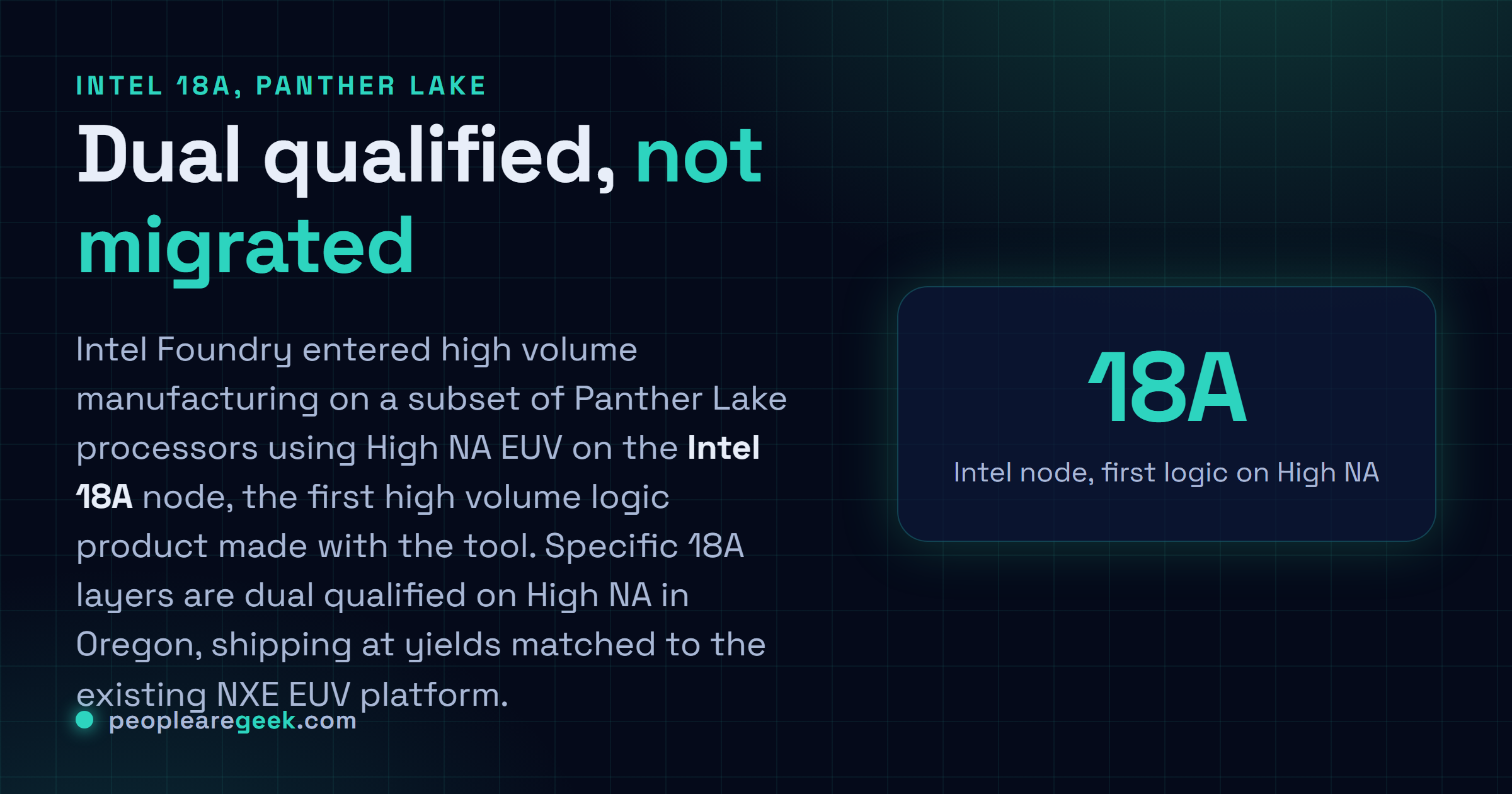
Intel Foundry has entered high volume manufacturing on a subset of Intel Core Ultra Series 3 processors, code named Panther Lake, on the Intel 18A node. Specific 18A layers are dual qualified on High NA EUV in Oregon, and ASML says the product ships to customers at yields matched to its existing NXE EUV platform. That makes Intel Foundry the first in the industry to ship a high volume logic product using High NA. Intel took delivery of its first High NA machine in 2024 at its research and development site in Hillsboro, Oregon, so this is roughly two years from tool arrival to shipping product.
The phrase to notice is dual qualified. It does not mean Intel switched to High NA. It means those particular layers are certified to run on either High NA or the older tools, and Intel can choose. That is a hedge, and a sensible one. You get real production data on the new machine, on a real product, with a proven fallback if something drifts. Nobody bets a shipping laptop CPU on a first generation tool without a way back.
The yield claim is the substantive part. Matched to the existing NXE platform means High NA is not currently costing Intel yield on those layers. It is not obviously winning yet either, at least not on that metric. What it buys, for now, is process simplification on the layers where it is used, and the knowledge of how to run the thing.
What this actually means for the rest of us
Be careful about the conclusion here. This is a subset of layers on a subset of one product line, matched on yield rather than beating it. It is a first step, not a transition, and the economics of High NA at scale are still an open question given what the machines cost.
What it does settle is the feasibility question. High NA prints shipping logic at competitive yield, which we now know rather than assume. For anyone specifying hardware, the practical read is that the roadmap below 18A has one fewer unknown in it than it did a week ago, and that the constraint on advanced capacity keeps looking like tools and time rather than physics. ASML adding thirty percent of low NA capacity for 2027 and looking at thirty percent more for 2028 is what a supplier does when it believes the demand is real and the limit is how fast it can build.
Sources and further reading
- ASML: reports 9.3 billion euros total net sales and 2.9 billion euros net income in Q2 2026
- ASML: High NA EUV reaches new readiness milestone with first high-volume Logic product
- TechPowerUp: ASML High NA EUV technology enters high-volume manufacturing with Intel 18A
- TechPowerUp: ASML reports 9.3 billion euros total net sales and 2.9 billion euros net income in Q2 2026
- Reuters via Yahoo Finance: Intel turns to next-generation ASML tool to help make its laptop chips
- Wccftech: Intel leverages ASML's High NA EUV technology to produce 18A Panther Lake chips
Frequently asked questions
What did ASML report for the second quarter of 2026?
ASML reported nine point three billion euros of total net sales and two point nine billion euros of net income for the second quarter of 2026, with a gross margin of fifty four percent and basic earnings per share of seven point five nine euros. It sold eighty six new lithography systems in the quarter, and installed base management sales came to two point seven six two billion euros. The company also bought back about one point one billion euros of shares and declared an interim dividend of one point eight eight euros per share, payable on August 5, 2026.
What is the new full year outlook?
ASML now expects total net sales of between forty three and forty five billion euros for 2026, with a gross margin between fifty four and fifty six percent. For the third quarter specifically it guided to between eleven and twelve billion euros of net sales at a gross margin of fifty five to fifty seven percent, with research and development costs around one point two billion euros and selling, general and administrative costs around zero point four billion.
What is High NA EUV and why does it matter?
High NA stands for high numerical aperture, and it is the next generation of extreme ultraviolet lithography. Numerical aperture describes how wide a cone of light the optics can collect and focus, and a wider cone lets you resolve smaller features. In practice High NA prints finer patterns in a single exposure where standard EUV would need multiple exposures stitched together. Fewer exposures means fewer steps, fewer chances to misalign, and potentially better yield on the smallest layers of a chip.
What exactly did Intel ship?
Intel Foundry entered high volume manufacturing on a subset of Intel Core Ultra Series 3 processors, code named Panther Lake, built on the Intel 18A node. Specific 18A layers are dual qualified on High NA EUV in Oregon, meaning those layers can be printed on either High NA or the existing platform. ASML said the product is shipping to customers at yields matched to its existing NXE EUV platform, and that Intel Foundry is the first in the industry to ship a high volume logic product using High NA.
Does dual qualified mean Intel has switched fully to High NA?
No, and that distinction is the interesting part. Dual qualified means those layers are certified to run on both High NA and the older NXE tools, so Intel can print them either way without changing the product. It is a hedge rather than a migration. It lets Intel build real production experience with the new tool while keeping a proven fallback for the same layers, which is a sensible way to introduce a machine this expensive into a line that has to keep shipping.
How much EUV capacity is ASML adding?
ASML expects to ship about sixty five low NA EUV machines in 2026, supporting EUV business growth of roughly forty five percent. It plans to add about thirty percent to that low NA capacity for 2027, and it is investigating another thirty percent increase for 2028. Chief executive Christophe Fouquet tied the demand to artificial intelligence, saying that ongoing AI related investments and continued progress in AI technologies are driving demand for advanced logic and memory chips.