New York has paused state environmental permits for new hyperscale data centers, those drawing fifty megawatts or more, for up to one year. Governor Kathy Hochul signed the executive order on July 14, 2026, making New York the first state in the country to put a statewide hold on large data center approvals. Projects whose permits were already deemed complete keep moving, so this is a brake on what comes next rather than a stop on what is already built. For anyone who plans capacity, the interesting part is not the politics. It is that power, not land or money, is now the thing that decides where compute can go.
The short answer
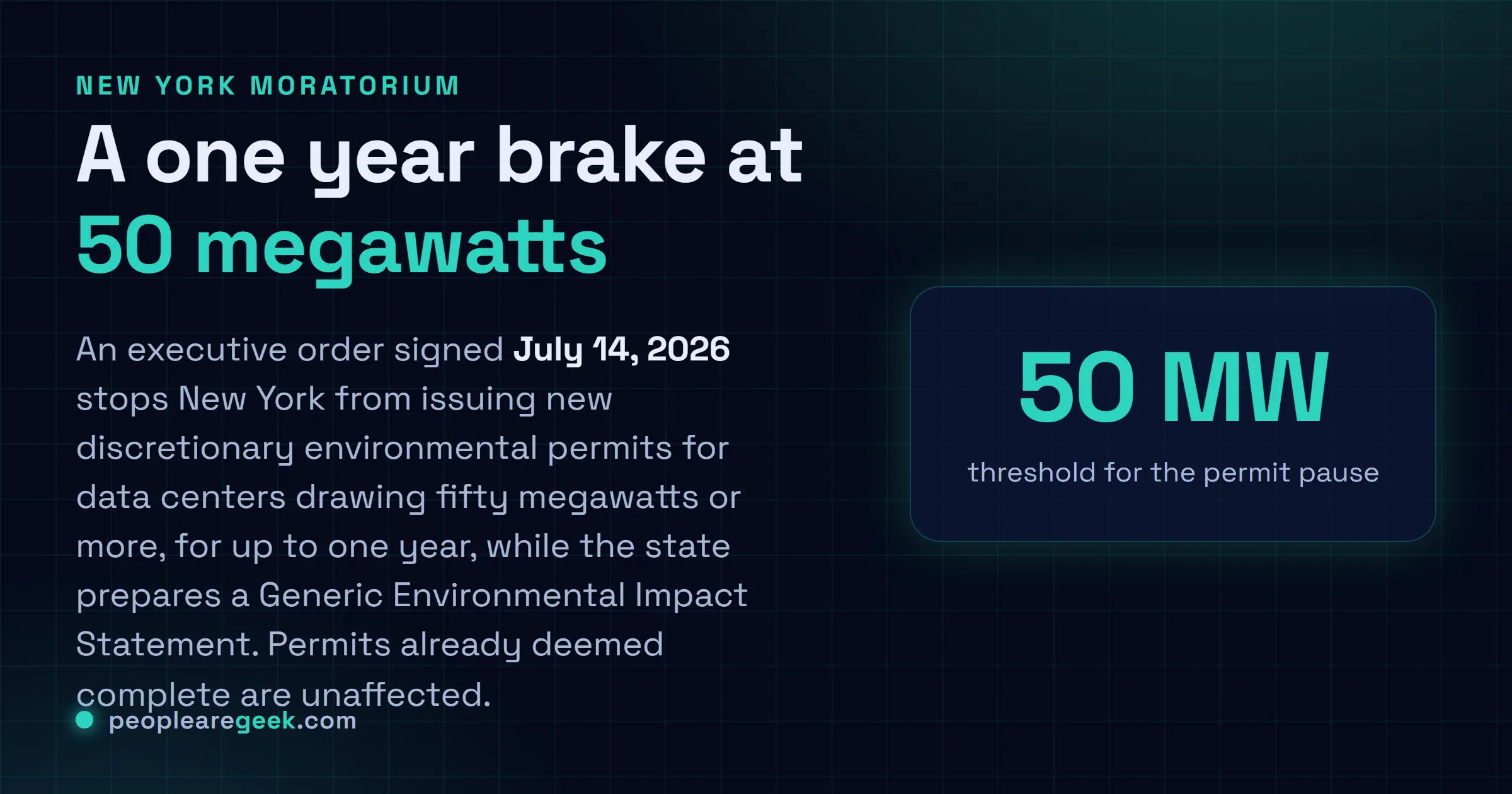
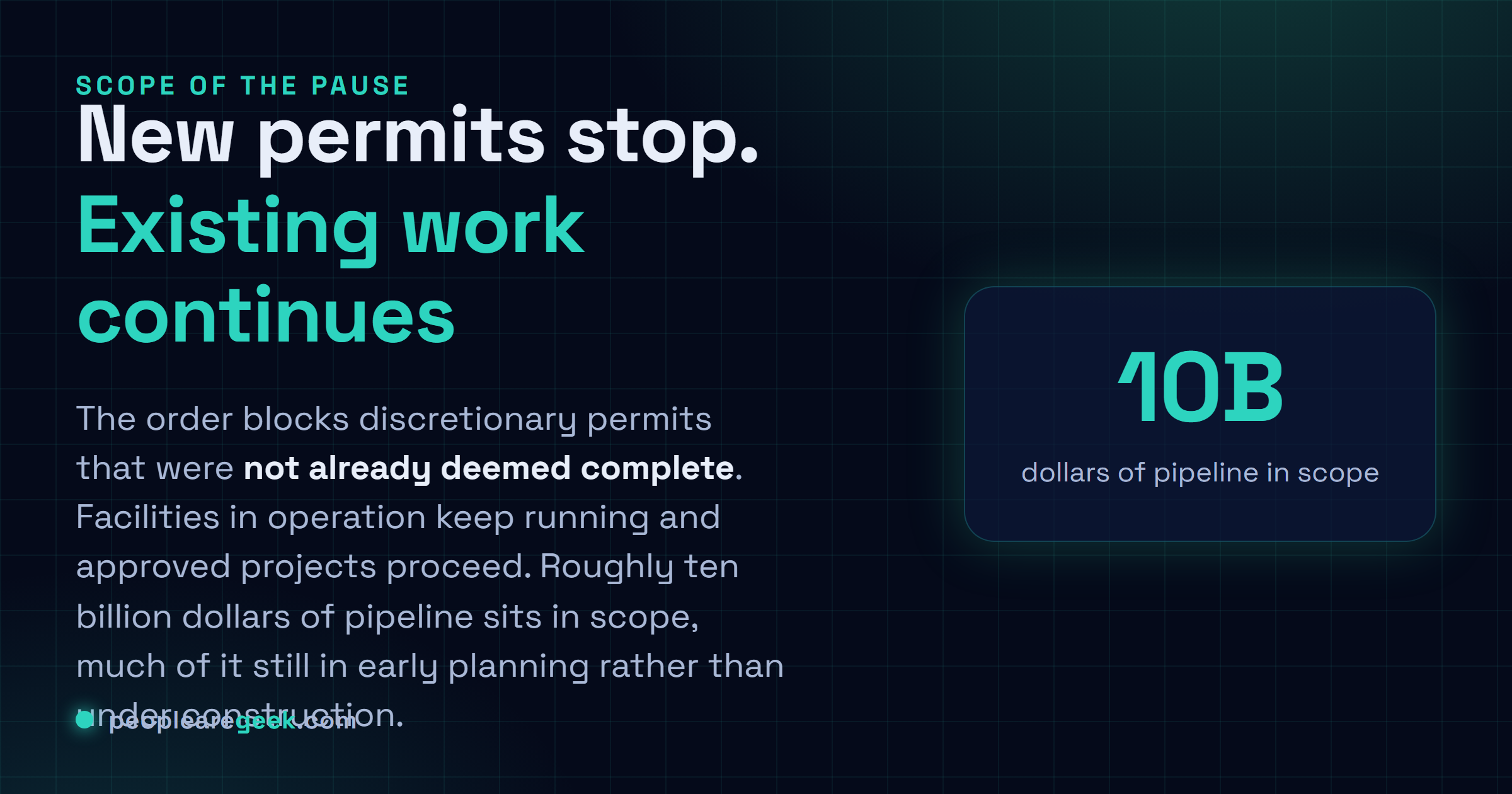
New York has become the first state to impose a statewide moratorium on new hyperscale data centers. An executive order signed by Governor Kathy Hochul on July 14, 2026 directs the Department of Environmental Conservation to stop issuing discretionary environmental permits for facilities drawing fifty megawatts or more, for up to one year, while the state prepares a Generic Environmental Impact Statement. Permits already deemed complete are unaffected. Reporting puts roughly ten billion dollars of pipeline in scope, much of it still in early planning. The state is separately pursuing legislation to repeal sales tax exemptions for large data centers.
For most of the last two decades, the question of where a data center goes had a fairly boring answer. Somewhere with cheap land, decent fiber, and a utility willing to sell you electricity. The order of those three has now reversed. New York just made that reversal official.
What the order does
On July 14, 2026, Governor Kathy Hochul signed an executive order pausing state environmental permits for new hyperscale data centers. The mechanism is narrow and worth reading precisely. The Department of Environmental Conservation will not issue discretionary permits that were not already deemed complete. That is the whole lever. It does not touch facilities already running, it does not revoke approvals that already cleared, and it does not ban construction outright. It stops the state from signing new discretionary paperwork.
The pause runs for up to one year, and it can end earlier. The clock is tied to a Generic Environmental Impact Statement, a category wide environmental review that the state intends to use as the basis for standards that future projects get measured against. When that review is done, the pause lifts.
The threshold, according to press reporting, is fifty megawatts. That number is a choice, and a revealing one. State legislators had floated twenty megawatts in June 2026, so fifty is the more permissive end of what was on the table. It is also, in practice, still restrictive, because a large share of what is actually being proposed in the current build cycle is hyperscale work well above one hundred megawatts.
Why a state does this
Hochul's stated rationale was that data center growth threatens to raise utility bills, deplete natural resources, and create uncertainty for residents. Strip away the framing and the underlying arithmetic is not really in dispute. New York carries the second highest commercial electricity rate in North America. Adding several fifty megawatt loads to a grid in that condition is a decision with consequences for everyone else connected to it, and the state would like to decide the rules before rather than after.
There is a second track running alongside the permit pause. The state is pursuing legislation to repeal sales tax exemptions for large data centers, the incentives originally written to attract exactly this kind of development. That combination, pausing approvals while moving to remove the tax carrot, tells you the state is not fine tuning. It is renegotiating the terms.

The part that matters if you plan capacity
It is easy to file this under regulation and move on. We would file it under capacity planning instead.
The useful reading is that the binding constraint on compute has moved. For years the scarce inputs were capital and chips, and those got most of the attention. What New York just demonstrated is that electricity, and the political consent to use it at scale, is now a gating factor that can move a project's date by a year with a signature. That is a different kind of risk than a supply chain delay, because it does not resolve by paying more.
If your roadmap assumes new regional capacity arrives on a particular date, that assumption now rests on a permitting process you do not control and cannot expedite. A few questions are worth asking your providers. Where does the capacity you are committing to physically sit? Is it already permitted, or is it in a pipeline? If a build slips by a year, what is the fallback region, and what does that do to your latency budget and your data residency commitments?
None of that is new discipline exactly. It is the discipline that anyone who has run capacity through a hardware shortage already has. The change is that the shortage in question is now electrical and political rather than industrial, and it shows up on a permitting calendar rather than a vendor quote.
What to watch next
Two dates matter. The Generic Environmental Impact Statement sets the real length of the pause, because the moratorium ends when the review does. And the executive order gives the state sixty days to issue a Community Investment Framework, which should signal what New York intends to ask of developers in exchange for approval going forward.
New York is the first state to do this. It is unlikely to be the last, because the pressures that produced the order are not local to New York. Electricity prices, interconnection queues, and water for cooling are contested in most places where large facilities are being proposed right now. The state that moves first is the one that tells you what the argument is going to look like everywhere else.
Sources and further reading
- Governor Kathy Hochul: First statewide moratorium on new hyperscale data centers
- CNBC: New York becomes first U.S. state to impose AI data center ban
- The Washington Post: New York becomes first state to impose data center moratorium
- Bisnow: New York data center moratorium halts 10 billion dollars of development
- Axios: Hochul signs data center moratorium executive order
Frequently asked questions
What exactly did New York pause?
The executive order, signed July 14, 2026, directs the state Department of Environmental Conservation to stop issuing discretionary environmental permits for new hyperscale data centers, defined by press reporting as facilities drawing fifty megawatts or more. The pause runs up to one year while the state prepares a Generic Environmental Impact Statement, and it can be lifted earlier if that review finishes ahead of schedule. Permits already deemed complete are not affected.
Does this stop data centers already running or approved in New York?
No. The order applies to new discretionary permits that were not already deemed complete. Facilities in operation keep operating, and projects that already cleared the permitting stage can proceed. Reporting puts roughly ten billion dollars of pipeline in scope, though much of that was still in early planning rather than under construction.
Why fifty megawatts and not some other number?
Fifty megawatts is the line the executive order drew, and it is higher than the twenty megawatt threshold state legislators had floated in June 2026. Fifty megawatts is roughly the draw of a facility with thousands of servers, and it is the scale at which a single building starts to matter to the regional grid rather than blending into ordinary commercial demand.
What is a Generic Environmental Impact Statement?
A GEIS is a broad environmental review that covers a whole category of projects instead of assessing each one from scratch. New York is using the pause to produce one for data centers, with the goal of writing standards that later projects get measured against. The upside for developers is that a finished GEIS can make subsequent reviews faster and more predictable. The cost is the wait while it gets written.
What does this mean for teams planning capacity?
It means treating power availability and local permitting as a scheduling input rather than a detail your provider handles quietly. If your roadmap assumes new regional capacity lands on a given date, that date now depends on a review process. The practical response is to ask providers where committed capacity physically sits, whether it is already permitted, and what the fallback region is if a build slips.
Is New York likely to be the only state doing this?
New York is the first to impose a statewide moratorium, but the pressures behind it are not unique to New York. Electricity prices, grid interconnection queues, and water use for cooling are live issues in many places where large facilities are being proposed. New York is a useful signal precisely because it moved first, not because it is an isolated case.