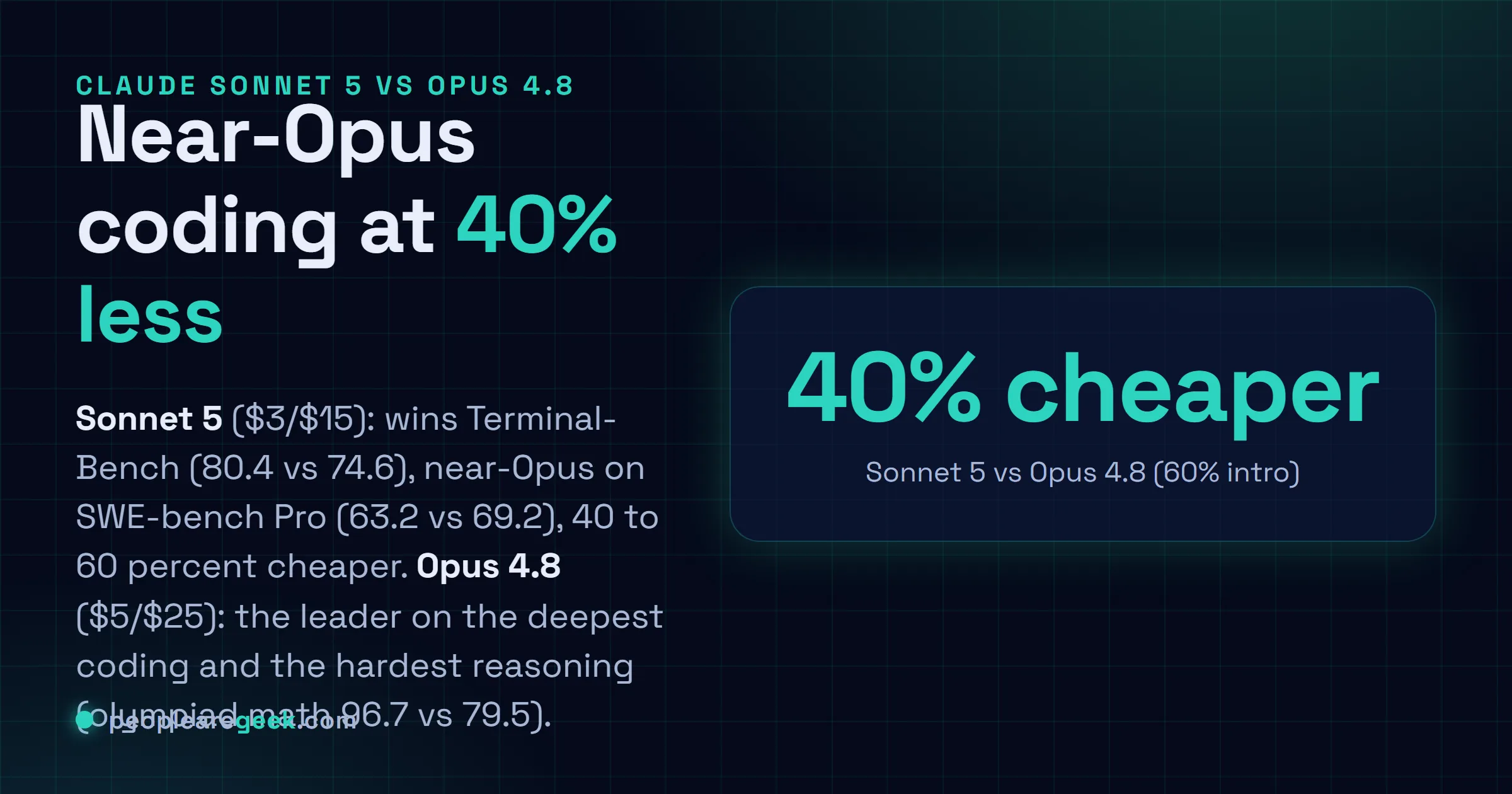
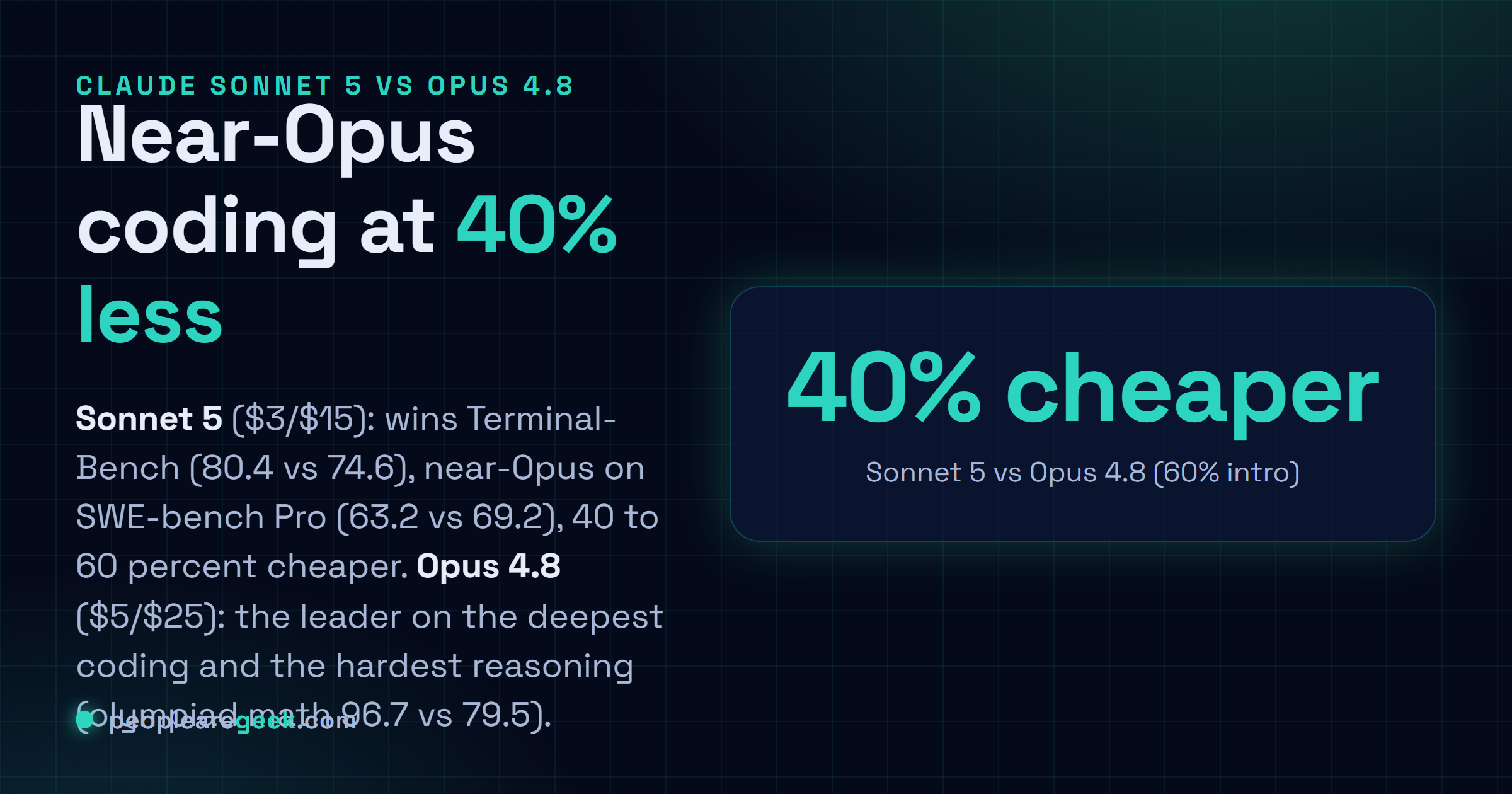
Claude Sonnet 5 vs Opus 4.8 is a rare kind of comparison, because for once the cheaper model is not obviously the weaker one. Anthropic shipped Sonnet 5 on June 30, 2026, and its own description says it out loud: near-Opus-4.8 performance at Sonnet pricing. The benchmarks back that up. Sonnet 5 lands within a few points of Opus on most tests, and actually beats it on some, while costing 40 percent less, or 60 percent less during the introductory period. So the real question is not which is better, it is narrower and more useful: when is Opus 4.8's extra headroom actually worth almost double the price. Here is the honest answer, with the launch numbers.
The short answer
Claude Sonnet 5 ($3/$15, intro $2/$10) lands within a few points of Opus 4.8, even winning Terminal-Bench and pro knowledge work, at 40 to 60 percent less money. Claude Opus 4.8 ($5/$25) stays the leader where it counts most: the deepest coding (SWE-bench Pro 69.2) and the hardest reasoning (olympiad math 96.7 vs 79.5). Same API, so route the hard jobs to Opus and the rest to Sonnet 5.
For most of the last two years, choosing a Claude model was simple: Opus for the hard stuff, Sonnet for volume, and you accepted a real quality drop for the cheaper tier. Sonnet 5 breaks that pattern. It is the first Sonnet that lands close enough to Opus that, as Anthropic puts it, Opus starts to look optional for most workloads. That does not make Opus 4.8 pointless, it makes the decision sharper. So instead of "which is better" (Opus, narrowly, overall), the useful question is where the extra money actually buys you something. If you also want to see how Sonnet 5 stacks up against OpenAI, our Claude Sonnet 5 vs GPT-5.6 comparison covers that.
The quick verdict
Skimming? Here it is.
| You are... | The pick | Why |
|---|---|---|
| Doing most coding and agentic work | Sonnet 5 | Within a few points, 40 to 60 percent cheaper |
| Running high volume | Sonnet 5 | The price gap compounds fast |
| Tackling the hardest reasoning or proof-math | Opus 4.8 | 96.7 vs 79.5 on olympiad math |
| Making the deepest, multi-step code changes | Opus 4.8 | Leads SWE-bench Pro, 69.2 vs 63.2 |
| Unsure | Sonnet 5, escalate to Opus | Same API, one-word swap when needed |
The honest default in mid-2026 is Sonnet 5, with Opus 4.8 held in reserve for the jobs that genuinely need the ceiling.
Benchmarks, head to head
These are the launch figures, on the tests where both models reported, so it is a fair side by side.
| Benchmark | What it measures | Claude Sonnet 5 | Claude Opus 4.8 |
|---|---|---|---|
| SWE-bench Pro | Real repository pull requests | 63.2 | 69.2 |
| Terminal-Bench 2.1 | Driving a terminal, agent tasks | 80.4 | 74.6 |
| GDPval-AA v2 (Elo) | Professional knowledge work | 1618 | 1603 |
| HLE with tools | Hard reasoning exam | 57.4 | 57.9 |
| USAMO 2026 | Olympiad proof-based math | 79.5 | 96.7 |
Read it as a shape, not a scoreboard. On four of the five, they are within a handful of points and Sonnet 5 even takes two of them. The exception is USAMO, the proof-based math olympiad, where Opus 4.8's 17-point lead is the widest gap in the whole comparison and a clear sign of where its extra reasoning depth shows up.
Where Opus 4.8 earns the premium
Two places, and they are specific. First, the hardest reasoning. That USAMO gap is not noise: proof-based math is a proxy for long, rigorous, multi-step reasoning that cannot be faked, and Opus 4.8 is simply better at it. If your work involves that kind of thinking, complex proofs, intricate architectural decisions, subtle correctness arguments, the premium buys real accuracy. Second, the deepest coding. On SWE-bench Pro, the real-pull-request benchmark, Opus 4.8 leads 69.2 to 63.2. On a genuinely hard, sprawling change, those points translate into fewer failed attempts.
Opus 4.8 is also Anthropic's most autonomous model for long-horizon agentic runs, the overnight-coding, hours-long-task tier. When the cost of a wrong answer is high and the task is at the edge of what any model can do, it is the safer instrument. That is the whole case for paying more: correctness at the frontier.
Where Sonnet 5 wins
Everywhere else, which is most places. It is 40 percent cheaper at standard pricing and 60 percent cheaper during the introductory period through August 31, 2026, and since output dominates a real bill, that is the number that shows up on your invoice. It wins Terminal-Bench 2.1 outright (80.4 to 74.6), so for agent-in-a-terminal work it is both cheaper and better. It edges Opus on professional knowledge work, ties on the tool-using reasoning exam, and lands within a few points on the deep-coding benchmark it loses. It holds the same 1M context and the same high-effort thinking.
The result is that for the vast majority of coding, chat, extraction, and agentic tasks, you would struggle to justify the Opus premium on quality alone. Sonnet 5 is the first Sonnet where that is true.
Price and the switch
The whole decision, in one place, plus the thing that makes it painless: they share an API, so switching is a one-word change.
| Claude Sonnet 5 | Claude Opus 4.8 | |
|---|---|---|
| Input, per 1M | ~$3 (intro ~$2) | ~$5 |
| Output, per 1M | ~$15 (intro ~$10) | ~$25 |
| Context window | 1,000,000 | 1,000,000 |
| Model ID | claude-sonnet-5 | claude-opus-4-8 |

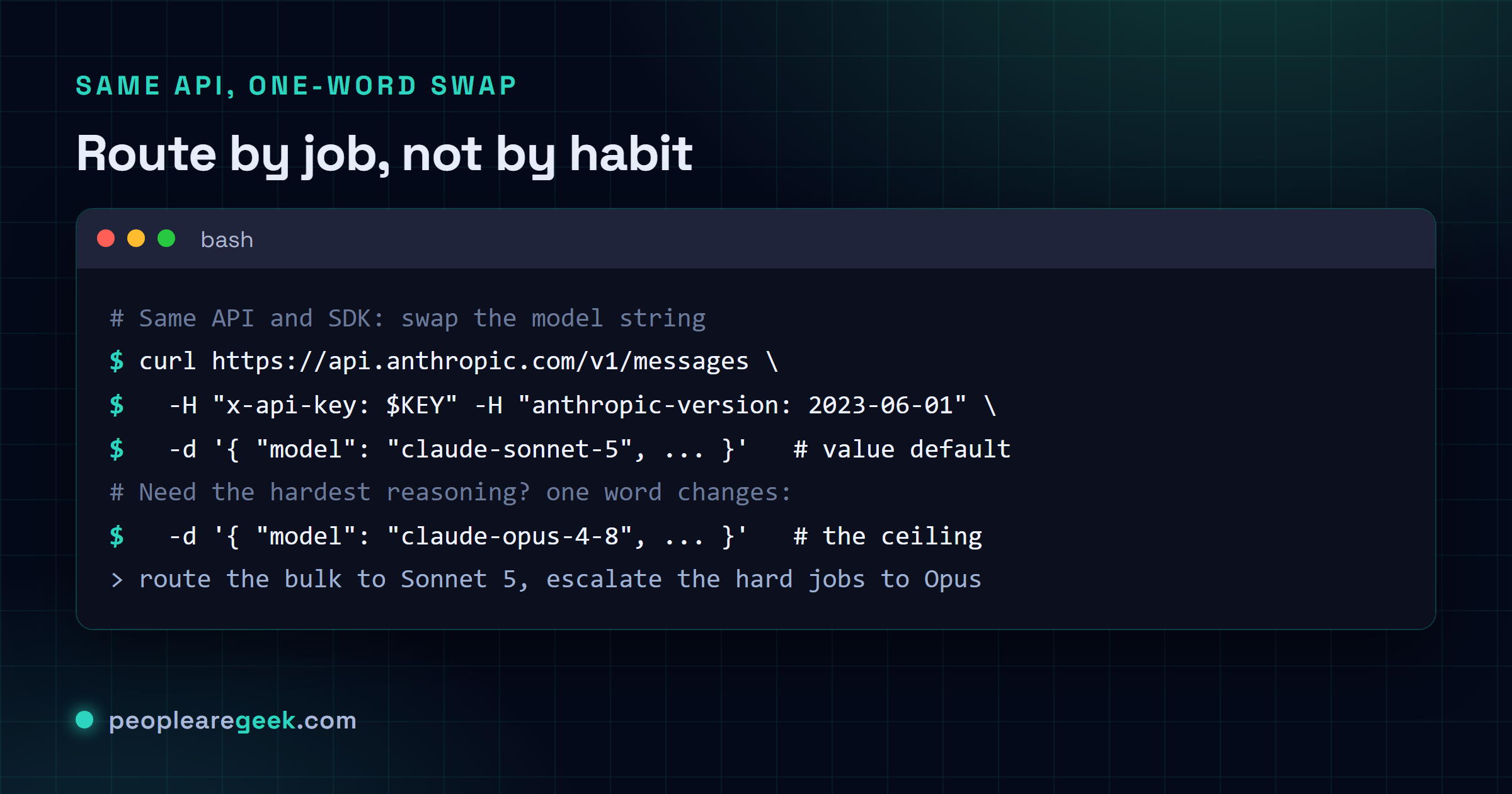
That shared surface is what makes the smart play practical: do not pick one forever, route by job. Send the bulk of your traffic to Sonnet 5, and escalate the handful of genuinely hard tasks to Opus 4.8, all without touching the rest of your code.
So which should you choose?
Default to Claude Sonnet 5. In mid-2026 it is the value pick by a wide margin: near-Opus quality on nearly everything, a clear win on terminal-driven agents, and 40 to 60 percent less money. Keep Claude Opus 4.8 for the specific jobs where its lead is real, the hardest reasoning and proof-math, and the deepest multi-step code changes, where the extra points are worth the extra dollars.
For a fuller picture of where these land against everything else, see our best AI model for coding in 2026 ranking. But the short version is simple: Sonnet 5 made "just use Opus" the wrong default for most teams, and that is a genuinely new thing in 2026.
Sources and further reading
- Anthropic, Claude Sonnet
- Claude Sonnet 5 vs Claude Opus 4.8, full comparison (llm-stats)
- SWE-bench Pro leaderboard (morphllm)
- Sonnet 5 vs Sonnet 4.6 vs Opus 4.8, cost-performance (MarkTechPost)
Frequently asked questions
Is Opus 4.8 worth almost double the price of Sonnet 5?
For most work, no, and Anthropic more or less says so. Sonnet 5 lands within a few points of Opus 4.8 on most benchmarks, and it even beats Opus on Terminal-Bench 2.1 (80.4 to 74.6) and on the GDPval professional-work score. Opus 4.8 pulls clearly ahead in two places: the deepest coding, where it leads SWE-bench Pro at 69.2 to 63.2, and the hardest reasoning, where it scores 96.7 to 79.5 on olympiad proof-based math, a 17-point gap. So pay for Opus when correctness on the very hardest problems is worth the premium; for everything else, Sonnet 5 is the value pick.
How much cheaper is Claude Sonnet 5 than Opus 4.8?
At standard pricing, Sonnet 5 is 3 dollars per million input tokens and 15 per million output, versus 5 and 25 for Opus 4.8. That is 40 percent cheaper on both. Through August 31, 2026, an introductory rate drops Sonnet 5 to 2 and 10, which makes it 60 percent cheaper than Opus on both input and output. Since output usually dominates a real bill, that gap compounds fast at volume.
Can I switch between Sonnet 5 and Opus 4.8 without changing code?
Yes. They share the same API, the same SDK, and the same Claude Code tool, so switching is a one-word change to the model string: claude-sonnet-5 or claude-opus-4-8. That makes a routing strategy easy: send the bulk of your work to Sonnet 5 and reserve Opus 4.8 for the hardest jobs, without rewriting anything. Both also expose adaptive thinking and the same effort levels.
Which is better for agentic coding?
It splits. On Terminal-Bench 2.1, which measures a model driving a terminal through a task, Sonnet 5 actually edges Opus 4.8, 80.4 to 74.6. On SWE-bench Pro, built from real repository pull requests, Opus 4.8 leads, 69.2 to 63.2. So for most agent loops and terminal-driven work, Sonnet 5 is both cheaper and competitive; reach for Opus 4.8 when the task is a deep, multi-step change where the last few points of coding accuracy matter.
Do they have the same context window and reasoning?
Yes, the surface is the same. Both ship a 1,000,000-token context window and up to 128,000 tokens of output, and both use adaptive thinking with effort you can set from low up to xhigh or max. The difference between them is capability tier and price, not features. That is what makes the choice a pure cost-versus-headroom decision rather than a feature comparison.