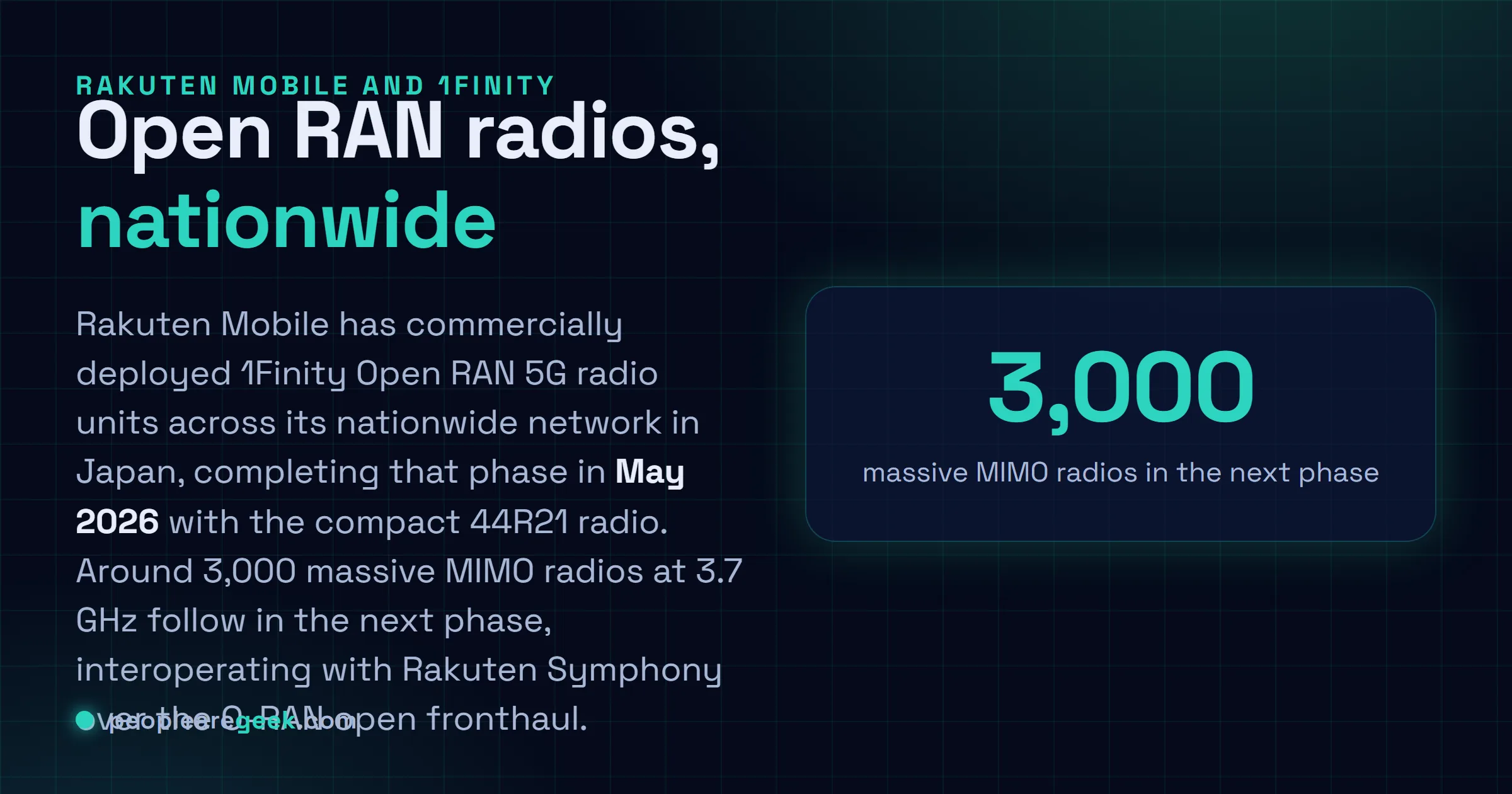
Rakuten Mobile has now deployed Open RAN 5G radio units from Fujitsu subsidiary 1Finity across its nationwide network in Japan, with that phase completed in May 2026 and reported in the trade press this week. The next phase is larger and more interesting, around three thousand massive MIMO radios at three point seven gigahertz, interoperating with Rakuten Symphony's centralised and distributed units over the O-RAN open fronthaul interface. For anyone who has spent a decade hearing that open interfaces cannot carry a real mobile network, this is the closest thing to a controlled experiment we have.
The short answer
Rakuten Mobile has commercially deployed 1Finity Open RAN 5G radio units across its nationwide network in Japan, completing that phase in May 2026 with the compact 44R21 radio. The next phase covers around three thousand 32T32R massive MIMO radios, the 1Finity 32A37 operating at three point seven gigahertz on Qualcomm's Dragonwing QRU100 platform, interoperating with Rakuten Symphony's centralised and distributed units over the O-RAN open fronthaul interface. Rakuten expects roughly seven percent more throughput in high traffic urban areas.
Open RAN has spent years as an argument rather than a network. The pitch was always coherent, and the counter argument was always the same, that standardising the interfaces just moves the difficulty into integration and the operator ends up paying for it anyway. What has been missing is a large network run that way long enough to settle the question. Rakuten Mobile has been that experiment, and it published another data point this week.
What was deployed
Rakuten Mobile has commercially deployed Open RAN 5G radio units from 1Finity, a Fujitsu subsidiary, across its nationwide network in Japan. The deployment used the 44R21 compact radio unit, an O-RAN compliant part, and was completed in May 2026. The plans behind it were announced by Rakuten Mobile and Fujitsu back in March 2025.
The 44R21's pitch is physical rather than electrical. It is compact and light, which reduces the installation space needed and lowers site lease costs. That sounds like a footnote until you remember that in a dense urban rollout the recurring cost of the site is often the number that decides whether a cell gets built. A smaller radio is a cheaper lease and a wider set of viable locations.
Why the interfaces matter
Worth pausing on the architecture, because the whole story sits on it.
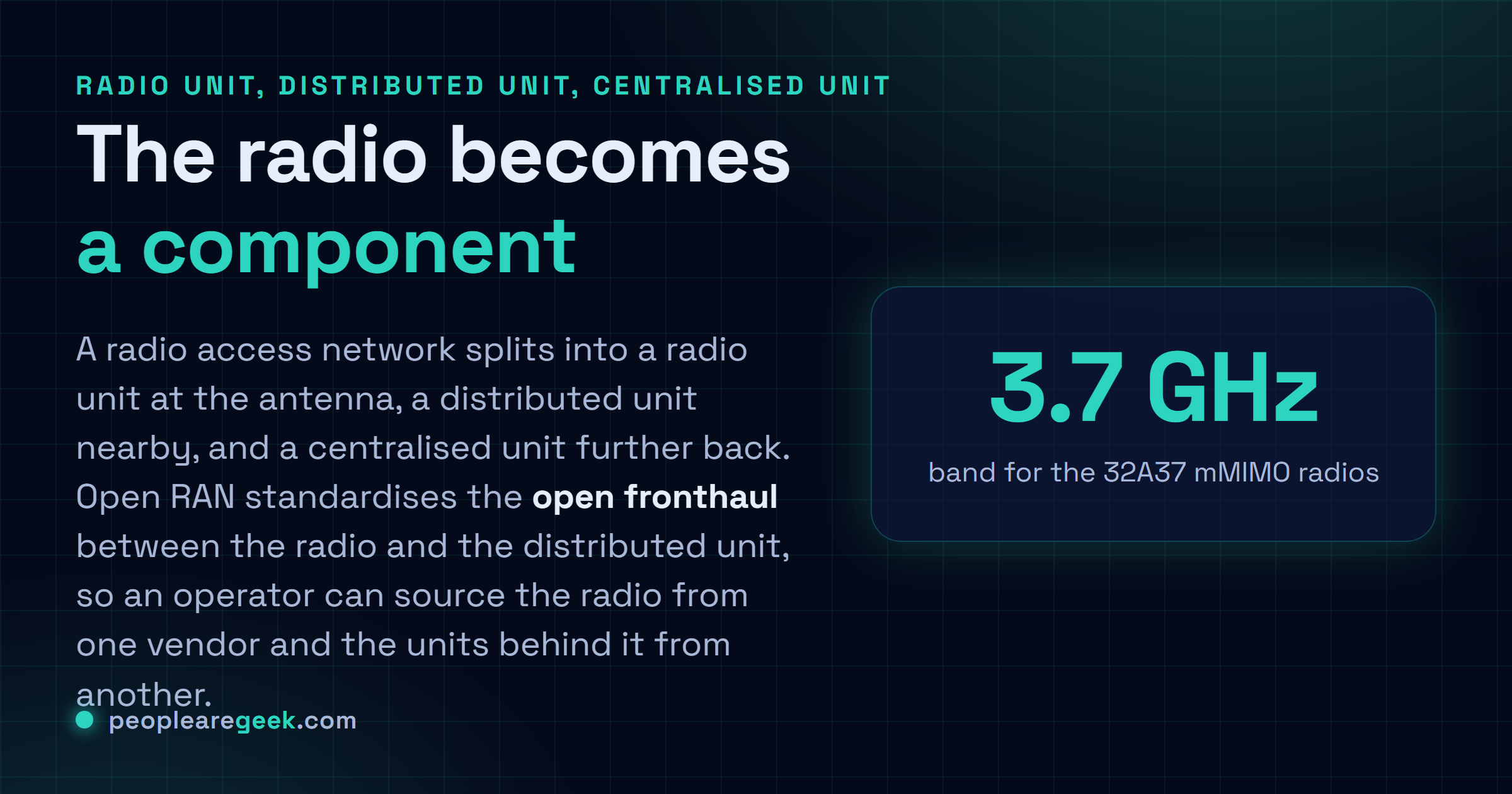
A radio access network breaks into three pieces. The radio unit sits at the antenna and handles the actual radio frequency work. The distributed unit sits nearby and handles the timing critical processing. The centralised unit sits further back and handles the rest. Traditionally, one vendor supplied all three, and the interfaces between them were proprietary. Choosing a vendor for a site meant choosing that vendor for every piece at that site, and for the upgrade path afterwards.
Open RAN standardises those interfaces. The important one here is the open fronthaul, the link between the radio unit and the distributed unit. Standardise it and the radio becomes a component you can source separately, which is what turns a vendor relationship into a purchase.
That is the theory. The practice is that a standard is only worth what its implementations agree on, and the long running criticism of Open RAN is that the integration cost of making several vendors' interpretations work together eats the savings.

The next phase, and the claim inside it
The larger deployment is the 1Finity 32A37 massive MIMO radio at three point seven gigahertz, around three thousand 32T32R units in the first phase of a bigger rollout, built on Qualcomm's Dragonwing QRU100 platform. They interoperate with Rakuten Symphony's centralised and distributed units over the O-RAN open fronthaul, which is precisely the multi vendor seam the standard exists to make routine. The radios are passively cooled, meaning no fans, which removes the component most likely to fail on a mast.
The 32T32R designation means thirty two transmit and thirty two receive chains. With that many antenna elements the radio can steer energy toward individual users rather than illuminating the whole cell, and serve several users on the same frequency simultaneously by separating them in space. In a dense urban cell that is where capacity comes from. Rakuten expects roughly seven percent more throughput in high traffic areas from wider coverage and higher gain antennas.
Seven percent is not a headline. The headline is what Sudhakar Pandey at Rakuten said about getting there, that the 1Finity massive MIMO integration did not face challenges because the majority of the configuration was already aligned with the O-RAN specifications.
Read that again with the criticism in mind. The charge against Open RAN was never that the radios would not work. It was that assembling them would cost more than it saved. An operator reporting that a new vendor's massive MIMO radios dropped into an existing multi vendor stack without a fight is a direct answer to that charge.
What to take from it
Hold the caveats. This is one operator, with an unusually deliberate architecture, reporting on its own integration, and Rakuten has an obvious interest in Open RAN succeeding since Rakuten Symphony sells the software. None of that makes the claim false, but it is not a neutral referee either.
Still, the direction is worth registering. The argument has moved from whether open interfaces can carry a nationwide 5G network to how much throughput the next radio adds. That is a different conversation, and a duller one, which is usually what it looks like when a technology stops being a bet and starts being infrastructure. For anyone specifying radio access networks, the useful update is that multi vendor fronthaul now has a nationwide production reference behind it rather than a slide deck.
Sources and further reading
- Telecompaper: Rakuten Mobile deploys 1Finity Open RAN radios across 5G network
- RCR Wireless: Rakuten Mobile to deploy 3,000 open mMIMO radios in Japan
- Business Wire: Rakuten Mobile to deploy 1Finity Open RAN massive MIMO radios at scale
- Mobile World Live: Rakuten Mobile rolls out 5G open RAN radios with 1Finity
- The Fast Mode: Rakuten Mobile partners with 1Finity to deploy massive MIMO Open RAN radios at scale
- Telecom Reseller: Rakuten Mobile expands Open RAN 5G network with 1Finity radios
Frequently asked questions
What did Rakuten Mobile actually deploy?
Rakuten Mobile has commercially deployed Open RAN compliant 5G radio units supplied by 1Finity, a Fujitsu subsidiary, across its nationwide mobile network in Japan. That deployment used the 44R21 compact radio unit and was completed in May 2026, following plans announced by Rakuten Mobile and Fujitsu in March 2025. The 44R21 is built for a small, light form factor, which reduces the physical installation space required and lowers site lease costs.
What is Open RAN in plain terms?
A radio access network splits into a radio unit at the antenna, a distributed unit nearby, and a centralised unit further back. Traditionally one vendor supplied all three and the interfaces between them were proprietary, so once you chose a vendor for a site you had effectively chosen it for everything at that site. Open RAN standardises those interfaces, in particular the open fronthaul link between the radio unit and the distributed unit, so an operator can buy the radio from one supplier and the units behind it from another.
What is coming in the next phase?
Rakuten Mobile plans to deploy the 1Finity 32A37 massive MIMO radio unit operating at three point seven gigahertz, around three thousand 32T32R massive MIMO radios in the first phase of a larger rollout, built on Qualcomm's Dragonwing QRU100 platform. These interoperate with Rakuten Symphony's centralised and distributed units over the O-RAN open fronthaul interface. The operator expects roughly a seven percent throughput improvement in high traffic urban areas, from wider coverage and higher gain antennas, and the radios use passive cooling.
What does 32T32R and massive MIMO mean?
MIMO stands for multiple input, multiple output, and it means using several antenna elements at once rather than one. 32T32R describes a radio with thirty two transmit and thirty two receive chains. With that many elements the radio can shape and steer beams toward individual users instead of broadcasting across the whole cell, and it can serve several users on the same frequency at the same time by separating them spatially. That is where the capacity gain in a dense urban cell comes from.
How hard was the integration?
According to Sudhakar Pandey at Rakuten, the 1Finity massive MIMO integration did not face challenges because the majority of the configuration was already aligned with the O-RAN specifications. That is the claim worth weighing, since the persistent criticism of Open RAN has been that multi vendor integration eats whatever savings the open interfaces deliver. A single operator reporting a smooth integration is evidence rather than proof, but it is the kind of evidence that has been in short supply.